
About My Health Engineer
Engineering the lifestyle that holds your health goals in place.
Most health plans hand you a target and assume you can switch everything else over the weekend. They give you a nutrition plan without knowing where your habits sit now or what your day-to-day pressures look like. The plan looks good on paper. It does not survive contact with a real life.
MHE works differently. The work is to engineer the lifestyle that gets you to your goals and keeps you there. That means designing the plan around your actual starting point, building the habits inside the plan so they outlast it, and treating health as one system instead of five separate problems. If life is stressful and sleep is short, adding a calorie deficit makes things worse. So stress and sleep get addressed as part of the nutrition plan, not as homework for later.
A Master's in Sport and Exercise Nutrition is what gives the depth to design plans that work biologically. A background in Biomedical Engineering and Systems Engineering is what gives the depth to build the tools that turn those plans into something you can run inside a real week. Those tools are now the My Health Engineer app.
01The MHE approach
Five pillars. One loop. A starting point that is yours, not someone else's.
The five pillars
01
Sleep
Recovery, hormone regulation, and the next day's appetite signals all run through sleep.
02
Stress
Nervous-system state sets the baseline for sleep, cravings, and motivation to act on plans.
03
Movement
Daily activity plus structured training drive metabolic capacity and joint resilience.
04
Hydration
Fluid balance and electrolytes affect energy, cognition, digestion, and recovery quality.
05
Nutrition
Macronutrient targets, fibre, and meal patterns work only when the other four pillars hold.
The Assessment Loop
Step 01 Assess runs once at the start. From there steps 02 through 07 form the cycle. After Reassess, the next pass loops back into Target with a clearer picture each time.
Assess
Take honest stock of where each pillar sits right now. Done once at the start.
Target
Pick the goal worth working toward this season.
Plan
Map the work between where you are and the target, broken into runnable steps.
Pick tools
Choose the behaviours, environment setups, and resources the plan calls for.
Take action
Run the plan inside your actual week.
Track
Watch what is moving. Note what is not.
Reassess
Update the picture. Pick the next target. Loop again.
The cycle
Steps 02 to 07. Each pass loops Reassess back into Target with a clearer picture.
Assess
Take honest stock of where each pillar sits right now. Done once at the start.
Target
Pick the goal worth working toward this season.
Plan
Map the work between where you are and the target, broken into runnable steps.
Pick tools
Choose the behaviours, environment setups, and resources the plan calls for.
Take action
Run the plan inside your actual week.
Track
Watch what is moving. Note what is not.
Reassess
Update the picture. Pick the next target. Loop again.
Nobody starts from the same place.
Once you have a clear read on where you are now and where you want to go, the gap between the two becomes legible. The work breaks into milestones, each with a short, runnable plan you can finish.
You finish each plan stronger, and the habits you built inside it stay with you. Momentum compounds. By the time you reach goals that looked out of reach at the start, they arrive on their own, because the habits underneath them are already running.
02The app
The method, running inside a real week.
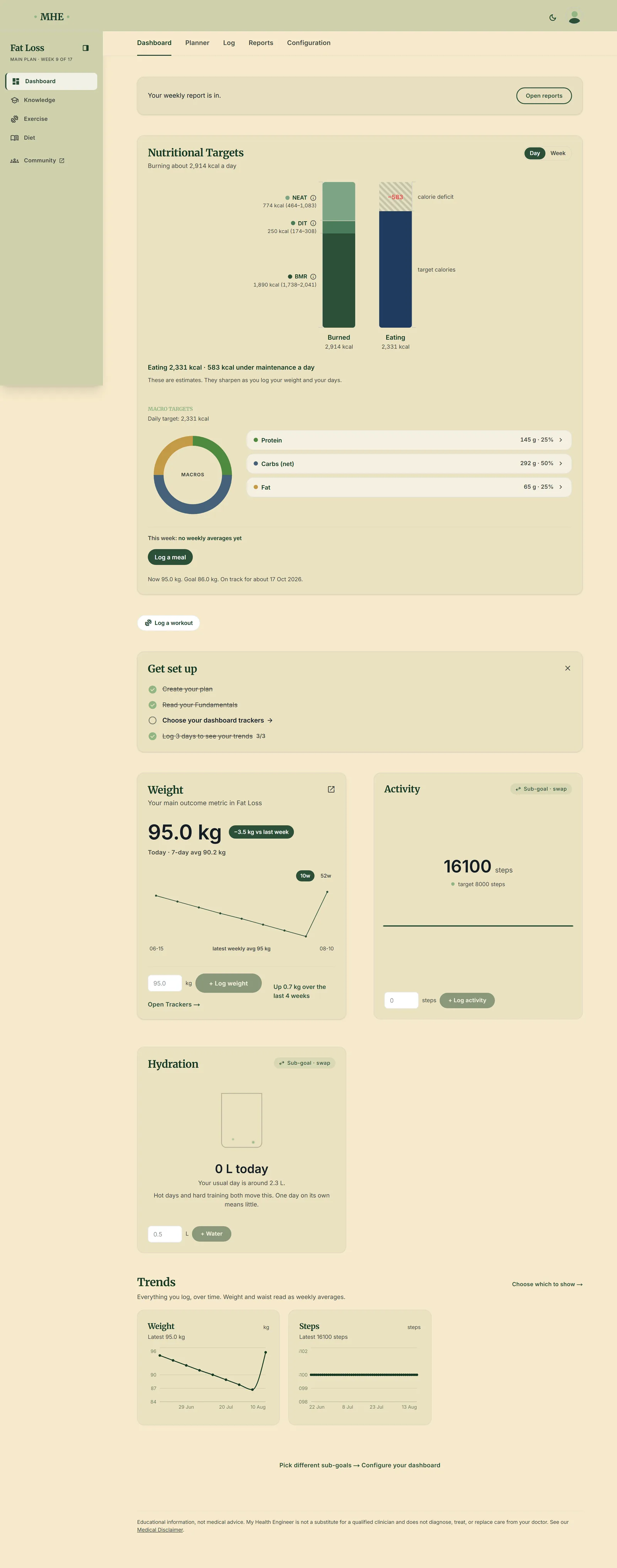
The approach above is what the app does on a schedule. You pick the program that matches why you came, log a normal week, and the app reads it and names the one thing worth changing next.
Nine programs sit inside one membership, so when the goal changes you move across rather than starting again somewhere else.
03Why this exists
How MHE got here.
MHE exists because I spent years watching smart people fail at health for the same structural reason. The advice they were following treated one pillar at a time, ignored the mechanism, and leaned on shame when results stalled. The pattern repeated across friends, family, and clients. The gap was a way of thinking, not a missing fact.
The output is two books in the From Resistance to Resilience series and the app that nine programs now run inside. UKAD and SENR membership keep the supplement and nutrition guidance honest as the work grows. The credentials shaped the work. The work, not the credentials, is the proof.
04Where to start
Where to start.
Start here
The app
Nine programs in one membership, the adaptive nutrition engine, the recipe library and food diary, and a weekly insights report that reads the week you actually logged.
See the appThe free calculator
Not ready to decide yet? Work out your daily calories and macros, with no account and no card.
Open the calculatorThe books
Where the method was worked out on paper. Neither one is needed to use the app.
05Questions
The questions that come up.
What makes this different from everything else I have tried?
Most programs hand you the target and assume you can change the rest of your life to fit it. MHE works the other way. The plan is designed around your actual starting point, and the habits you need to make the plan run are built inside the plan itself. By the time the plan finishes you are not back where you started looking for the next one.
Will this still help if I am managing multiple conditions?
Yes, with the caveat that the books and programs are educational resources, not medical treatment. They complement an existing care plan rather than replace it. The systems approach is most useful when several pillars need attention at once, which is often the case with chronic conditions.
Do I have to follow strict rules or count every calorie?
No. The default approach is to build eating patterns that make better choices automatic. Calorie counting is a tool you can pick up when you want to accelerate a specific result, and a tool you can put down when it is no longer useful. The books show you both.
How fast should I expect results?
It depends on the pillar you start with. Stress work and breathing routines often produce changes in days. Hydration changes for someone with sensitivities take weeks. Strength gains take months. The framework adapts to whatever pace your body and your life allow.
Is this just for women, or for a specific demographic?
The method is not for one demographic. It is for anyone whose health behaviours keep stalling under real life. The MSc research focus was on PCOS and insulin resistance, so there is depth on women's metabolic health where you need it. The systems thinking underneath applies to anyone, from someone restarting after years off to a high performer trying to squeeze more out of an already-stacked schedule.