Vitamin B5 (Pantothenic Acid): Evidence-Based Review
What is Vitamin B5
Vitamin B5, also called pantothenic acid, is a water-soluble vitamin your body needs every day. Your body uses it to build Coenzyme A (CoA), a helper molecule that turns the food you eat into usable energy and supports many repair and building processes.
You will often see B5 described as “found everywhere”. That is mostly true. It shows up in many animal and plant foods, and because your body does not store much of it, you need a steady intake from diet or supplements.
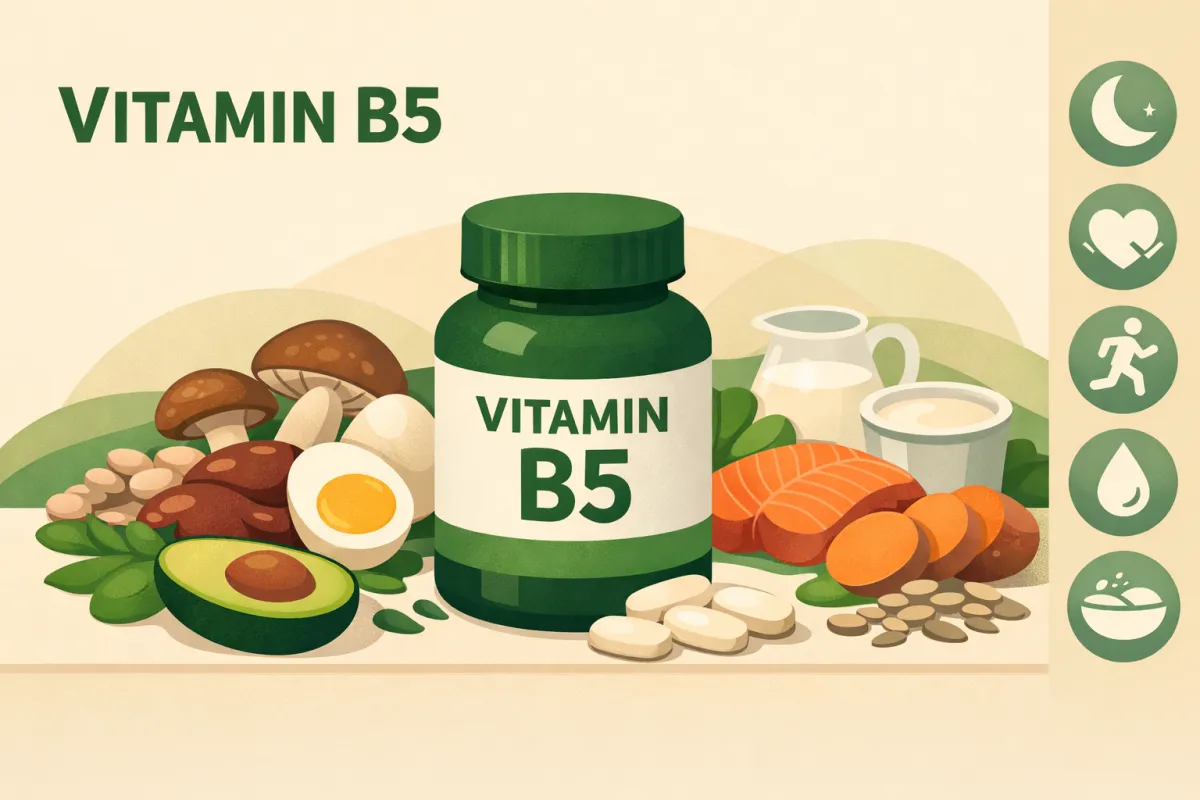
Natural sources: mushrooms (especially shiitake), eggs, chicken liver, avocado, sunflower seeds, trout or salmon, sweet potatoes, legumes, milk, and yogurt.
Common supplement forms: calcium pantothenate (most common), D-pantothenic acid, panthenol (a provitamin form often used for skin), and pantethine (a B5-derived form used more often for lipid support).
What it is not: Vitamin B5 is not a stimulant, not a “detox” product, and not a replacement for sleep, calories, protein, or a balanced diet.
Who is Vitamin B5 for
Who’s most likely to benefit
People who are most likely to notice a benefit from B5 are usually in one of these buckets:
• You have a lower-quality or restrictive diet and you rarely eat B5-rich foods.
• You are under chronic stress and your recovery capacity feels “thin” (low energy, poor stress tolerance, brain fog).
• You are training hard and you want to remove easy nutritional bottlenecks that can limit energy metabolism.
• You want modest lipid support and are specifically using pantethine (not plain pantothenic acid).
Who might not notice much
If you eat a varied diet and you already take a decent multivitamin or B-complex, you may not feel a clear “effect” from adding extra B5. That is not failure. It often just means you already have enough.
Who should be cautious
Vitamin B5 is generally very safe, but extra caution makes sense if:
• You are pregnant or breastfeeding and considering high doses (hundreds of mg to grams).
• You are considering very high doses (more than 500 mg per day) for a medical condition.
• You have significant digestive sensitivity, since very high doses can cause loose stools.
TLDR
• Vitamin B5 (pantothenic acid) is a daily, water-soluble vitamin used to make Coenzyme A, a core tool for energy metabolism.
• Deficiency is uncommon in developed countries because B5 is present in many foods.
• If your intake is low, supplementation can help restore normal energy, mood stability, and resilience.
• For general support, most people use modest doses, often inside a B-complex.
• If your goal is cholesterol and triglyceride support, pantethine is the better-studied B5-related form.
• B5 is not a quick fix for fatigue, sleep, or stress. It is a “foundations” nutrient.
• Side effects are uncommon, but very high doses can cause mild stomach upset or diarrhea.
• You do not need to load or cycle B5. Consistency matters more than timing.
What people take Vitamin B5 for
Energy and fatigue support
Stress resilience and “running on empty” recovery
Cholesterol and triglyceride support (pantethine)
Skin support (topical and oral)
Exercise endurance and recovery support
Sleep quality support (indirect)
Lupus and rheumatologic symptoms (high-dose, investigational)
Osteoarthritis pain
1. Energy and fatigue support
Efficacy: Positive
Who primarily benefit: People with lower B5 intake, higher life stress, or higher training demand.
What the evidence suggests: B5 is required to produce Coenzyme A, which your cells use to convert carbohydrates, fats, and protein into usable energy. If B5 intake is low, fatigue, low appetite, and reduced resilience can show up. Supplementing helps most when it corrects a shortfall, not when it piles on top of an already adequate diet.
Typical protocol used: 10 to 50 mg per day (often in a B-complex) for 4 to 8 weeks.
Practical expectation: If B5 was a limiting factor, people usually notice steadier daytime energy and less “drag” under stress. If intake was already adequate, the change may be subtle or absent.
2. Stress resilience and “running on empty” recovery
Efficacy: Positive
Who primarily benefit: People under chronic stress who feel worn down and struggle to recover.
What the evidence suggests: B5 supports the production of CoA, which is involved in the synthesis of stress-response hormones such as cortisol. This does not mean B5 “fixes stress”, but it does help ensure your physiology has the raw materials it needs to respond normally.
Typical protocol used: 50 to 100 mg per day in a balanced B-complex for 4 to 8 weeks.
Practical expectation: The most realistic win is not “no stress”. It is better tolerance, fewer energy crashes, and a slightly wider buffer between stress and symptoms.
3. Cholesterol and triglyceride support (pantethine)
Efficacy: Positive
Who primarily benefit: People with mildly elevated LDL cholesterol or triglycerides who are not looking to start medication immediately, or who want supportive nutrition alongside lifestyle change.
What the evidence suggests: The strongest lipid data is for pantethine, a B5-derived compound. Across several trials, pantethine has shown modest improvements in LDL cholesterol and triglycerides over 12 to 16 weeks. Plain pantothenic acid has weaker and less consistent evidence for lipids.
Typical protocol used: Pantethine 600 to 900 mg per day for 12 to 16 weeks, then reassess with bloodwork.
Practical expectation: Think “meaningful but not magical”. Improvements are often modest and work best when paired with diet quality, fiber intake, and consistent movement.
4. Skin support (topical and oral)
Efficacy: Mixed
Who primarily benefit: People using topical panthenol for skin barrier support, irritation, and healing.
What the evidence suggests: Panthenol is widely used topically because it converts to pantothenic acid in skin and supports barrier function. Oral high-dose B5 has been discussed for acne in online communities, but human evidence is limited and inconsistent.
Typical protocol used: Topical panthenol as directed. For oral experimentation, most people stay conservative: 10 to 50 mg per day as part of a B-complex for 8 weeks.
Practical expectation: Topical panthenol can support comfort and barrier feel. For acne, do not assume B5 is the main lever unless you have addressed basics (sleep, stress, protein, fiber, and skin care routine).
5. Exercise endurance and recovery support
Efficacy: Early (promising but limited)
Who primarily benefit: Endurance athletes or people training frequently who want to cover micronutrient bases.
What the evidence suggests: There is limited human research suggesting high-dose pantothenic acid may influence endurance markers in trained athletes, but results have not been consistently replicated. Indirectly, B5 supports energy metabolism and recovery by supporting CoA and stress-hormone biology.
Typical protocol used: 50 to 100 mg per day in a B-complex for 4+ weeks. High-dose protocols (grams per day) exist in older studies but are not necessary for most people and are best avoided without professional supervision.
Practical expectation: Do not expect a dramatic performance boost. If you notice anything, it is more often steadier training energy and slightly improved recovery capacity.
6. Sleep quality support (indirect)
Efficacy: Early
Who primarily benefit: People whose sleep is being disrupted by chronic stress, low nutrient intake, or inconsistent routine.
What the evidence suggests: B5 is involved in pathways related to acetylcholine, a neurotransmitter important for normal REM sleep architecture. However, direct trials of B5 alone for sleep outcomes are limited. This is best viewed as foundational support, not a sleep aid.
Typical protocol used: 10 to 50 mg per day (often within a B-complex) for 4 to 8 weeks, taken earlier in the day.
Practical expectation: If B5 was part of a broader bottleneck, sleep may feel slightly more stable. If your sleep issues are primary insomnia or sleep apnea, B5 is unlikely to move the needle.
7. Lupus and rheumatologic symptoms (high-dose, investigational)
Efficacy: Moderate for cutaneous symptoms (older, uncontrolled evidence), Early for systemic outcomes
Who primarily benefit: People with lupus who are working with a clinician and exploring adjunctive nutritional strategies.
What the evidence suggests: Older case series and smaller studies suggest high-dose pantothenic acid may help some people with cutaneous lupus symptoms. Evidence quality is limited, and modern high-quality trials are lacking.
Typical protocol used: Wide range in older literature (hundreds of mg to grams per day). This is not a self-experiment category.
Practical expectation: If used, it should be part of a supervised plan with clear monitoring and realistic expectations.
8. Osteoarthritis pain
Efficacy: Mixed
Who primarily benefit: People exploring low-risk nutritional support alongside standard care.
What the evidence suggests: Small trials have produced inconsistent results, and protocols differ between studies (some combine B5 with other compounds). At this stage, the evidence is not strong enough to consider B5 a reliable intervention for joint pain.
Typical protocol used: If trialed, keep it simple: 10 to 50 mg per day in a B-complex for 8 weeks, while tracking pain and function.
Practical expectation: Some people may notice nothing. If you do notice benefit, it is usually modest and gradual.
When it’s not worth taking Vitamin B5
Vitamin B5 is usually low ROI when:
• Your diet is varied and you already take a multivitamin or B-complex.
• You want a fast, noticeable effect for stress, sleep, or performance.
• You are trying to treat a medical condition without addressing the basics (sleep schedule, protein and fiber intake, movement, and stress load).
• You are planning to use very high doses without medical supervision, especially for autoimmune conditions.
Nuances and individual differences
Baseline status changes everything
Most of the practical benefit from B5 comes from correcting an intake gap. If you are already getting enough from food and a decent multivitamin, more B5 does not necessarily translate into more energy, better sleep, or lower stress. In nutrition, “enough” often looks like stability, not stimulation.
Special populations
Pregnancy and breastfeeding: Typical dietary intakes are considered appropriate (Adequate Intake is higher in pregnancy and breastfeeding). High-dose supplementation has not been well studied, so stick to conservative doses unless advised by a qualified clinician.
Children and adolescents: Use age-appropriate doses, ideally via food first or a standard children’s multivitamin.
Older adults: B5 needs do not clearly rise with age, but dietary intake can fall. If appetite is reduced, a low-dose B-complex can be a practical safety net.
Autoimmune conditions: High-dose protocols for lupus exist in older literature but should be treated as investigational and supervised.
Co-nutrients and stacking
B5 rarely acts alone. If you are taking it for energy or stress resilience, a balanced B-complex often makes more sense than isolating B5, because B vitamins work together in energy metabolism.
If your goal is stress resilience, pairing good nutrition with adequate protein, magnesium, and vitamin C is often more impactful than pushing B5 dose higher.
Testing and monitoring
If you are using pantethine for lipid support, bloodwork is the sensible feedback loop. Check a lipid panel before starting, then recheck after 12 to 16 weeks. If there is no meaningful movement, it is a signal to shift strategy rather than escalating dose indefinitely.
How to take Vitamin B5
Simple starter approach
For most healthy adults, the simplest approach is to aim for adequate intake from food first, then add a modest supplement dose if you want a safety net. A common starter is 10 to 25 mg of B5 per day as part of a B-complex, taken daily for 4 to 8 weeks. Track energy, stress tolerance, and sleep stability rather than looking for an immediate “kick”.
Typical dose range
For general foundational support, 5 to 50 mg per day covers the needs of most people.
If you are under chronic stress or training hard, 50 to 100 mg per day (usually within a B-complex) is a common, conservative range.
For lipid support, the protocol is different because it typically uses pantethine, not plain pantothenic acid. Typical trials use 600 to 900 mg per day of pantethine for 12 to 16 weeks.
Very high doses (1 to 10 g per day) have been used in older clinical research for specific medical conditions, but that is not a general wellness protocol and should not be self-prescribed.
Timing
B5 is not a timing-sensitive supplement. You can take it with or without food. If you are taking it for energy and stress resilience, morning or early afternoon is a practical default.
Loading vs maintenance, cycling, and breaks
B5 does not require loading. Your body does not store large amounts, so the primary goal is consistent daily intake. Cycling is not required. If you stop supplementing, levels can drop back toward baseline relatively quickly.
Duration to see effects
• Energy and fatigue: 1 to 2 weeks for some people, but 4 to 8 weeks is a fair trial window.
• Stress resilience: 4 to 8 weeks is a realistic timeframe.
• Lipids (pantethine): plan for 12 to 16 weeks before judging results.
• Skin barrier support (topical panthenol): days to weeks, depending on the issue.
• Investigational autoimmune protocols: timelines vary, but should be clinician-guided.
Forms and whether form matters
For most people, calcium pantothenate (or D-pantothenic acid) is the practical, standard choice.
Pantethine is the form with better support for lipid outcomes, but it is usually more expensive.
Panthenol is commonly used topically and converts to pantothenic acid. It can be useful for skin barrier support, but it is not clearly superior for systemic goals.
Avoid products that list “DL-pantothenic acid”, since the L-form is inactive.
Food vs supplement
Many people can meet their needs through food alone because B5 is widely distributed across common foods. Supplementation is most useful as a targeted tool when diet quality is low, stress load is high, training volume is high, or a specific pantethine protocol is being used for lipids.
Safety and side effects
Common side effects
Most people tolerate B5 well.
At very high doses (often several grams per day), some people report:
• Loose stools or diarrhea
• Mild stomach upset
• Rare headache
• Occasional sleep disruption in sensitive individuals
If side effects occur, reduce the dose or stop and reassess.
Serious risks (rare, but important)
Serious toxicity from pantothenic acid has not been reported in humans in typical supplemental ranges. The primary “risk” in practice is using very high doses without supervision, or using supplements with poor quality control.
Red-flag symptoms (stop and seek care) are not specific to B5, but include severe allergic reactions (rash, swelling, difficulty breathing) to any supplement ingredient.
Contraindications and caution groups
• Pregnancy and breastfeeding: conservative dosing is preferred unless supervised.
• Autoimmune disease: treat high-dose protocols as investigational.
• Significant gastrointestinal sensitivity: avoid high doses that can worsen loose stools.
Interactions
No major medication interactions are known for typical B5 doses. Practical considerations:
• B5 works best as part of an overall adequate B-vitamin status, so pairing with a B-complex is often more logical than taking B5 alone.
• Long courses of antibiotics can reduce gut bacteria that produce small amounts of B vitamins. A standard multivitamin or B-complex can be a reasonable support during and after extended antibiotic use.
For athletes: anti-doping and contamination risk
Pantothenic acid is not a banned substance. The main risk for athletes is not the vitamin itself, but contamination or adulteration of supplement products. If you are in a drug-tested sport, prioritise reputable brands and batch-tested certifications.
Quality checklist (buying guide)
What to look for on labels
Look for:
• A clear ingredient name and form (for example calcium pantothenate, D-pantothenic acid, pantethine, or panthenol).
• A clear dose per serving listed in mg.
• Simple, transparent formulas with minimal unnecessary additives if you are sensitive.
• If you want lipid support, ensure the product is specifically pantethine, not just “B5”.
Third-party testing and certifications
Third-party testing means an independent organisation has tested the product and or audited manufacturing to verify label claims and screen for contaminants. No certification can guarantee a supplement is completely free of all risks, but reputable testing can meaningfully reduce common quality problems.
If you compete in drug-tested sport, supplement use always carries some risk because products can be contaminated or adulterated with prohibited substances. If you choose to use supplements anyway, prioritise products that are batch-tested under recognised anti-doping focused programmes such as NSF Certified for Sport, Informed Sport, Informed Choice, or BSCG Certified Drug Free.
For general quality assurance (identity, purity, potency, and contaminant screening), look for verification or certification programmes such as USP Verified, NSF/ANSI 173 certification, or a ConsumerLab quality seal. Some categories also have specialised quality programmes, for example IFOS for fish oil. If a company claims testing, ask for a recent Certificate of Analysis (COA) for the exact batch you are buying.
Red flags
• ❌ No batch number and no expiry.
• ❌ No COA available on request.
• ❌ “Proprietary blend” with no exact amounts.
• ❌ Unrealistic health claims.
• ❌ Very cheap pricing vs market norms.
Storage and stability
B5 is generally stable. Store supplements in a cool, dry place, away from heat and direct sunlight. Do not use products past their expiry date.
The Five Pillar impact analysis of Vitamin B5
Five Pillar overview
Vitamin B5 is a “foundations” nutrient. Its strongest role is supporting energy metabolism through Coenzyme A, which touches almost every cell process. That is why its impact often shows up across multiple pillars, but usually in a subtle way unless intake is low.
Practically, B5 is most relevant for Nutrition (covering micronutrient adequacy) and Stress Management (supporting stress-response hormone production and recovery capacity). Its impact on Exercise is plausible and sometimes noticeable in high-demand training blocks, especially when used inside a B-complex. Its impact on Sleep is more indirect, and it does not meaningfully affect Hydration.
Five Pillar impact table

Five Pillar detailed review
Sleep
Pillar verdict (practical): B5 may support sleep indirectly by supporting stress physiology and neurotransmitter pathways, but it is not a direct sleep supplement. If sleep is poor because life stress is high and nutrition is inconsistent, B5 as part of a B-complex can help remove friction.
What it may improve
• More stable sleep when stress is the main disruptor
• More consistent REM architecture in the context of adequate nutrition
• Less “wired but tired” feeling in some people, indirectly through better recovery capacity
Practical protocol
• Use a B-complex containing 10 to 50 mg of B5 per day
• Take it in the morning or early afternoon
• Run the trial for 4 to 8 weeks while tracking sleep quality and next-day energy
When it’s not worth it
• You want immediate sedation or faster sleep onset
• Sleep apnea or significant insomnia is untreated
• Your diet already covers B vitamins and you are sleeping well
Stress Management
Pillar verdict (practical): This is one of the more relevant pillars for B5. The benefit is mostly about resilience and recovery, not eliminating stress.
What it may improve
• Better tolerance to busy periods
• Fewer energy crashes during the day
• Slightly improved mood stability when nutrition has been inconsistent
Practical protocol
• 50 to 100 mg per day as part of a B-complex
• Take daily for 4 to 8 weeks
• Pair with the basics: consistent sleep schedule, protein at meals, and daily movement
When it’s not worth it
• Stress is primarily driven by lifestyle overload with no recovery time
• You are looking for an “anti-anxiety” supplement effect
• You are already consistent with nutrition and stress is well managed
Exercise
Pillar verdict (practical): B5 is not an ergogenic shortcut, but it can be part of good “training nutrition hygiene”, especially in endurance-heavy blocks.
What it may improve
• Training energy consistency (especially when calories are adequate)
• Recovery capacity in high-volume weeks (often as part of a B-complex)
• Reduced likelihood that micronutrient gaps limit adaptation
Practical protocol
• 50 to 100 mg per day in a B-complex
• Take daily, any time of day
• Evaluate after 4+ weeks using training logs (energy, pace, recovery, soreness)
When it’s not worth it
• Training is inconsistent and basics are missing (sleep, total calories, protein)
• You are expecting a pre-workout-like effect
• You plan to use gram-level doses without supervision
Hydration
Pillar verdict (practical): B5 does not meaningfully change hydration status.
Nutrition
Pillar verdict (practical): Nutrition is where B5 fits best. It is either a simple adequacy tool (food or low-dose supplement), or a more targeted pantethine protocol for lipids.
What it may improve
• Micronutrient adequacy when diet is inconsistent
• Energy metabolism support when overall B-vitamin intake is low
• Modest lipid improvements when using pantethine
Practical protocol
• Food-first: include one or two B5-rich foods daily (eggs, mushrooms, avocado, legumes)
• If supplementing: 10 to 50 mg per day (B-complex) for 8 weeks
• For lipids: pantethine 600 to 900 mg per day, then recheck lipids after 12 to 16 weeks
When it’s not worth it
• You are trying to replace diet quality with supplements
• You have high cardiovascular risk and are avoiding medical care
• Lipid results are not improving after a full 12 to 16 week trial with lifestyle support
FAQ
Is pantethine the same as Vitamin B5?
Pantethine is a compound derived from Vitamin B5. Your body can use it as a precursor in CoA-related pathways, and it is the form most commonly studied for cholesterol and triglyceride outcomes.
Can I take Vitamin B5 with a B-complex?
Yes. In most cases, taking B5 within a balanced B-complex is the most practical way to support energy metabolism, because B vitamins work together.
Does Vitamin B5 help acne?
Evidence is mixed. Topical panthenol can support the skin barrier, but oral high-dose B5 for acne is not well proven. If acne is your goal, address sleep, stress, protein, fiber, and a consistent skincare routine first.
Should I take Vitamin B5 at night?
It can be taken any time, but morning or early afternoon is the safest default if you are sensitive to any change in sleep.
How much is too much?
For most people, doses up to 100 mg per day are conservative. Very high doses (grams per day) have been used in older studies, but they can cause diarrhea and should not be self-prescribed.
Can I use Vitamin B5 during pregnancy?
Dietary intake and standard prenatal doses are considered appropriate. High-dose supplementation has limited data, so keep it conservative and discuss higher doses with a qualified clinician.
This article is for educational purposes only. It is not medical advice and it is not prescriptive.
Supplements can vary widely in quality and contamination risk, including products that are not tested for banned substances and products that contain concentrated plant, herb, or mushroom extracts.
If you are a competitive athlete, in a drug-tested sport, have a complex medical history, are pregnant or breastfeeding, take medications, or have a diagnosed health condition, prioritise direct guidance from a qualified professional who can advise you within the context of your specific needs.
Even if you are otherwise healthy, consult a qualified practitioner before making major health or lifestyle changes, including starting new supplements, changing dose significantly, or combining multiple supplements.
