
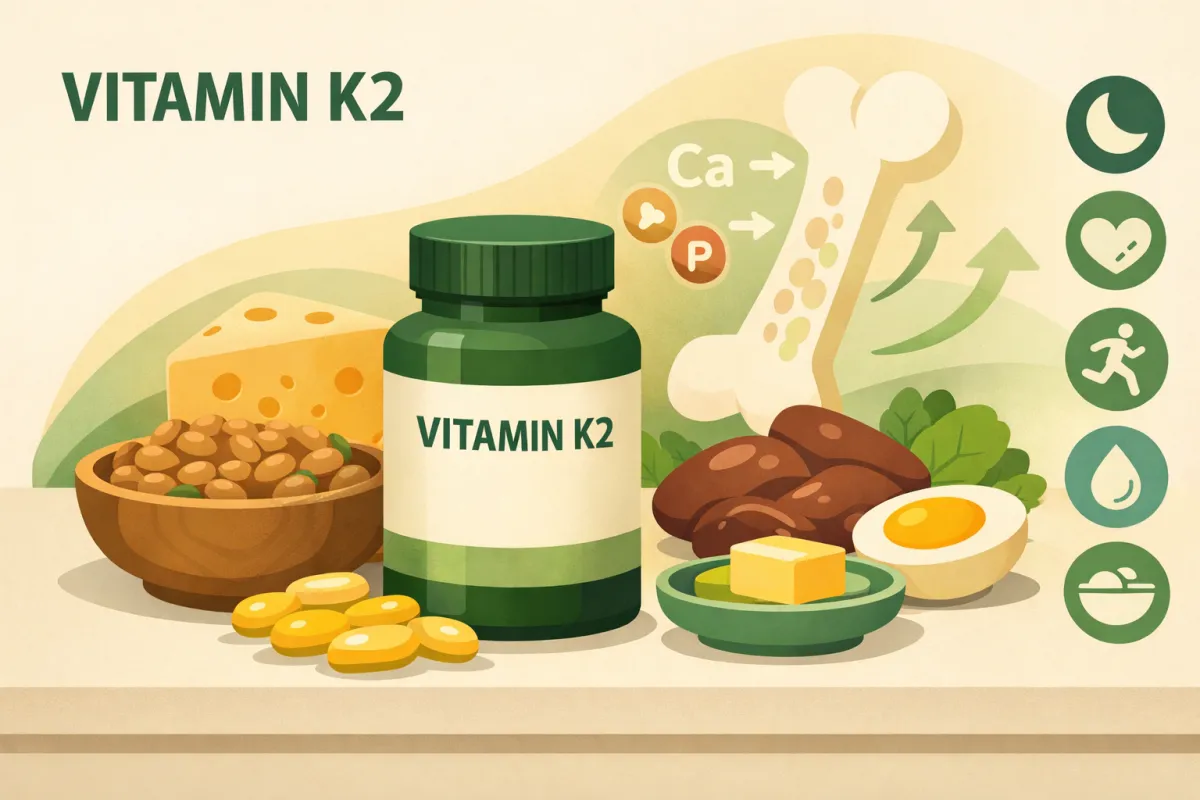
Vitamin K2
What is Vitamin K2
Vitamin K2 (menaquinone) is a fat-soluble vitamin that helps your body switch on proteins that manage where calcium goes. When Vitamin K2 status is adequate, those proteins help guide calcium into bones and teeth, and help reduce inappropriate calcium build-up in soft tissues like arteries.
Vitamin K2 is related to Vitamin K1 (phylloquinone), but they are not the same in practice. Vitamin K1 is abundant in leafy greens and is used heavily for blood clotting. Vitamin K2 is harder to obtain from a typical Western diet and appears to be more relevant for extra-liver tissues, especially bone and blood vessels.
Natural sources
Vitamin K2 is found mainly in fermented foods and some animal foods.
Fermented foods (higher in MK-7): natto is the standout source, with smaller amounts in aged cheeses and some fermented vegetables.
Animal foods (higher in MK-4): egg yolks, liver, and butter, especially from pasture or grass-fed sources.
Supplement forms
You will mainly see two forms:
MK-7: a longer-chain form that stays in circulation longer and is the most common form used in modern supplement trials.
MK-4: a shorter-chain form that clears from blood quickly. When MK-4 has shown benefits in studies, it is usually at much higher doses (milligram range).
What it is not
Vitamin K2 is not a calcium supplement.
Vitamin K2 is not a replacement for Vitamin D, magnesium, resistance training, protein intake, or overall dietary quality.
Vitamin K2 is not a blood thinner. In fact, it is involved in activating clotting factors, which is why it interacts with warfarin.
Who is Vitamin K2 for
Who is most likely to benefit
If you are low in dietary Vitamin K2 (common if you rarely eat natto, aged cheeses, or organ meats), supplementation is more likely to matter. The groups most commonly targeted in research are:
Older adults and postmenopausal women who want to support bone turnover markers and bone density over time.
People with prediabetes, type 2 diabetes, or metabolic syndrome, where some trials show improvements in glucose markers.
People who take Vitamin D long term and want a more complete calcium-management strategy.
Who might not notice much
People already eating high-K2 foods regularly (especially natto).
People expecting an obvious short-term "feeling" effect. Many of K2's effects are biomarker-based and slow.
Who should be cautious
Anyone taking warfarin or other vitamin K antagonists.
People with advanced kidney disease or severe liver disease.
People on glucose-lowering medications, because improved insulin sensitivity can change medication needs.
TLDR
Vitamin K2 helps activate proteins that guide calcium into bones and away from soft tissue build-up.
MK-7 is the most practical form for most people because it stays in the body longer and is widely studied.
For general health, a common research-based range is 45 to 200 micrograms (mcg) per day of MK-7.
For bone and metabolic support, many trials use 90 to 180 mcg per day of MK-7 for at least 3 to 6 months.
MK-4 can be effective in some contexts, but usually at 15 to 45 milligrams (mg) per day, split across doses.
Strongest evidence is for improved Vitamin K status markers (like osteocalcin carboxylation). Clinical outcomes like fracture reduction or heart event reduction are less established.
Cardiovascular calcification outcomes are mixed: biomarkers often improve, but coronary calcium progression has not consistently improved in large trials.
Vitamin K2 commonly pairs well with Vitamin D3, and often makes sense with magnesium.
Take K2 with a meal that contains fat for better absorption.
If you use a K2 product combined with minerals (calcium or magnesium), quality and stability become more important.
What people take Vitamin K2 for
1. Bone health and osteoporosis prevention
2. Cardiovascular health and vascular calcification
3. Glucose control and insulin sensitivity
4. Mood and anxiety support
5. Exercise recovery and muscle function
6. Dental health support
1. Bone health and osteoporosis prevention
Efficacy: Positive
Who primarily benefit: Older adults, postmenopausal women, and anyone with low bone density or low K2 intake.
What the evidence suggests: Vitamin K2 reliably improves bone-related biomarkers, especially activation of osteocalcin. Some trials also show modest improvements in bone mineral density over 1 to 3 years. However, proof that K2 alone prevents fractures is still limited.
Typical protocol used: MK-7 at 90 to 180 mcg daily for 6 to 12 months (or longer). In some countries, pharmaceutical-grade MK-4 has been used at 45 mg per day (often split into 3 doses).
Practical expectation: Do not expect to "feel" a difference. The most realistic win is improved bone turnover markers in the first 2 to 3 months, and potentially small changes in bone density over 6 to 12 months.
2. Cardiovascular health and vascular calcification
Efficacy: Neutral to Positive (Mixed)
Who primarily benefit: People with higher cardiovascular risk, particularly those with low Vitamin K status or existing calcification who are already addressing fundamentals (blood pressure, lipids, smoking, activity).
What the evidence suggests: Vitamin K2 can improve Vitamin K status biomarkers linked to vascular calcification risk (for example inactive MGP markers). That said, clinical outcomes are not yet clear. Some large trials have not shown a meaningful slowing of coronary artery calcium progression over the study window.
Typical protocol used: MK-7 at 90 to 180 mcg daily for 6 to 12 months. Some studies use higher doses (for example several hundred mcg daily) in higher-risk populations.
Practical expectation: You are unlikely to notice anything subjectively. If it helps, it is more likely to show up as a biomarker improvement or slower progression over a long timeframe, and it will not override major risk factors.
3. Glucose control and insulin sensitivity
Efficacy: Positive
Who primarily benefit: People with prediabetes, type 2 diabetes, or metabolic syndrome, especially if dietary K2 intake is low.
What the evidence suggests: Multiple trials report modest improvements in fasting glucose, fasting insulin, and HbA1c after sustained MK-7 supplementation. The effect size varies and is not a substitute for nutrition, exercise, and weight management, but it can be a meaningful supporting lever.
Typical protocol used: MK-7 at 90 to 180 mcg daily for at least 3 to 6 months (HbA1c takes time to shift). Some trials use MK-4 in the milligram range for shorter periods.
Practical expectation: If you monitor glucose, you might see slightly better fasting numbers over 8 to 12 weeks. If you take glucose-lowering medication, improved control can increase the risk of hypoglycemia unless dosing is reviewed.
4. Mood and anxiety support
Efficacy: Positive (Early evidence)
Who primarily benefit: People with metabolic dysfunction who also experience low mood or anxiety, where inflammation and glucose dysregulation may be part of the picture.
What the evidence suggests: Early human data suggests small improvements in anxiety scores in specific groups, and animal studies suggest antioxidant and anti-inflammatory mechanisms. This is not yet strong enough to treat K2 as a primary mental health tool.
Typical protocol used: MK-7 at 90 to 180 mcg daily for 12 weeks or longer.
Practical expectation: Some people report calmer mood over 6 to 12 weeks, often when K2 is part of a broader plan (sleep, movement, micronutrients). If anxiety or depression is significant, prioritise professional care.
5. Exercise recovery and muscle function
Efficacy: Positive (Very early evidence)
Who primarily benefit: Resistance-trained people and athletes who already have the basics covered (sleep, protein, smart programming) and are exploring marginal gains.
What the evidence suggests: Mechanistic data suggests Vitamin K2 may influence muscle energy metabolism through osteocalcin and mitochondrial pathways. Human data for performance or recovery is limited, and some studies are still in protocol or early stages.
Typical protocol used: MK-7 at 90 to 180 mcg daily for 12 weeks or longer, taken consistently.
Practical expectation: If there is a benefit, it is likely subtle: slightly reduced soreness or improved recovery markers over time, not a dramatic performance change.
6. Dental health support
Efficacy: Neutral (Theoretical)
Who primarily benefit: People focused on long-term mineral balance and tooth support, especially if they also use Vitamin D and maintain good oral hygiene.
What the evidence suggests: Vitamin K2 activates proteins involved in mineral handling, which may matter for teeth. Human clinical trials specifically for dental outcomes are not well established.
Typical protocol used: MK-7 at 45 to 180 mcg daily as part of a broader micronutrient strategy.
Practical expectation: Do not expect clear, short-term changes. If you want dental improvements, the highest ROI still comes from dental hygiene, fluoride where appropriate, and diet quality.
When it is not worth taking Vitamin K2
Vitamin K2 is usually low ROI when:
You already eat natto or high-K2 fermented foods frequently.
You are expecting a fast, noticeable effect on energy, sleep, or mood.
You are not addressing the fundamentals for the outcome you care about (for example, no resistance training but aiming for stronger bones).
Vitamin K2 is also not worth the risk without medical oversight when:
You take warfarin or another vitamin K antagonist and cannot commit to consistent intake and monitoring.
You have advanced kidney disease or severe liver disease and have not discussed supplementation with your clinician.
Nuances and individual differences
Baseline status changes everything
Vitamin K2 is a nutrient where baseline intake matters. If you routinely eat K2-rich foods, adding a supplement may do very little. If you eat almost none, a modest MK-7 supplement can meaningfully change Vitamin K status biomarkers within weeks.
A practical way to think about it is: K2 helps activate proteins. If those proteins are already well activated, extra K2 is not likely to move the needle.
Special populations
Pregnancy and breastfeeding: Vitamin K2 is generally considered safe at typical supplemental doses, but direct trial data in pregnancy is limited. Many prenatal formulas already contain Vitamin K. If you are pregnant or breastfeeding, avoid high-dose MK-4 protocols unless advised by a clinician.
Children and adolescents: Dietary sources are preferred. Supplementation should be clinician-guided.
Older adults: K2 is often more relevant due to higher fracture risk and lower dietary intake. It still works best alongside resistance training, protein, and adequate Vitamin D.
Kidney disease (especially stages 4 to 5): K2 may accumulate because it is fat soluble and because mineral metabolism is altered. Discuss with a nephrologist.
Liver disease: The liver is involved in Vitamin K metabolism. Use clinician guidance.
People on anticoagulants: Warfarin interacts directly with Vitamin K. Consistency is the main issue, not "never". Any change in intake should be coordinated with INR monitoring.
People on diabetes medications: If glucose control improves, medication needs can change. Monitor closely.
Co-nutrients and stacking
Vitamin K2 rarely makes sense in isolation. The most practical stacks are:
Vitamin D3 + Vitamin K2: Vitamin D helps absorb calcium and regulates related proteins; K2 helps activate the proteins that direct calcium. This pairing is logical for bone and mineral balance.
Magnesium: Supports Vitamin D metabolism and is broadly useful for glucose control and muscle function.
Calcium (food first): If calcium intake is high from supplements, ensuring adequate K2 status may be more important. If calcium intake is low, prioritise food sources first.
Testing and monitoring
Testing is not required for most people, but it can be useful when decisions are high-stakes.
Warfarin users: INR monitoring is essential if K2 intake changes.
Metabolic health goals: Tracking fasting glucose and HbA1c over 3 to 6 months gives objective feedback.
Bone health: DXA scans are slow-moving. Use 6 to 12 month windows and combine with training and protein.
How to take Vitamin K2
Simple starter approach
For most healthy adults, a simple and realistic default is MK-7 at 90 to 120 mcg once daily, taken with a meal that contains fat. Run this for 8 to 12 weeks as a trial. If your goal is bone or metabolic support, consider continuing for 6 months or longer, because the main outcomes take time.
Typical dose range
For MK-7, most practical protocols fall in the 45 to 200 mcg per day range.
For general maintenance: 45 to 100 mcg per day.
For bone, cardiovascular, and metabolic support: 90 to 180 mcg per day.
For MK-4, effective protocols in research are typically in the 15 to 45 mg per day range (note: mg is 1,000 times larger than mcg). Because MK-4 clears quickly, doses are often split across the day.
Timing
What matters most is taking Vitamin K2 with dietary fat and taking it consistently.
A good default is to take it with breakfast or your largest meal. If you already take Vitamin D3, taking them together is practical.
Loading vs maintenance
Vitamin K2 does not require a loading phase. With MK-7, blood levels build gradually over a few weeks because MK-7 stays in circulation longer.
Duration to see effects
Biomarkers of Vitamin K status: often improve within 4 to 12 weeks.
Glucose markers: often require 8 to 24 weeks.
Bone density: requires 6 to 12 months (and is influenced heavily by training and protein).
Forms and whether form matters
For most people, MK-7 is the best-supported and most convenient form.
Other forms you might see:
MK-4: can be appropriate when a clinician is using a higher-dose protocol. Low-dose MK-4 supplements may not replicate the results seen in research.
Mixed menaquinones: may be fine, but the evidence base is less consistent than for MK-7.
Powder capsules: can work, but they rely on you taking them with fat.
Oil-based softgels or drops: often a good practical choice for absorption.
Food vs supplement
If you eat natto regularly, you can often meet or exceed common supplemental MK-7 doses from food alone. For most people, that is not realistic due to taste preferences and availability.
If you do not eat K2-rich fermented foods, supplementation is a simple way to close a common dietary gap.
Safety and side effects
Common side effects
Vitamin K2 is generally well tolerated.
Occasional side effects include mild digestive upset, nausea, or headache. Taking K2 with food and splitting the dose (if sensitive) can reduce the likelihood.
Serious risks (rare, but important)
The main practical risk is not toxicity. It is interaction with anticoagulant medications.
If you take warfarin and change Vitamin K intake without monitoring, clotting status can become unsafe.
Contraindications and caution groups
Use medical guidance if you:
Take warfarin or other vitamin K antagonists.
Have advanced kidney disease (especially stages 4 to 5).
Have severe liver disease.
Are pregnant or breastfeeding and considering higher-dose protocols.
Interactions
Warfarin (Coumadin) and other vitamin K antagonists: Vitamin K2 can reduce the drug effect. Consistency and INR monitoring are essential.
Direct oral anticoagulants (DOACs): evidence is less clear, but caution is reasonable.
Glucose-lowering medications: improved insulin sensitivity can increase hypoglycemia risk if medication is not adjusted.
Fat absorption blockers (for example orlistat): may reduce absorption of fat-soluble vitamins, including K2.
For athletes: anti-doping and contamination risk
Vitamin K2 itself is not a banned substance. The real risk is product contamination.
If you compete in tested sport, prioritise third-party certified products and avoid products that use proprietary blends or do not provide batch information.
Quality checklist (buying guide)
What to look for on labels
The form is clearly stated (for example MK-7 or MK-4), not just "Vitamin K2".
Dose is clearly stated per serving (mcg for MK-7, mg for high-dose MK-4).
Oil-based softgel or liquid format, or clear instructions to take with fat.
Source transparency (fermentation-derived MK-7 is common).
Batch number and expiry date.
A special quality note: Vitamin K2 can be unstable when stored with certain minerals (especially calcium and magnesium). If a product combines K2 with minerals, look for evidence of stabilisation and third-party testing.
Third-party testing and certifications
Third-party testing means an independent organisation has tested the product and or audited manufacturing to verify label claims and screen for contaminants. No certification can guarantee a supplement is completely free of all risks, but reputable testing can meaningfully reduce common quality problems.
If you compete in drug-tested sport, supplement use always carries some risk because products can be contaminated or adulterated with prohibited substances. If you choose to use supplements anyway, prioritise products that are batch-tested under recognised anti-doping focused programmes such as NSF Certified for Sport, Informed Sport, Informed Choice, or BSCG Certified Drug Free.
For general quality assurance (identity, purity, potency, and contaminant screening), look for verification or certification programmes such as USP Verified, NSF/ANSI 173 certification, or a ConsumerLab quality seal. Some categories also have specialised quality programmes, for example IFOS for fish oil. If a company claims testing, ask for a recent Certificate of Analysis (COA) for the exact batch you are buying.
Red flags (required)
❌ No batch number and no expiry.
❌ No COA available on request.
❌ “Proprietary blend” with no exact amounts.
❌ Unrealistic health claims.
❌ Very cheap pricing vs market norms.
Storage and stability
Vitamin K2 can degrade with heat and light. Store it as the label directs, usually in a cool, dry place away from sunlight. Avoid leaving softgels in hot cars or near kitchen heat sources.
If your product combines K2 with minerals, be more cautious about storage and shelf-life, and prioritise reputable testing.
The Five Pillar impact analysis of Vitamin K2
Five Pillar overview
Vitamin K2 most strongly supports the Nutrition pillar because it helps activate proteins that manage calcium use and metabolic signalling. Its second-strongest contribution is often Exercise, mainly through bone support and potential muscle metabolism pathways.
It is not a direct sleep or hydration tool. Any sleep benefit is indirect at best, usually through improved mineral balance in people who are also optimising Vitamin D and magnesium.
For stress and mood, the evidence is early. If you are dealing with metabolic dysfunction, K2 may be one small lever that reduces inflammation and improves glucose control, which can indirectly support mood stability.
Five Pillar impact table

Five Pillar detailed review
Sleep
Vitamin K2 is not a direct sleep supplement. If it helps sleep at all, it is likely indirect and baseline-dependent.
What it may improve
Indirect support for muscle relaxation when paired with Vitamin D and magnesium.
Indirect support for restless sensations related to mineral balance in some people.
Long-term bone and mineral balance that may reduce aches that disrupt sleep.
Practical protocol
Use MK-7 90 to 120 mcg daily with breakfast that contains fat.
If you take Vitamin D3, take them together.
Give it 8 to 12 weeks and track sleep separately (magnesium, light exposure, routine).
When it is not worth it
If your main sleep issue is stress, insomnia, or poor sleep routine.
If you expect an immediate effect.
Stress Management
Vitamin K2 is not primarily a stress supplement, but it may support stress resilience indirectly through metabolic improvements in some people.
What it may improve
Mood stability when glucose control improves.
Inflammation-related fatigue in metabolic dysfunction.
Oxidative stress markers (mechanistic support).
Practical protocol
Use MK-7 90 to 180 mcg daily with food.
Combine with fundamentals: regular movement, protein intake, sleep routine.
Evaluate over 12 weeks, not days.
When it is not worth it
If anxiety or depression is significant and untreated.
If you are not addressing lifestyle drivers (sleep, caffeine timing, movement).
Exercise
Vitamin K2 is best viewed as a long-term support tool for training, not a pre-workout.
What it may improve
Bone turnover markers and potentially bone density over time.
Muscle metabolism pathways (early evidence).
Recovery markers and soreness (very early evidence).
Practical protocol
Use MK-7 90 to 180 mcg daily with a meal containing fat.
Pair with Vitamin D3 if you supplement it.
Run for 12 weeks before judging results.
When it is not worth it
If you are not doing resistance training.
If sleep and protein intake are not consistent.
Hydration
Vitamin K2 does not directly affect fluid balance or electrolytes.
Nutrition
This is where Vitamin K2 is most practically useful, especially when your diet is low in K2-rich foods.
What it may improve
Activation of proteins that manage calcium placement.
Markers of glucose control in some trials (fasting glucose, insulin, HbA1c).
Inflammatory balance in metabolic dysfunction (supportive evidence).
Practical protocol
Use MK-7 90 to 120 mcg daily with a meal containing fat.
Continue for 3 to 6 months if your goal is metabolic markers.
Monitor glucose if you take diabetes medication.
When it is not worth it
If you already eat natto or high-K2 fermented foods regularly.
If you are unwilling to take it consistently.
If you take warfarin and cannot coordinate INR monitoring.
FAQ
Is MK-7 better than MK-4
For most people, yes. MK-7 stays in the bloodstream longer and is the form used most often in modern trials at practical microgram doses. MK-4 can be useful, but research-backed protocols are typically in the milligram range and often clinician-guided.
Should I take Vitamin K2 with Vitamin D
Often, yes. Vitamin D helps with calcium absorption and related signalling. Vitamin K2 helps activate proteins that guide calcium into bone. Taking them together with food is a practical default.
Do I need to take calcium with Vitamin K2
Not necessarily. Many people can meet calcium needs through food. If you supplement calcium, making sure Vitamin D and Vitamin K2 status are adequate is more important. If a product combines K2 with calcium and magnesium, quality and stability matter.
Can I take Vitamin K2 if I am on warfarin
Do not self-prescribe. Vitamin K directly interacts with warfarin. Some people use consistent Vitamin K intake under medical supervision with INR monitoring, but changes in intake without guidance can be dangerous.
How long does it take to work
Biomarkers can change in 4 to 12 weeks. Glucose markers often need 8 to 24 weeks. Bone density changes, if they happen, usually require 6 to 12 months and depend heavily on training and protein.
How should I store Vitamin K2
Keep it away from heat and direct light. Follow label storage instructions. If the product includes minerals, be more cautious about shelf-life and choose reputable testing.
This article is for educational purposes only. It is not medical advice and it is not prescriptive.
Supplements can vary widely in quality and contamination risk, including products that are not tested for banned substances and products that contain concentrated plant, herb, or mushroom extracts.
If you are a competitive athlete, in a drug-tested sport, have a complex medical history, are pregnant or breastfeeding, take medications, or have a diagnosed health condition, prioritise direct guidance from a qualified professional who can advise you within the context of your specific needs.
Even if you are otherwise healthy, consult a qualified practitioner before making major health or lifestyle changes, including starting new supplements, changing dose significantly, or combining multiple supplements.
