
Vitamin E
Vitamin E is often marketed as a general-purpose “anti-aging antioxidant”. That framing misses the real value.
Vitamin E tends to matter most when your body is dealing with higher oxidative stress. Think hard training blocks, chronic inflammation, and ageing-related brain stress. In those contexts, it can be a useful tool. In low-stress, low-risk contexts, it’s often low return.
What is Vitamin E
Vitamin E is not a single molecule. It’s a family of eight fat-soluble compounds: four tocopherols and four tocotrienols. “Fat-soluble” means your body absorbs it best with a meal that contains fat, and it ends up in cell membranes, where it can protect delicate fats from oxidation.
Only one form is officially recognised to meet human vitamin E requirements: alpha-tocopherol. That’s why most research and most supplement labels focus on alpha-tocopherol, even though other forms (like gamma-tocopherol and tocotrienols) may have their own biological effects.
Natural vs synthetic vitamin E
Natural vitamin E is typically labelled RRR-alpha-tocopherol (sometimes written as “d-alpha-tocopherol”). Your body preferentially uses this form.
Synthetic vitamin E is typically labelled all-rac-alpha-tocopherol (sometimes written as “dl-alpha-tocopherol”). It’s a mix of different versions, and your body uses it less efficiently.
In practical terms, natural vitamin E is often treated as roughly about twice as potent as synthetic on a per-IU basis.
Food sources
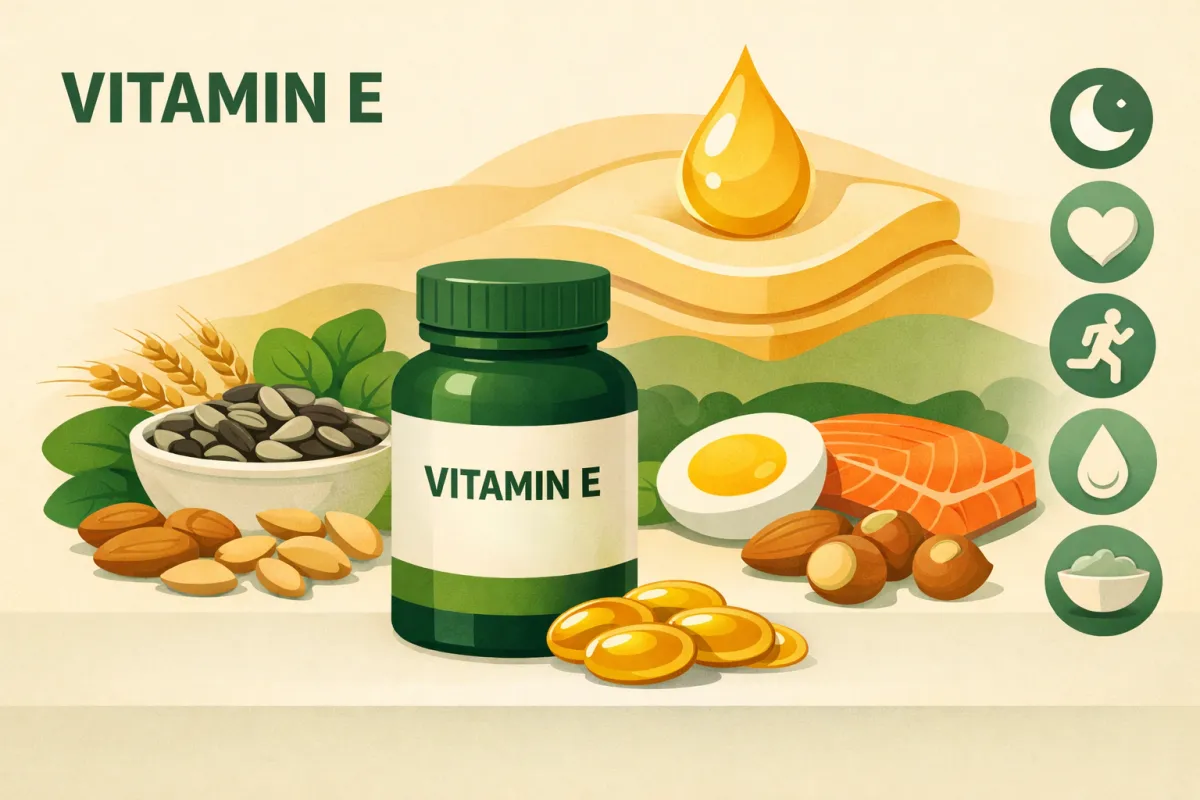
Food-first is realistic for many people. A small handful of nuts and a salad with oil-based dressing can cover a meaningful portion of daily needs. Sources of Vitamin E include wheat germ, sunflower seeds, almonds, hazelnut, spinach, egg yolk, and oily fish.
Cooking and heat can reduce vitamin E content, so minimally processed foods and fresh oils tend to preserve more.
Supplement forms
Most vitamin E supplements fall into a few categories. The form you choose matters mainly for long-term use and for people trying to cover specific bases.
Alpha-tocopherol (natural or synthetic) is the most common. It’s also the form your body uses to meet vitamin E requirements.
Alpha-tocopheryl acetate is an esterified, shelf-stable form that your body converts as needed. It’s a practical option when stability matters.
Mixed tocopherols include alpha plus other tocopherols (often gamma and delta). For regular use, this can be a sensible default because you get a broader profile.
Tocotrienols are biologically interesting, but they can be less reliably absorbed unless a specialised delivery system is used. If you take high-dose alpha-tocopherol alongside tocotrienols, absorption of tocotrienols can drop.
What vitamin E is not
Vitamin E is not a substitute for a diet built around whole foods. It’s also not a primary prevention tool for heart disease in the general population. And it’s not a “more is better” supplement, because higher doses can add risk, especially bleeding risk.
Who is Vitamin E for
Who’s most likely to benefit: People with higher oxidative stress. This includes athletes in intense training blocks, older adults with low dietary intake, and people with chronic inflammation or metabolic syndrome patterns.
Who might not notice much: Generally healthy people who already eat vitamin E-rich foods, have low inflammation, and are not training hard. If your baseline oxidative stress is low, the practical effect is often subtle.
Who should be cautious: Anyone with a higher bleeding risk, especially people taking anticoagulants or antiplatelet drugs, those with a history of haemorrhagic stroke, bleeding disorders, or anyone scheduled for surgery.
TLDR
Vitamin E is a family of compounds, but alpha-tocopherol is the main form used to meet requirements.
It is fat-soluble, so take supplements with a meal that contains fat.
Evidence is best for reducing exercise-induced muscle damage in athletes, especially at 300 to 500 IU/day.
There is early evidence for improved sleep quality in postmenopausal insomnia using 400 IU/day mixed tocopherols for a month.
Vitamin E can reduce inflammation markers in some people, but it usually requires higher doses for 8+ weeks, which increases safety considerations.
For type 2 diabetes and insulin resistance, vitamin E may produce modest improvements in glucose control over time.
For heart disease prevention in the general population, results are mixed, and high doses may increase haemorrhagic stroke risk.
If you do not have a clear reason to use it, prioritise food sources and the basics first.
What people take Vitamin E for
Muscle recovery and reduced exercise-induced muscle damage
Sleep quality in postmenopausal insomnia
Lowering inflammation markers
Glucose control and insulin resistance support
Cognitive decline and brain ageing support
Cardiovascular disease prevention
1. Muscle recovery and reduced exercise-induced muscle damage
Efficacy: Positive
Who primarily benefit: Athletes and highly active people doing high-intensity or high-volume training, especially endurance or repeated eccentric work.
What the evidence suggests: Across randomised trials, vitamin E can reduce biomarkers of muscle damage (like creatine kinase and lactate dehydrogenase). The signal tends to be stronger in athletes than in untrained people. Interestingly, lower doses appear to work better than higher doses in this context.
Typical protocol used: 300 to 500 IU/day, taken daily with a meal, for 2 to 4 weeks before a demanding training block and continued through it. Avoid exceeding 500 IU/day for this goal.
Practical expectation: Less next-day soreness and a slightly faster return to “ready to train” feeling. Do not expect visible performance jumps from vitamin E alone.
2. Sleep quality in postmenopausal insomnia
Efficacy: Positive (early)
Who primarily benefit: Postmenopausal women with chronic insomnia symptoms.
What the evidence suggests: One good randomised controlled trial found meaningful improvements in self-reported sleep quality (PSQI scores) after one month of supplementation. The mechanism is not fully clear and may involve hormone or nervous system signalling, not only antioxidant effects.
Typical protocol used: 400 IU/day of mixed tocopherols, taken with dinner, for 4 weeks.
Practical expectation: Modest improvement in sleep quality and fewer bad nights. If insomnia is driven by sleep apnoea, severe anxiety, or depression, vitamin E is unlikely to be the main lever.
3. Lowering inflammation markers
Efficacy: Positive
Who primarily benefit: People with higher baseline inflammation, metabolic syndrome traits, or chronic inflammatory patterns.
What the evidence suggests: Meta-analyses suggest vitamin E can reduce inflammatory markers such as CRP and IL-6, especially when taken consistently for long enough. Effects are not instant, and they are not guaranteed if baseline inflammation is already low.
Typical protocol used: Often 500 to 800 IU/day for 8+ weeks in research settings. This is the range where benefits are more likely, but it is also the range where bleeding risk becomes more relevant.
Practical expectation: You probably will not “feel” lower CRP. The benefit is usually seen on bloodwork over time and may support broader lifestyle changes.
4. Glucose control and insulin resistance support
Efficacy: Positive
Who primarily benefit: People with type 2 diabetes or insulin resistance, especially when oxidative stress and inflammation are elevated.
What the evidence suggests: Across randomised trials, vitamin E tends to produce modest improvements in fasting glucose and HbA1c in type 2 diabetes. It’s best viewed as an adjunct to diet, movement, sleep, and medication optimisation, not a replacement.
Typical protocol used: 400 to 800 IU/day for 8+ weeks. For many people, 400 to 600 IU/day is a reasonable trial range when medically appropriate.
Practical expectation: Small improvements, not dramatic changes. If you monitor glucose, work with your clinician so medications can be adjusted safely as numbers change.
5. Cognitive decline and brain ageing support
Efficacy: Positive
Who primarily benefit: Older adults, especially those with low dietary vitamin E intake and higher oxidative stress.
What the evidence suggests: Observational research links higher vitamin E intake with slower cognitive decline. Intervention trials are more mixed, and benefits, if present, likely require long-term consistency rather than a short course.
Typical protocol used: Commonly 400 IU/day in supplementation studies, alongside a food-first approach.
Practical expectation: This is a long game. You will not notice a quick effect. The aim is risk reduction, not a short-term “brain boost”.
6. Cardiovascular disease prevention
Efficacy: Neutral
Who primarily benefit: For most people, no clear group consistently benefits for primary prevention.
What the evidence suggests: Large trials and meta-analyses show no reliable reduction in overall cardiovascular events or mortality from vitamin E supplementation in the general population. Higher-dose supplementation may increase haemorrhagic stroke risk, even if it slightly reduces ischaemic stroke risk.
Typical protocol used: Trials often used 400 to 800 IU/day over long periods, which is part of the reason safety signals show up.
Practical expectation: If your goal is heart disease prevention, your best returns are still the fundamentals: blood pressure, lipids, smoking status, sleep, movement, and diet quality.
When it’s not worth taking Vitamin E
Vitamin E is often low return when:
Your diet already includes vitamin E-rich foods most days.
You are not training hard and do not have meaningful inflammation markers.
You want “general longevity insurance” without a defined problem to solve.
Vitamin E may be a poor choice when risks outweigh likely benefit, for example:
You take anticoagulants or antiplatelet medications without medical supervision.
You have a history of haemorrhagic stroke or a bleeding disorder.
You are approaching surgery and are using high-dose vitamin E.
Nuances and individual differences
Baseline status changes everything
Vitamin E tends to look “stronger” in research when baseline oxidative stress is high. That’s why athletes, people with chronic inflammation, and some older adults often see more meaningful effects than healthy people with good diets.
If you are already covering the basics and your inflammation markers are normal, vitamin E is unlikely to move the needle much.
Special populations
Pregnancy and breastfeeding: Vitamin E is essential, but high-dose supplementation is not automatically safer just because it’s a vitamin. Staying close to the RDA through food and standard prenatal formulations is usually the conservative approach unless supervised.
Older adults: Food intake can drift down with age, and oxidative stress can drift up. This is a group where adequacy matters, and modest supplementation may be reasonable if diet is inconsistent.
Kidney and liver disease: Data are limited. Because vitamin E is fat-soluble and stored, conservative dosing and clinician oversight are appropriate.
Co-nutrients and stacking
Vitamin E does not work in isolation.
Vitamin C can help recycle vitamin E after it neutralises free radicals, which is one reason diets rich in fruits and vegetables pair well with vitamin E.
Selenium works with vitamin E in antioxidant enzyme systems. This does not mean mega-dosing either, but it does mean adequacy matters.
High doses of fat-soluble vitamins can compete for absorption. If you take high-dose vitamin A or large doses of beta-carotene, consider separating timing from vitamin E and always take both with food.
Testing and monitoring
There is no universal need to test vitamin E status, but monitoring can matter when:
You are using higher doses long-term.
You take anticoagulant or antiplatelet medications.
You are tracking cardiometabolic markers (CRP, HbA1c, lipids) to evaluate whether the trial is doing anything meaningful.
How to take Vitamin E
Simple starter approach
For most healthy adults, the simplest approach is food-first and conservative supplementation. If you want a trial, start with 200 to 400 IU/day, taken with a meal that contains fat, and run it for 4 to 8 weeks. If there is no clear benefit and no specific clinical reason, stop and reassess.
Typical dose range
Vitamin E dosing depends heavily on your goal.
For adequacy, the adult RDA is 15 mg/day, which is roughly 22 IU/day of natural vitamin E or 33 IU/day of synthetic vitamin E.
For common researched goals:
Exercise recovery: 300 to 500 IU/day (lower tends to be better here).
Postmenopausal insomnia: 400 IU/day of mixed tocopherols.
Inflammation or metabolic support: commonly 400 to 800 IU/day for at least 8 weeks.
Higher doses are not automatically better. Past a point, risk increases and returns often flatten.
Timing
Timing matters mainly for absorption. Vitamin E is fat-soluble, so take it with a meal that contains fat. A practical default is dinner.
If you take other fat-soluble vitamins or carotenoids at high doses, consider separating them from vitamin E to reduce competition.
Loading vs maintenance
Vitamin E does not require a loading phase. Consistent daily intake is the point. Because it is stored in body fat, levels build gradually.
Duration to see effects
Exercise recovery: you may notice small changes within days, but the more reliable effect tends to show up after 2 to 4 weeks of consistent intake.
Sleep in menopause: the studied time frame was about 1 month.
Inflammation and metabolic markers: often 4 to 8+ weeks, and sometimes longer.
Cognitive protection: likely months to years, and is not something you can “feel” quickly.
Forms and whether form matters
Form matters more than most people think.
Natural (RRR) alpha-tocopherol is generally used more efficiently than synthetic.
Mixed tocopherols are often a sensible default because they provide more than just alpha-tocopherol.
Alpha-tocopherol only can be effective, but very high alpha-only dosing may suppress other forms like gamma-tocopherol.
Tocotrienols are interesting but often poorly absorbed, and they can compete with alpha-tocopherol. If you use them, product quality and delivery system matter.
Food vs supplement
Many people can cover adequacy with food. If your goal is simply meeting needs, start with diet.
Supplementation is more defensible when you have a specific target that matches research, like a short-term training block, postmenopausal insomnia, or a clinician-guided metabolic health plan.
Safety and side effects
At normal dietary intakes, vitamin E is generally safe. Most meaningful risks show up at higher supplemental doses.
Common side effects
Side effects are uncommon, but high doses can cause gastrointestinal upset (nausea, diarrhoea), headache, fatigue, or rash in some people. If symptoms occur, reducing the dose or stopping usually resolves the issue.
Serious risks (rare, but important)
The main serious concern is increased bleeding risk at higher doses. Vitamin E can reduce platelet clumping and has mild anticoagulant effects.
At higher doses, research suggests:
A potential increase in haemorrhagic stroke risk.
An interaction-driven rise in bleeding risk when combined with anticoagulant or antiplatelet medications.
Red-flag symptoms to treat seriously include unusual bruising, prolonged bleeding from small cuts, black stools, vomiting blood, sudden severe headache, weakness on one side, or vision changes.
Contraindications and caution groups
Use caution and get medical guidance if you:
Take anticoagulants (for example warfarin, apixaban) or antiplatelets (for example aspirin, clopidogrel).
Have a history of haemorrhagic stroke.
Have a bleeding disorder.
Are scheduled for surgery and are using higher doses.
Pregnancy and breastfeeding: There is insufficient reason to use high-dose vitamin E without supervision. Stay close to the RDA unless guided by a clinician.
Interactions
Vitamin E can interact with:
Anticoagulants and antiplatelet drugs (additive bleeding risk).
Vitamin K status (low vitamin K plus high vitamin E is not a good combination for clotting balance).
Some immunosuppressants (possible additive effects).
Tamoxifen (high-dose vitamin E may reduce efficacy).
Vitamin E can also compete with other fat-soluble nutrients for absorption at high doses.
For athletes: anti-doping and contamination risk
Supplements can be contaminated or adulterated. If you compete in drug-tested sport, prioritise products that are batch-tested under recognised anti-doping focused programmes. “Batch tested” means the actual production batch was tested, not just the company’s general process.
Quality checklist (buying guide)
What to look for on labels
Look for:
The exact form: RRR-alpha-tocopherol, mixed tocopherols, or alpha-tocopheryl acetate.
A clear dose per serving in IU and or mg.
Allergen and oil base information (some products use soy oil or other carriers).
A batch number and expiry date.
Third-party testing and certifications
Third-party testing means an independent organisation has tested the product and or audited manufacturing to verify label claims and screen for contaminants. No certification can guarantee a supplement is completely free of all risks, but reputable testing can meaningfully reduce common quality problems.
If you compete in drug-tested sport, supplement use always carries some risk because products can be contaminated or adulterated with prohibited substances. If you choose to use supplements anyway, prioritise products that are batch-tested under recognised anti-doping focused programmes such as NSF Certified for Sport, Informed Sport, Informed Choice, or BSCG Certified Drug Free.
For general quality assurance (identity, purity, potency, and contaminant screening), look for verification or certification programmes such as USP Verified, NSF/ANSI 173 certification, or a ConsumerLab quality seal. Some categories also have specialised quality programmes, for example IFOS for fish oil. If a company claims testing, ask for a recent Certificate of Analysis (COA) for the exact batch you are buying.
Red flags
❌ No batch number and no expiry.
❌ No COA available on request.
❌ “Proprietary blend” with no exact amounts.
❌ Unrealistic health claims.
❌ Very cheap pricing vs market norms.
Storage and stability
Vitamin E can degrade with heat, light, and time. Store in a cool, dark place. Oils (especially wheat germ oil) can oxidise more quickly, so refrigerate after opening and use within a few months.
The Five Pillar impact analysis of Vitamin E
Five Pillar overview
Vitamin E is not a “foundation” supplement. It’s a context supplement.
Where it shines is when oxidative stress is predictably high, such as intense training blocks or chronic inflammation. That places its biggest practical value in the Movement pillar for athletes and active people, and in the Nutrition pillar for people with insulin resistance or metabolic syndrome traits.
It has a niche role in the Sleep pillar for postmenopausal insomnia, based on early evidence. For hydration, it has no meaningful role. For stress, the evidence is too early to treat it as a primary tool.
Five Pillar impact table

Five Pillar detailed review
Sleep
Pillar verdict (practical): Vitamin E is not a universal sleep supplement. It has one promising lane: postmenopausal insomnia, where a month-long trial improved sleep quality scores.
What it may improve:
Sleep quality in postmenopausal insomnia (self-reported)
Frequency of bad nights in that specific subgroup
Possible reduction in reliance on sedatives for some people
Practical protocol (starter):
Use 400 IU/day mixed tocopherols
Take with dinner
Run a 4-week trial
Track sleep quality weekly, not nightly
When it’s not worth it:
No insomnia symptoms
Sleep apnoea or breathing-related sleep disruption
Insomnia primarily driven by severe anxiety or depression
Stress Management
Pillar verdict (practical): Evidence is too limited to treat vitamin E as a primary stress tool. If it helps, it likely does so indirectly by reducing inflammation and oxidative load.
What it may improve:
Inflammation-linked stress load (indirect)
Oxidative stress markers in some contexts
Mood in some depression-focused combinations (limited data)
Practical protocol:
Prioritise sleep, movement, and stress practices first
If trialling vitamin E, keep dose conservative unless supervised
Always take with a meal containing fat
When it’s not worth it:
Acute stress spikes
Panic or anxiety disorder requiring evidence-based care
Low baseline inflammation with no clear target
Exercise
Pillar verdict (practical): This is where vitamin E has its clearest upside. Lower-dose supplementation can reduce exercise-induced muscle damage in athletes, especially during hard training blocks.
What it may improve:
Creatine kinase and LDH (muscle damage markers)
Next-day soreness after high-volume training
Perceived recovery between sessions
Practical protocol:
Use 300 to 500 IU/day
Take daily with a meal
Start 2 weeks before a demanding block if possible
Do not exceed 500 IU/day for recovery goals
When it’s not worth it:
Sedentary lifestyle
Low-intensity exercise only
Expecting performance gains without training and recovery basics
Hydration
Pillar verdict (practical): Vitamin E is not a hydration supplement. It does not meaningfully affect fluid balance, electrolytes, or heat tolerance.
Nutrition
Pillar verdict (practical): Vitamin E can be a helpful adjunct in type 2 diabetes and metabolic syndrome contexts, but effects are usually modest and show up over weeks, not days.
What it may improve:
Fasting glucose (modest)
HbA1c over time (modest)
Inflammation markers that interfere with insulin signalling
Practical protocol:
Use 400 to 600 IU/day with food
Run at least 8 weeks before judging
Track HbA1c and fasting glucose with clinician support
Pair with diet and movement changes for leverage
When it’s not worth it:
Normal glucose control with low inflammation
Using it as a replacement for proven interventions
High bleeding risk without oversight
FAQ
Should I take vitamin E every day?
Not necessarily. If your diet consistently includes nuts, seeds, and quality oils, you may already be close to adequacy. Daily supplementation makes more sense when you have a specific goal that matches evidence.
What’s the best time of day to take vitamin E?
Take it with a meal that contains fat. For most people, dinner is a simple default.
Is natural vitamin E better than synthetic?
Natural vitamin E (RRR-alpha-tocopherol) is generally used more efficiently. Synthetic can still work, but you may need a higher IU dose for similar biological impact.
Can vitamin E help with skin?
Topical vitamin E has mixed evidence, and oral supplementation is not a guaranteed skin upgrade. If you care about skin, the highest ROI is still sun protection, adequate protein, and overall diet quality.
Can vitamin E increase bleeding?
At higher supplemental doses, yes, especially when combined with anticoagulants or antiplatelet drugs. If you bruise easily, have bleeding issues, or take blood thinners, get medical guidance before using it.
Do I need mixed tocopherols or is alpha-tocopherol enough?
Alpha-tocopherol is the form that meets requirements, and it can be enough. Mixed tocopherols can be a sensible default because they provide a broader profile, especially if you are supplementing regularly.
This article is for educational purposes only. It is not medical advice and it is not prescriptive.
Supplements can vary widely in quality and contamination risk, including products that are not tested for banned substances and products that contain concentrated plant, herb, or mushroom extracts.
If you are a competitive athlete, in a drug-tested sport, have a complex medical history, are pregnant or breastfeeding, take medications, or have a diagnosed health condition, prioritise direct guidance from a qualified professional who can advise you within the context of your specific needs.
Even if you are otherwise healthy, consult a qualified practitioner before making major health or lifestyle changes, including starting new supplements, changing dose significantly, or combining multiple supplements.
