
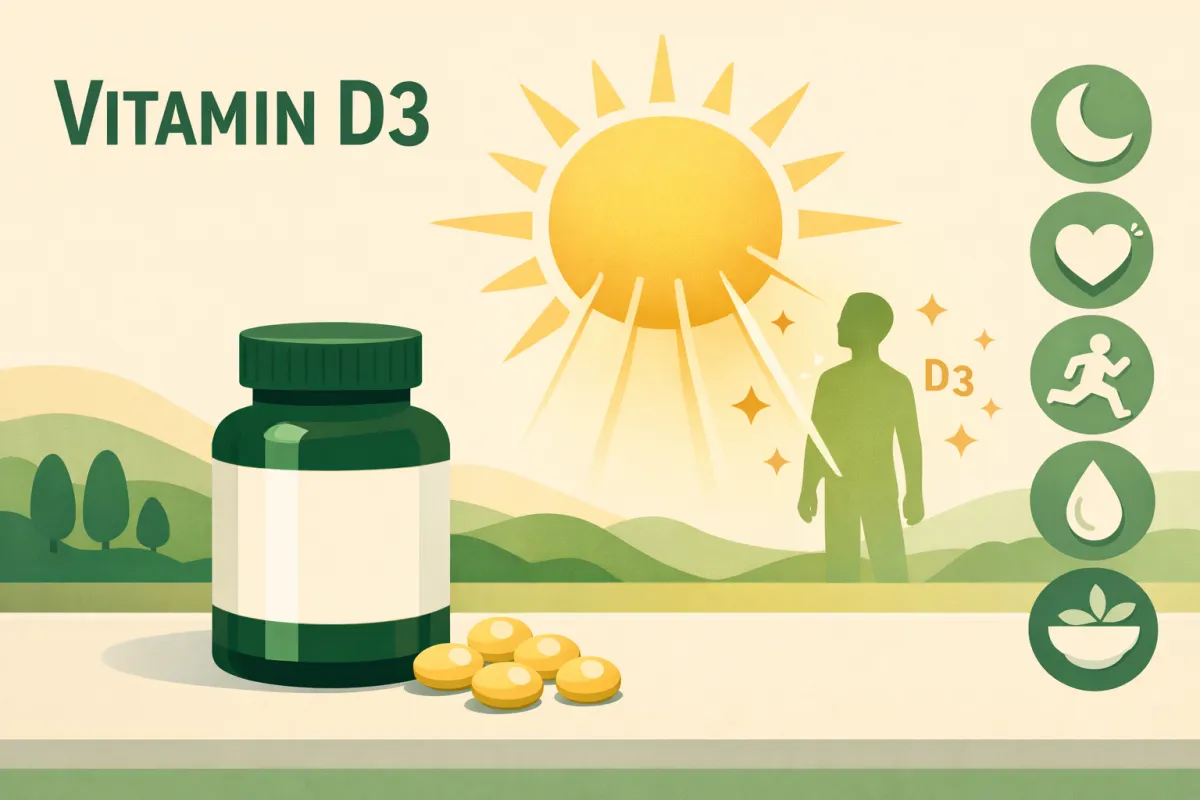
Vitamin D3
What it Vitamin D3
Vitamin D3, also called cholecalciferol, is a fat-soluble nutrient that acts more like a hormone than a typical vitamin. Your skin can make it when it is exposed to UVB sunlight. Your liver and kidneys then convert it into the active form your body uses to regulate calcium, bones, muscles, and parts of immune function.
Natural sources of vitamin D are limited. The most reliable food sources are oily fish (such as salmon, sardines, and mackerel), egg yolks, and some mushrooms that have been exposed to sunlight. Many people also get small amounts from fortified foods such as milk, plant milks, cereals, or spreads, but doses vary by product and are often not enough on their own.
Vitamin D supplements are usually vitamin D3 (cholecalciferol). Common supplement forms include oil-based softgels, microencapsulated capsules or powders, and oil-based liquid drops.
What vitamin D3 is not: it is not a fast-acting energy supplement, it is not a substitute for osteoporosis treatment when bone disease is advanced, and it is not a general longevity pill for people who already have adequate vitamin D status.
Who Vitamin D3 is for
Vitamin D3 is most useful when there is a clear reason your vitamin D status is likely low, or when you have a goal that depends on correcting deficiency.
Who’s most likely to benefit: People with limited sun exposure (especially in winter or at higher latitudes), darker skin tones, older adults, people with malabsorption issues, and athletes training indoors. People with measured low blood levels of 25-hydroxyvitamin D are the clearest high-value group.
Who might not notice much: People who get regular midday sun exposure, eat oily fish often, and already have adequate blood levels. Also, people expecting a noticeable day-to-day feeling change from low maintenance doses may not feel much even if their labs improve.
Who should be cautious: People with kidney disease, hyperparathyroidism, a history of high blood calcium, sarcoidosis or similar inflammatory granulomatous diseases, or a history of kidney stones. If you are pregnant, on multiple medications, or taking high-dose calcium, treat vitamin D dosing as clinician-guided.
TLDR
Vitamin D3 helps your body absorb and use calcium and phosphorus. This is why it matters for bones and muscle function.
The biggest benefits are seen when you are deficient. If your levels are already adequate, extra vitamin D usually does little.
Daily dosing tends to work better than large occasional doses. Big monthly boluses have not performed well and may increase falls in older adults.
For bone health and fracture risk, vitamin D is most useful in older adults and people with low levels. It works best alongside adequate calcium and magnesium.
Vitamin D supplementation can reduce the risk of acute respiratory infections, especially in people with low baseline vitamin D, when taken daily or weekly.
Sleep and mood improvements are possible, but they are not universal. Benefits are most consistent in people who are low at baseline and who supplement for at least 8 weeks.
Vitamin D does not reliably prevent heart attacks or strokes on its own. The best-supported uses are targeted (bones, deficiency correction, infection risk, some mood outcomes).
Quality and dosing discipline matter. Chronic high dosing can cause high blood calcium and kidney problems, so do not treat it as a more-is-better supplement.
If you are unsure, a simple blood test for 25-hydroxyvitamin D can tell you whether supplementation is worth it and what dose range makes sense.
What people take Vitamin D3 for (common uses)
Bone health and fracture prevention
Immune function and respiratory infections
Sleep quality support
Mood and depression support
Muscle strength and athletic performance
Cancer mortality risk (adjunctive)
Cardiovascular health and calcification
Glucose control in prediabetes or metabolic syndrome
1. Bone health and fracture prevention
Efficacy: Positive (Strong if deficient)
Who primarily benefit: Older adults, postmenopausal women, people at risk of osteoporosis, people on long-term corticosteroids, and anyone with confirmed low vitamin D levels.
What the evidence suggests: Vitamin D3 increases calcium absorption and helps keep parathyroid hormone in a healthy range, which protects bone over time. Supplementation is most effective when deficiency is present. Daily lower-dose strategies (often around 800 to 1,000 IU per day) tend to outperform large bolus doses for fracture and fall outcomes, especially in older adults.
Typical protocol used: 800 to 1,000 IU (20 to 25 mcg) daily as a baseline. If deficiency is confirmed, 1,000 to 2,000 IU (25 to 50 mcg) daily for 8 to 12 weeks, then retest. Pair with adequate calcium intake and magnesium; consider vitamin K2 when using higher doses or when bone health is the goal.
Practical expectation: You rarely feel bone benefits. Expect changes to show up as improved labs and longer-term risk reduction. Bone density changes take many months to years.
2. Immune function and respiratory infections
Efficacy: Positive (most consistent in deficiency)
Who primarily benefit: People who get frequent seasonal respiratory infections, people with low baseline vitamin D, and people with minimal sun exposure.
What the evidence suggests: Vitamin D supports antimicrobial peptides and can reduce excessive inflammatory signalling in the airways. Trials and meta-analyses show reduced acute respiratory infection risk, with the strongest effects in people who start out deficient. Daily or weekly dosing patterns appear to work better than infrequent high-dose boluses.
Typical protocol used: 1,000 to 2,000 IU (25 to 50 mcg) daily during low-sun months, typically for 8 to 12 weeks or through the winter season. If levels are low, use the higher end of this range and retest.
Practical expectation: You may notice fewer or milder colds over time. The effect is not immediate and is best judged across a season.
3. Sleep quality support
Efficacy: Positive (early to moderate evidence)
Who primarily benefit: People with poor sleep quality and low vitamin D status, especially in winter or with limited daytime light exposure.
What the evidence suggests: Small trials suggest vitamin D3 can improve subjective sleep quality scores and may reduce time to fall asleep, particularly in deficient individuals. Effects are not universal and may depend on dose, timing, and co-nutrients such as magnesium.
Typical protocol used: 2,000 to 4,000 IU (50 to 100 mcg) daily for 8 to 12 weeks, taken with food. Some sleep-focused studies use higher doses (around 3,500 to 7,100 IU daily), but higher dosing should be paired with testing and a clear rationale.
Practical expectation: If it helps, the common pattern is falling asleep a bit faster and waking slightly less, usually after several weeks rather than days.
4. Mood and depression support
Efficacy: Positive (moderate evidence in deficiency)
Who primarily benefit: People with low vitamin D levels and depressive symptoms, including seasonal low mood. It is most appropriate as an adjunct, not a standalone treatment.
What the evidence suggests: Meta-analyses of trials suggest vitamin D supplementation can modestly improve depression scores, with stronger effects when baseline vitamin D is low. Mechanisms likely include neurotransmitter support and reduced neuroinflammation, but vitamin D is not a substitute for therapy or medication when needed.
Typical protocol used: 1,600 to 4,000 IU (40 to 100 mcg) daily for at least 8 weeks, ideally guided by baseline and follow-up blood testing. Magnesium sufficiency is important for activation and may improve response.
Practical expectation: If it works, expect a small but meaningful lift in baseline mood and resilience, not an immediate emotional shift.
5. Muscle strength and athletic performance
Efficacy: Positive (conditional on deficiency)
Who primarily benefit: Athletes and active people with low vitamin D status, indoor training schedules, or winter training. Older adults with weakness or falls risk may also benefit when deficient.
What the evidence suggests: Vitamin D receptors exist in muscle tissue and vitamin D appears to support strength, recovery, and muscle contraction efficiency. Studies are mixed overall, but deficient athletes often improve strength and some performance markers after correcting low levels. People who are already sufficient usually do not gain extra performance from higher dosing.
Typical protocol used: 2,000 to 4,000 IU (50 to 100 mcg) daily for 8 to 12 weeks if deficient, then retest. Maintain with 800 to 1,500 IU daily if sun exposure remains low.
Practical expectation: If you are low at baseline, you may recover slightly faster and feel stronger over several weeks. If you are already sufficient, you should expect little to no change.
6. Cancer mortality risk (adjunctive)
Efficacy: Positive (early evidence, modest effect)
Who primarily benefit: General population as a possible risk modifier, with the biggest rationale being correction of deficiency rather than high-dose prevention.
What the evidence suggests: Meta-analyses of randomised trials suggest vitamin D3 supplementation may reduce cancer-specific mortality, even when it does not clearly reduce cancer incidence. The absolute benefit appears modest, and this is not a primary cancer prevention strategy.
Typical protocol used: Typical trial dosing varies, but most practical approaches stay within 800 to 2,000 IU daily unless deficiency is documented. Focus on maintaining sufficiency rather than megadosing.
Practical expectation: This is a long-term risk outcome. You will not feel a direct effect, and decisions should be based on overall health strategy, not this single claim.
7. Cardiovascular health and calcification
Efficacy: Neutral for vitamin D3 alone; Positive (early) when paired with vitamin K2 in select cases
Who primarily benefit: For vitamin D alone, no specific cardiovascular group has consistent benefit. For D3 plus K2, the potential use case is people taking higher-dose vitamin D for bone goals and who also want to support healthy calcium placement.
What the evidence suggests: Large trials have not shown vitamin D3 alone reduces heart attacks or strokes in the general population. Mechanistically, vitamin D increases calcium absorption. Vitamin K2 activates proteins that help direct calcium into bone and away from soft tissue. Early evidence suggests D3 plus K2 may be helpful in some calcification-related contexts, but this is still emerging.
Typical protocol used: If using vitamin D above maintenance doses, consider pairing with vitamin K2 (often 90 to 180 micrograms of MK-7 daily). Do not combine K2 with warfarin unless a clinician is supervising.
Practical expectation: Do not expect symptom changes. Treat this as a risk-management choice, especially if you use vitamin D and calcium together.
8. Glucose control in prediabetes or metabolic syndrome
Efficacy: Positive (early evidence, small effect)
Who primarily benefit: People with prediabetes or type 2 diabetes who also have low vitamin D levels, as a supporting strategy alongside diet, exercise, and medical care.
What the evidence suggests: Low vitamin D is associated with insulin resistance. Some trials show modest improvements in fasting glucose and HbA1c after supplementation in metabolically impaired groups, especially when deficiency is corrected. Results are mixed and effects are small compared with lifestyle changes.
Typical protocol used: 1,000 to 2,000 IU (25 to 50 mcg) daily for 12 weeks or longer, with follow-up testing. Pairing with magnesium is often sensible because magnesium supports both vitamin D activation and glucose regulation.
Practical expectation: You may not feel a change. Any benefit is usually modest and is best tracked with labs and overall metabolic progress.
When it’s not worth it
Vitamin D3 is low return when you already have adequate blood levels and you are simply hoping for a general health boost. In that case, more vitamin D does not usually translate into better outcomes.
It is usually not worth using high doses without testing. Vitamin D has a wide safety margin at normal doses, but chronic overuse can push calcium too high, especially if you also take calcium supplements.
If your main goal is cardiovascular event prevention, vitamin D3 alone is not a reliable strategy. Focus on the core drivers (blood pressure, lipids, fitness, sleep, diet), and treat vitamin D as a correction tool when low.
If you have conditions that raise calcium (for example sarcoidosis, primary hyperparathyroidism, severe kidney disease), supplementation without clinical oversight is not worth the risk.
Nuances and individual differences
Baseline status changes everything
Vitamin D is one of the clearest examples of baseline-dependence. If you are deficient, supplementation can meaningfully improve bone markers, infection risk, muscle function, and sometimes mood or sleep. If you are already sufficient, the same dose may do very little. This is why testing can be unusually high ROI for vitamin D compared with many other supplements.
Responder differences and conversion limits
Vitamin D3 must be converted in the liver and kidneys into its active form. If liver or kidney function is impaired, effects can be weaker and safety needs more attention. Magnesium is also required for conversion. If magnesium intake is low, you can take vitamin D and still not get the expected benefit because activation is limited.
Body fat also matters. Vitamin D is stored in fat tissue, which can lower circulating blood levels in people with obesity. In practice, some people need 1.5 to 2 times the standard dose to reach the same blood level, and dosing is best guided by testing rather than guesswork.
Special populations
Older adults: Skin production declines with age and fracture risk rises. This is a population where daily vitamin D (often 800 to 1,000 IU) is commonly reasonable, especially when deficiency risk is high.
Darker skin tones and higher latitudes: Darker skin reduces UVB-driven production, and winter at higher latitudes can limit UVB enough that skin production drops sharply. These are practical reasons supplementation is often useful seasonally.
Pregnancy and breastfeeding: Needs and safety depend on baseline status. Many guidelines stay conservative (often around 400 to 800 IU daily) unless deficiency is documented. If you are pregnant, treat higher dosing as clinician-guided.
Malabsorption disorders: Conditions that impair fat absorption can reduce vitamin D uptake from standard supplements. In these cases, dosing may need to be higher or use specific clinical forms, with testing every few months.
Kidney stones or kidney disease: Vitamin D can increase calcium absorption and urinary calcium. If you are stone-prone or have kidney disease, keep doses conservative and use medical guidance for anything above maintenance.
Co-nutrients and stacking
Vitamin D works in a system, not in isolation. The core co-nutrients are magnesium (needed for activation), calcium (the main mineral vitamin D helps you manage), and vitamin K2 (helps direct calcium into bone and away from soft tissue). If you take vitamin D for bone health or at higher doses, pairing with magnesium and considering K2 is a practical strategy that fits the biology.
If you are using vitamin D for mood or sleep, magnesium often has additive value because it supports relaxation and sleep onset. The goal is not stacking everything. The goal is removing obvious bottlenecks that limit vitamin D’s effect.
Testing and monitoring
A blood test for serum 25-hydroxyvitamin D is the standard way to assess status. Many clinicians use 50 nmol/L (20 ng/mL) as a minimum threshold for sufficiency, but targets can vary by guideline and by clinical context.
If you start supplementation to correct low levels, a practical retest window is about 8 to 12 weeks. This is usually long enough to see a stable change in blood levels and to adjust dose if needed. If you use higher doses, have risk factors, or combine with high-dose calcium, monitoring calcium status may also be appropriate under medical supervision.
How to take vitamin D3
Simple starter approach
For a simple, realistic default, take 800 to 1,000 IU (20 to 25 mcg) of vitamin D3 daily with your largest meal that contains fat. Run this for 8 to 12 weeks during low-sun months or if you rarely get midday sun. If you can, get a baseline blood test first and retest after the trial so you can avoid both underdosing and overdosing.
Typical dose range
Maintenance for many adults is around 600 to 1,000 IU (15 to 25 mcg) per day. People at higher risk of low levels (older adults, minimal sun exposure, darker skin, indoor athletes) often use 800 to 2,000 IU (20 to 50 mcg) per day.
For confirmed deficiency correction, a common approach is 1,000 to 2,000 IU (25 to 50 mcg) daily for 8 to 12 weeks, then recheck. For mood and sleep studies, doses are often 1,600 to 4,000 IU (40 to 100 mcg) daily, usually for 8 or more weeks. The generally accepted adult upper limit for routine self-supplementation is 4,000 IU (100 mcg) daily. Higher dosing can be appropriate in specific cases, but it should be guided by testing and clinical oversight.
If you prefer a conversion: 1 microgram of vitamin D equals 40 IU. This helps when labels use different units.
Timing
Take vitamin D with food, ideally a meal that contains fat, because absorption is better. Morning or evening is usually less important than consistency, but some people report that late dosing can affect sleep. If you notice this, take it earlier in the day.
Daily dosing is the most reliable strategy. Weekly dosing can work, but daily tends to produce steadier blood levels and better outcomes in infection and fall research. Avoid very large monthly boluses unless a clinician is using a specific medical protocol.
Loading vs maintenance / cycling, etc...
Most practical vitamin D strategies are a correction phase followed by a maintenance phase. If you are low, use a higher daily dose for 8 to 12 weeks, then reduce to a maintenance dose once levels normalise. Cycling on and off is usually not necessary unless sun exposure changes markedly by season.
Large bolus dosing (for example a single very high dose monthly) can trigger feedback mechanisms and has not performed well in several outcomes. A steady daily routine is the safer default for most people.
Duration to see effects
Blood levels (25-hydroxyvitamin D) typically rise within 4 to 8 weeks. Respiratory infection risk benefits are usually judged over 8 to 12 weeks or across a season. Sleep changes, when they happen, often appear within 4 to 12 weeks. Mood outcomes typically require at least 8 weeks. Muscle strength and recovery changes, when baseline deficiency exists, often show up over 4 to 8 weeks. Bone density changes take the longest, often 12 to 24 months, even though bone turnover markers may improve earlier.
Forms and whether form matters
The best-supported form is vitamin D3 (cholecalciferol). Vitamin D2 is used to fortify some products but is generally less preferred. Oil-based softgels and oil-based drops tend to absorb well. Microencapsulated forms can also be effective and are often used for vegan products.
Source matters mainly for dietary preference. Many D3 products are derived from lanolin (sheep wool). Vegan D3 is usually derived from lichen. Both can be effective when the dose is accurate and the product is stable.
Gummies can be convenient for maintenance, but they often contain added sugar and potency can decline faster. Water-soluble or micellised forms can be useful in specific malabsorption contexts, but for most people with normal fat digestion, oil-based products are the more reliable default.
Food vs supplement
In theory, food and sunlight can cover vitamin D needs. In practice, many diets contain limited vitamin D, and winter sunlight in many regions does not provide enough UVB for consistent production. If you can reliably get safe midday sun exposure and eat oily fish regularly, supplements may be unnecessary. If not, a modest daily supplement is often the simplest way to maintain sufficiency.
Safety and side effects
Common side effects
At standard doses (roughly 400 to 2,000 IU daily), vitamin D3 is usually very well tolerated and most people report no side effects. If side effects occur, they are often related to taking high doses for long periods or to pairing vitamin D with high-dose calcium.
To reduce risk, stay within reasonable doses, avoid large bolus dosing unless supervised, take vitamin D with food, and ensure magnesium intake is adequate. If you are using higher doses, do not treat calcium supplements as automatic. Use food-first calcium unless a clinician has told you otherwise.
Serious risks (rare, but important)
The primary serious risk is vitamin D toxicity, which is uncommon but can occur with chronic high-dose use (often 10,000 IU or more daily for months). Toxicity drives high blood calcium (hypercalcaemia), which can cause kidney stones, kidney damage, and abnormal heart rhythms.
Red-flag symptoms include persistent nausea or vomiting, constipation, unusual weakness, confusion, excessive thirst, and frequent urination. If these occur while using high-dose vitamin D, stop supplementation and seek medical evaluation.
Contraindications and caution groups
Do not self-supplement with vitamin D without medical guidance if you have severe kidney disease, primary hyperparathyroidism, a history of hypercalcaemia, sarcoidosis, tuberculosis, histoplasmosis, or certain cancers that alter vitamin D metabolism. These conditions can raise active vitamin D and calcium levels, and extra vitamin D can become dangerous.
Use caution if you have a history of kidney stones, are taking thiazide diuretics, or routinely use high-dose calcium supplements. In these cases, conservative dosing and monitoring can reduce risk. People with malabsorption disorders or obesity may need different dosing, but this should be guided by blood testing rather than assumptions.
Interactions
Corticosteroids can reduce vitamin D absorption and increase calcium loss, which is one reason long-term steroid use raises osteoporosis risk. Some anticonvulsants increase vitamin D breakdown, which can lower blood levels over time. Orlistat reduces fat absorption and can reduce vitamin D uptake.
Warfarin and other anticoagulants require special care. Vitamin D does not directly act like vitamin K, but high-dose protocols and especially stacking vitamin D with vitamin K2 can complicate anticoagulation management. If you take warfarin, keep dosing consistent and discuss any changes with your clinician.
High-dose vitamin D combined with calcium supplements can increase hypercalcaemia risk in susceptible people. If you are combining multiple supplements, consider a clinician-guided plan.
For athletes: anti-doping and contamination risk
Vitamin D3 is not a banned substance under WADA rules. The practical risk for athletes is not doping legality, but supplement contamination or mislabelling.
If you compete in tested sport, prioritise third-party certified products and keep batch records. This is particularly important if you use combination products that include multiple ingredients.
Quality checklist (buying guide)
What to look for on labels
Look for cholecalciferol or vitamin D3 on the label. Avoid products that only say “vitamin D” without specifying D2 or D3. Ensure the dose is clearly stated per serving in IU or micrograms.
Prefer oil-based delivery (for example in MCT oil, olive oil, or fish oil) or stable microencapsulated forms. If you are vegan, look for lichen-derived D3. If you are sensitive to additives, avoid unnecessary dyes, sweeteners, or high-sugar gummies.
Check expiry dates and storage instructions. Vitamin D potency can decline over time, especially in gummies or products exposed to heat and light.
Third-party testing and certifications
Third-party testing means an independent organisation has tested the product and or audited manufacturing to verify label claims and screen for contaminants. No certification can guarantee a supplement is completely free of all risks, but reputable testing can meaningfully reduce common quality problems.
If you compete in drug-tested sport, supplement use always carries some risk because products can be contaminated or adulterated with prohibited substances. If you choose to use supplements anyway, prioritise products that are batch-tested under recognised anti-doping focused programmes such as NSF Certified for Sport, Informed Sport, Informed Choice, or BSCG Certified Drug Free.
For general quality assurance (identity, purity, potency, and contaminant screening), look for verification or certification programmes such as USP Verified, NSF/ANSI 173 certification, or a ConsumerLab quality seal. Some categories also have specialised quality programmes, for example IFOS for fish oil. If a company claims testing, ask for a recent Certificate of Analysis (COA) for the exact batch you are buying.
Red flags
❌ No batch number and no expiry.
❌ No COA available on request.
❌ “Proprietary blend” with no exact amounts.
❌ Unrealistic health claims.
❌ Very cheap pricing vs market norms.
Storage and stability (if relevant)
Store vitamin D in a cool, dark place. Heat and light can reduce potency over time, especially for liquids and gummies. Keep caps tightly closed and avoid leaving products in hot cars or on sunny windowsills.
The MHE Five Pillar impact analysis
Five Pillar overview
Vitamin D3 most strongly supports the Nutrition pillar because it is a foundational nutrient that affects calcium handling, bone structure, and several downstream systems.
Bone outcomes are the most established clinical use case, particularly for older adults and people with deficiency risk.
Its second most meaningful impact is on Exercise, but mainly by correcting deficiency. When levels are low, muscle function and recovery can improve. When levels are adequate, extra vitamin D is unlikely to help.
Sleep and Stress Management benefits are plausible and supported by moderate evidence, but they are more variable between individuals and are most consistent when deficiency is present.
It does not meaningfully affect Hydration directly. It also does not provide broad longevity benefits in people who are already sufficient. The practical strategy is testing when possible, conservative dosing, and pairing with magnesium and sensible lifestyle fundamentals.
Five Pillar impact table

Five Pillar detailed review
Sleep
Pillar verdict (practical): Vitamin D3 can support sleep quality for some people, mainly when low vitamin D is part of the problem.
If your sleep issues are driven by stress, screens, shift work, or sleep apnoea, vitamin D is unlikely to be the main lever.
What it may improve
Improved subjective sleep quality in some trials (better PSQI scores).
Slightly shorter time to fall asleep in some people when deficient.
More stable sleep timing in some low-sun contexts (early evidence).
Practical protocol
Start with 1,000 to 2,000 IU daily with breakfast or lunch for 8 to 12 weeks.
If deficiency is confirmed and sleep is a priority, consider 2,000 to 4,000 IU daily and ensure magnesium intake is adequate.
Keep the rest of sleep hygiene basics in place (consistent bedtime, lower evening light).
When it’s not worth it
You already sleep well and are hoping for marginal optimisation.
Your main issue is sleep apnoea or chronic insomnia where behavioural therapy is the priority.
You are taking late-day doses that worsen your sleep timing.
Stress Management
Pillar verdict (practical): Vitamin D3 can modestly support mood and stress resilience when low vitamin D is present.
Think of it as a foundation builder, not a fast-acting calming supplement.
What it may improve
Small to moderate improvements in depressive symptoms in deficient individuals.
Possible support for seasonal low mood during winter months.
Potential reductions in inflammatory signalling that can worsen mood.
Practical protocol
Start with 1,000 to 2,000 IU daily with food for 8 weeks, then reassess.
If you have confirmed deficiency and mood symptoms, consider 2,000 to 4,000 IU daily for 8 to 12 weeks, ideally alongside professional care.
Pair with magnesium if intake is low.
When it’s not worth it
You are looking for an acute anxiety relief effect.
You have severe depression or anxiety and are not engaging with evidence-based care.
You are already sufficient and are increasing dose hoping for bigger emotional effects.
Exercise
Pillar verdict (practical): Vitamin D3 can improve strength and recovery when it corrects deficiency, especially in indoor or winter athletes.
If you are already sufficient, extra vitamin D is unlikely to enhance performance.
What it may improve
Improved strength and power in some deficient athlete studies.
Potential improvement in recovery markers and inflammation after training.
Lower stress fracture risk support through better bone mineralisation in low-status athletes.
Practical protocol
Test first if possible. If low, take 2,000 to 4,000 IU daily with food for 8 to 12 weeks.
Retest and then maintain with 800 to 1,500 IU daily during low-sun periods.
Do not treat vitamin D as a substitute for training progression, sleep, or protein intake.
When it’s not worth it
You are already sufficient and are hoping for a performance boost from higher doses.
You are using intermittent mega-doses rather than a steady daily routine.
You have kidney disease or a history of kidney stones and are dosing aggressively.
Hydration
Pillar verdict (practical): Vitamin D3 does not directly influence hydration status.
Nutrition
Pillar verdict (practical): Vitamin D3 is a high-impact nutrient when you are low, because it affects calcium absorption, bone structure, and several metabolic pathways.
It is most valuable as a correction tool and as a maintenance tool in low-sun environments.
What it may improve
Improved calcium absorption and better regulation of parathyroid hormone.
Support for bone mineralisation when paired with adequate calcium intake.
Modest support for glucose regulation in deficient prediabetes or metabolic syndrome cohorts (early evidence).
Immune support that can influence illness frequency across a season.
Practical protocol
Start with 800 to 1,000 IU daily with your largest meal for 8 to 12 weeks in low-sun months.
If low on testing, use 1,000 to 2,000 IU daily and retest after 8 to 12 weeks.
Ensure magnesium intake is sufficient. Consider vitamin K2 if bone health is a core goal and doses are above maintenance.
When it’s not worth it
You already have adequate blood levels and are supplementing for vague reasons.
You are using high doses without testing and without considering calcium status.
You have a condition that raises calcium and are not under medical supervision.
FAQ
Is vitamin D2 as good as vitamin D3?
Vitamin D3 is generally preferred in supplementation and research. Vitamin D2 can raise blood levels, but D3 is more commonly used and tends to be the practical default unless a clinician recommends otherwise.
What test should I use to check my vitamin D status?
The standard test is serum 25-hydroxyvitamin D, often written as 25(OH)D. It reflects your overall vitamin D status and is used to guide dosing decisions.
What blood level should I aim for?
Many guidelines treat about 50 nmol/L (20 ng/mL) as a minimum threshold for sufficiency. Some clinicians aim higher for specific goals, but the most important point is avoiding deficiency and avoiding excess.
Can I get enough vitamin D from sunlight alone?
Sometimes, yes. It depends on latitude, season, time outdoors, skin tone, age, and sunscreen use. In many regions, winter UVB is too low for consistent production, which is why seasonal supplementation is common.
Should I take vitamin D with vitamin K2?
If you are using vitamin D for bone health or using higher doses, pairing with vitamin K2 can make biological sense because K2 helps activate proteins that guide calcium into bone. If you take warfarin, do not add K2 unless your clinician is supervising.
What is the best time of day to take vitamin D?
Take it with a meal that contains fat for better absorption. Timing is otherwise flexible, but if you notice it affects your sleep, take it earlier in the day.
How do I know if I am taking too much?
The main concern is high blood calcium. Signs can include nausea, constipation, weakness, confusion, excessive thirst, and frequent urination. If you are using high doses long-term, testing is the safest way to avoid overshooting.
Does vitamin D prevent colds?
It can reduce the risk of acute respiratory infections, especially in people who start out deficient, and when taken consistently (daily or weekly). It is not a guarantee and it works best as part of a broader sleep, nutrition, and hygiene strategy.
This article is for educational purposes only. It is not medical advice and it is not prescriptive.
Supplements can vary widely in quality and contamination risk, including products that are not tested for banned substances and products that contain concentrated plant, herb, or mushroom extracts.
If you are a competitive athlete, in a drug-tested sport, have a complex medical history, are pregnant or breastfeeding, take medications, or have a diagnosed health condition, prioritise direct guidance from a qualified professional who can advise you within the context of your specific needs.
Even if you are otherwise healthy, consult a qualified practitioner before making major health or lifestyle changes, including starting new supplements, changing dose significantly, or combining multiple supplements.
