
Vitamin B6
What is Vitamin B6
Vitamin B6 is a water-soluble vitamin your body uses as a coenzyme. In practical terms, it acts like an “on switch” for enzymes that run hundreds of everyday jobs including turning food into energy, building and repairing proteins, making neurotransmitters, and supporting healthy red blood cell production.
Vitamin B6 is not one single molecule. It’s a family of related compounds (pyridoxine, pyridoxal, and pyridoxamine, plus their phosphate forms). The main “active” form inside the body is pyridoxal-5-phosphate (often shortened to P-5-P or PLP).
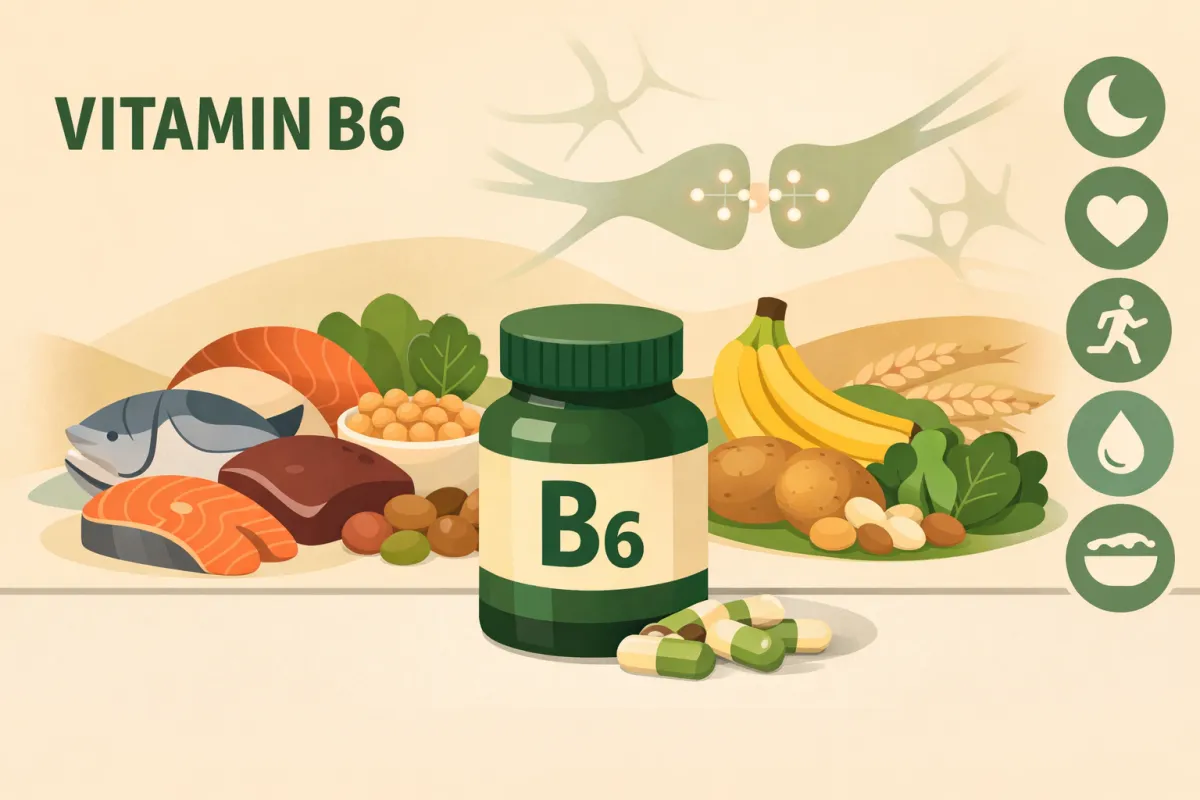
Food sources include fish (tuna and salmon), poultry, beef liver, chickpeas, potatoes, bananas, whole grains, nuts, and leafy greens. Because B6 is sensitive to heat and processing, heavily processed foods tend to contain less.
Common supplement forms include pyridoxine hydrochloride (the most common and inexpensive form) and P-5-P (a pre-activated form). Your liver can convert dietary B6 and pyridoxine into the active form, although conversion efficiency can vary across individuals.
Vitamin B6 is not a stimulant and it’s not a “detox” tool. If you see claims like that, they are marketing, not physiology.
Who is Vitamin B6 for
Who’s most likely to benefit: Pregnant women dealing with nausea, women with PMS-related mood symptoms, and adults who are under high stress or have low dietary intake are the groups most likely to notice a real difference. It can also be clinically important in specific medical situations such as X-linked sideroblastic anemia, where B6 is a first-line therapy under medical supervision.
Who might not notice much: If you already eat a varied diet and you are not in a deficiency or high-need state, extra B6 usually feels subtle. This is a “support the machinery” nutrient. It helps things run properly rather than creating a dramatic sensation.
Who should be cautious: Be cautious if you take multiple products that contain B6 (multivitamins, energy drinks, electrolyte powders, gummies). Chronic high intake can cause peripheral neuropathy in some people. Also use caution if you take levodopa without carbidopa, are managing diabetes with glucose-lowering medication, have liver disease, or are pregnant and considering high doses beyond typical morning-sickness protocols.
TLDR
Vitamin B6 helps your body make neurotransmitters (serotonin, dopamine, GABA) and build hemoglobin for oxygen transport.
The active form used in cells is P-5-P. Most supplements use pyridoxine, which your liver converts to P-5-P.
Best-supported use: reducing nausea and vomiting in early pregnancy when taken consistently for several days.
Likely helpful for PMS mood symptoms and may take the edge off mild anxiety at 50 to 100 mg per day.
It can lower homocysteine (especially with folate and B12), but lowering homocysteine does not reliably translate into fewer heart attacks or strokes.
Evidence for carpal tunnel syndrome is mixed. It may help if deficiency is present, but it is not a reliable standalone solution.
A niche effect: short-term high-dose B6 can improve dream recall, but this is not a sleep treatment.
Main risk is nerve toxicity from chronic high intake. Symptoms include tingling, numbness, burning, or balance issues.
For general support, low doses (2 to 10 mg per day) are usually sufficient if your diet is already decent.
If you supplement, add up all sources to avoid accidental “stacking” into high daily totals.
What people take Vitamin B6 for (common uses)
Pregnancy-related nausea (morning sickness)
Premenstrual syndrome (PMS), especially mood symptoms
Chemotherapy-induced nerve damage (prevention in specific regimens)
Mild to moderate anxiety (adjunct support)
Depressive symptoms (support when deficiency or high-need states are present)
Carpal tunnel syndrome
Homocysteine management and cardiovascular risk markers
Cognitive support in older adults (adequate intake, not megadosing)
X-linked sideroblastic anemia (clinical use)
Dream recall and lucid dreaming interest
1. Pregnancy-related nausea (morning sickness)
Efficacy: Very positive
Who primarily benefit: Pregnant women in the first trimester who are experiencing nausea and vomiting.
What the evidence suggests: Multiple well-designed human studies show that vitamin B6 can reduce nausea and vomiting in early pregnancy. Benefits often show up within a few days, especially when dosing is split across the day. In practice, B6 is commonly used alone or paired with doxylamine under clinician guidance.
Typical protocol used: 10 to 25 mg, three times daily (30 to 75 mg per day) for at least 3 to 7 days, then continue through the worst weeks as needed.
Practical expectation: Less nausea, fewer vomiting episodes, and better ability to eat and hydrate. It will not necessarily eliminate symptoms completely, but it often makes them more manageable.
2. Premenstrual syndrome (PMS), especially mood symptoms
Efficacy: Positive
Who primarily benefit: Women who notice irritability, low mood, or emotional volatility in the second half of their cycle.
What the evidence suggests: Across multiple trials, vitamin B6 has shown meaningful improvement in overall PMS symptoms, with the most consistent effects on mood-related symptoms. Study quality varies, so it is not a guaranteed fix, but it is a reasonable first-line option before stronger interventions for many people.
Typical protocol used: 50 to 100 mg daily. Many people start during the luteal phase (the second half of the cycle) and continue through the first days of menstruation. Others use it daily if symptoms are consistent month to month.
Practical expectation: A smoother emotional baseline and less “edge” during the premenstrual window. Physical symptoms may improve, but mood tends to respond more reliably.
3. Chemotherapy-induced nerve damage (prevention in specific regimens)
Efficacy: Positive (for prevention in specific contexts)
Who primarily benefit: People receiving chemotherapy drugs known to commonly cause peripheral neuropathy, under oncology supervision.
What the evidence suggests: Some trials suggest that combining B6 with vitamin B12 can reduce the risk of developing chemotherapy-related neuropathy in certain regimens. This is not a cure once neuropathy is established, and it is not universal across all chemotherapy protocols.
Typical protocol used: A clinician-directed protocol. One common approach in trials used oral B6 alongside B12 during the induction phase of treatment for several weeks.
Practical expectation: Lower likelihood of developing new tingling or numbness during treatment. Effects depend on the chemotherapy drug, baseline nutrient status, and individual sensitivity.
4. Mild to moderate anxiety (adjunct support)
Efficacy: Positive to neutral (depends on baseline status)
Who primarily benefit: Adults with mild anxiety symptoms, especially during high-stress periods or when diet quality is inconsistent.
What the evidence suggests: A large randomized trial found that high-dose B6 reduced self-reported anxiety compared with placebo over about a month. The most plausible mechanism is improved production of GABA, a calming neurotransmitter. The effect size is modest and it should be viewed as a support tool, not a standalone treatment for anxiety disorders.
Typical protocol used: 50 to 100 mg daily for 4 weeks, then reassess. If you are also consuming fortified drinks or a multivitamin, account for those doses.
Practical expectation: A subtle reduction in “mental noise” and physical tension. If you have severe anxiety, panic attacks, or functional impairment, this is unlikely to be sufficient on its own.
5. Depressive symptoms (support when deficiency or high-need states are present)
Efficacy: Neutral to positive
Who primarily benefit: People with low dietary intake, women in higher-risk windows (for example late pregnancy), or those using medications that deplete B6.
What the evidence suggests: The evidence is weaker for depression than for anxiety. Some studies show associations between low B6 status and higher depression risk, and smaller trials suggest potential benefit in specific populations. The most defensible claim is that adequate B6 supports neurotransmitter production and low status can worsen mood.
Typical protocol used: Start with nutritional adequacy first. If supplementing, consider 10 to 25 mg per day, or 50 mg per day short term in higher-need windows with clinician guidance.
Practical expectation: If you are low in B6, mood may feel more stable over weeks. If you are already sufficient, effects may be minimal. Do not use this as a replacement for mental health care.
6. Carpal tunnel syndrome
Efficacy: Neutral (mixed evidence)
Who primarily benefit: People with confirmed B6 deficiency and carpal tunnel symptoms, or those exploring conservative options before invasive care.
What the evidence suggests: Research is inconsistent. Some trials show no meaningful benefit, while others report improvements in pain or nerve conduction at higher doses. The most likely scenario where B6 helps is when deficiency is present. For many people, splinting, workload changes, and clinical evaluation have stronger evidence.
Typical protocol used: If you are trialing it, keep it conservative: 25 to 50 mg per day for 6 to 8 weeks, then stop if there is no clear benefit. Consider testing B6 status if symptoms persist.
Practical expectation: If deficiency is a contributor, tingling and pain may improve. If deficiency is not present, you may notice nothing.
7. Homocysteine management and cardiovascular risk markers
Efficacy: Positive (for lowering homocysteine), unclear for hard outcomes
Who primarily benefit: People with elevated homocysteine, low B vitamin intake, or older adults with suboptimal B vitamin status.
What the evidence suggests: B6, folate, and B12 work together to recycle homocysteine. Supplementation reliably lowers homocysteine in many people. However, lowering homocysteine does not consistently translate into fewer cardiovascular events in large trials, so the best use case is correcting deficiency and normalizing an elevated marker rather than expecting direct heart protection.
Typical protocol used: Use a balanced B-complex or a targeted trio: B6 (10 to 25 mg), folate, and B12 daily for 8 to 12 weeks, then retest if you are monitoring homocysteine.
Practical expectation: A measurable drop in homocysteine on labs. You are unlikely to “feel” this change.
8. Cognitive support in older adults (adequate intake, not megadosing)
Efficacy: Positive (for adequacy)
Who primarily benefit: Older adults at risk of low B vitamin intake, especially those with limited diets or absorption issues.
What the evidence suggests: Observational data suggests that adequate intake of B6 is associated with better performance in certain cognitive domains, particularly processing speed. This supports a practical takeaway: deficiency is bad for the brain, and adequacy is protective. There is not strong evidence that high-dose B6 makes cognition better if you are already sufficient.
Typical protocol used: Aim for dietary adequacy first. If supplementing, typical ranges are 2 to 10 mg per day, often as part of a multivitamin or B-complex.
Practical expectation: Not a “brain booster.” The value is mainly in avoiding deficiency-related decline and supporting normal neurotransmitter metabolism.
9. X-linked sideroblastic anemia (clinical use)
Efficacy: Positive (in a specific genetic condition)
Who primarily benefit: People diagnosed with X-linked sideroblastic anemia, managed by a clinician.
What the evidence suggests: In the X-linked form, pyridoxine is a first-line therapy and a meaningful proportion of patients improve hemoglobin with treatment. This is not a general-use indication and should not be self-treated without a confirmed diagnosis.
Typical protocol used: A clinician-supervised trial is typical, often 50 to 100 mg daily for around 3 months to identify responders.
Practical expectation: Improved hemoglobin and anemia symptoms if you are a responder. Non-responders will need alternative medical management.
10. Dream recall and lucid dreaming interest
Efficacy: Positive (niche outcome)
Who primarily benefit: People interested in remembering dreams more clearly, not people seeking insomnia treatment.
What the evidence suggests: A small trial found that higher-dose B6 before bed improved dream recall over several days. It did not meaningfully improve sleep quality. This is a niche use case and the safety tradeoff matters because high chronic intakes increase neuropathy risk.
Typical protocol used: 240 mg taken before bed for 5 days (as used in research). Because neuropathy risk rises with higher long-term intake, treat this as an occasional short experiment rather than a daily habit.
Practical expectation: More remembered dreams and clearer recall. Some people also report vivid dreams, which can be unpleasant.
When it’s not worth it
You already take a multivitamin or B-complex and you are adding B6 “on top” without a clear reason.
You are using high-dose B6 long term for general wellness. This increases risk with little upside.
You are relying on B6 to treat insomnia, chronic fatigue, or weight loss. Those are not evidence-based uses.
You have tingling, numbness, burning sensations, or balance issues. Stop and get evaluated rather than pushing through.
You have carpal tunnel symptoms that are worsening or causing weakness. You need proper assessment, not just supplements.
Nuances and individual differences
Genetics and responder differences
People vary in how efficiently they convert supplemental pyridoxine into the active form (P-5-P) and how sensitive their nervous system is to higher intakes. In practice, this shows up as two people taking the same dose and having very different experiences. If you do not respond to standard pyridoxine, or you have known liver issues, a trial of the P-5-P form may be reasonable. If you develop tingling or numbness at doses that most people tolerate, treat that as a personal sensitivity signal: stop the supplement, review all sources of B6 in your routine, and speak with a clinician if symptoms persist.
Baseline status changes everything
Vitamin B6 is a classic “baseline-dependent” nutrient. If you are low, correcting that can improve real symptoms such as irritability, low mood, poor stress tolerance, and impaired nerve function. If you are already sufficient, higher doses do not necessarily add benefits and may add risk. This is why the best starting move is often to clean up intake, then supplement modestly only when there is a clear goal.
Special populations
Pregnancy: vitamin B6 is widely used for morning sickness at split doses. Avoid chronic high doses beyond typical nausea protocols unless your clinician directs it.
Breastfeeding: needs are slightly higher than baseline, but megadosing is not recommended.
Older adults: low intake is more common, and adequacy matters for cognition and overall function. Conservative supplementation may make sense if diet is limited.
Liver disease: conversion of pyridoxine can be impaired. Discuss form choice and dosing with a clinician.
Diabetes and glucose-lowering medication: ensure you are not using high doses without monitoring, as overly aggressive B6 intake may increase hypoglycemia risk in susceptible individuals.
Parkinson’s disease on levodopa without carbidopa: supplemental B6 can reduce levodopa effectiveness. This does not apply in the same way when levodopa is paired with carbidopa, but you should still confirm with your prescribing clinician.
Co-nutrients and stacking
B6 works in a network. For homocysteine management, it pairs best with folate and vitamin B12. For stress and sleep support, magnesium is a practical companion because B6 can improve magnesium absorption and both nutrients influence nervous system function. Also note that riboflavin (vitamin B2) supports activation of B6, which is one reason a balanced diet or a low-dose B-complex can outperform isolated megadosing.
Testing and monitoring
If you are using B6 for a specific outcome (for example homocysteine reduction) or you are concerned about deficiency or toxicity, testing can clarify decisions. A common lab marker is plasma pyridoxal-5-phosphate (PLP). If you are changing dose meaningfully, a practical retest window is about 8 to 12 weeks, along with symptom tracking and a careful audit of all B6 sources in your routine.
How to take vitamin B6
Simple starter approach
If you are a generally healthy adult and you simply want to cover the basics, start low. Use 5 to 10 mg of vitamin B6 once daily with a meal for 2 to 4 weeks. Track how you feel, and more importantly, audit your other sources (multivitamin, fortified drinks, gummies) so your total daily intake stays reasonable. If there is no clear goal or no clear benefit, stop and rely on food.
If you are targeting a specific outcome like PMS mood symptoms or mild anxiety, start at 50 mg per day for 4 weeks, then reassess. If you are using B6 for morning sickness, use split dosing across the day.
Typical dose range
Dietary needs are measured in micro amounts (around 1 to 2 mg per day for most adults), and many people meet this through food. Supplemental dosing depends on the goal. For general coverage, 2 to 10 mg per day is usually sufficient. For PMS mood support and anxiety trials, studies commonly use 50 to 100 mg per day. For morning sickness, typical protocols use 10 to 25 mg three times daily (30 to 75 mg per day). For clinical indications such as X-linked sideroblastic anemia, dosing is managed by a clinician and commonly falls around 50 to 100 mg daily.
Because nerve toxicity is the primary risk, avoid treating high-dose B6 as an “everyday forever” supplement. Many people choose to stay under 50 mg per day unless they have a time-limited protocol or clinician supervision.
Timing
Timing matters less than consistency. Take B6 with food if you are prone to nausea. For morning sickness, split dosing (morning, afternoon, evening) is a practical strategy. For dream recall experiments, the studied protocol uses a single dose before bed, but this should be treated as short term only.
Loading vs maintenance / cycling
There is no meaningful loading phase for vitamin B6. Think of it as a maintenance nutrient. If you are using a higher dose for a specific reason, run it as a time-limited trial (for example 4 weeks for anxiety support, or one to two cycles for PMS) rather than keeping the dose high indefinitely.
Duration to see effects
Vitamin B6 can work quickly for some outcomes, but not all. Morning sickness protocols often show benefit within 3 to 7 days. Dream recall changes can appear within 3 to 5 days. Anxiety support trials typically reassess at around 4 weeks. PMS improvements may take one to two menstrual cycles. If you are correcting deficiency, many symptoms improve within 1 to 4 weeks, depending on severity and overall diet quality.
Forms and whether form matters
Most research and most multivitamins use pyridoxine hydrochloride. For most healthy people, this works well because the body can convert it to the active form (P-5-P). P-5-P is sometimes preferred when there are liver concerns or when someone does not respond to pyridoxine. However, even “active” forms are partially broken down during absorption and then rebuilt in tissues, so the difference is not always dramatic.
Other forms you may see include pyridoxal and pyridoxamine. For typical consumer use, the key is less about the exact form and more about avoiding unnecessarily high chronic intake.
Food vs supplement
A food-first approach can cover B6 for many people. If your diet regularly includes poultry, fish, potatoes, chickpeas, bananas, and whole grains, you may already be meeting your needs. Supplementation becomes more relevant when diet quality is inconsistent, intake is low due to restriction, medication use increases needs, or you are targeting a specific, evidence-backed protocol such as morning sickness.
Safety and side effects
Common side effects
At low supplemental doses (for example 2 to 10 mg per day), vitamin B6 is generally very well tolerated. At higher doses (50 to 100 mg per day), some people report nausea (especially on an empty stomach), headache, or drowsiness. Taking it with food and lowering the dose usually resolves these issues.
Serious risks (rare, but important)
The main serious risk is peripheral neuropathy from chronic high intake. This can feel like tingling, numbness, burning, reduced sensation, or worsening balance and coordination. While classic toxicity is associated with very high doses, real-world cases have also been reported at lower daily intakes when used long term or when people unknowingly “stack” multiple B6 sources.
Red-flag symptoms
tingling or “pins and needles” in hands or feet.
Numbness, burning sensations, or reduced ability to feel temperature.
Unsteadiness, clumsiness, or trouble with balance.
Symptoms that continue to worsen week to week.
If these show up, stop all supplemental B6 immediately and seek medical guidance. Clearance can take weeks, and early action is important.
Contraindications and caution groups
Avoid vitamin B6 supplements if you have had B6-induced neuropathy in the past or you have a known allergy to pyridoxine or related compounds.
Pregnancy and breastfeeding: B6 at nutritional doses is appropriate, and split-dose protocols for morning sickness are widely used. Avoid chronic high dosing beyond typical nausea protocols unless medically supervised.
Use extra caution if you have liver disease, existing neuropathy, diabetes treated with glucose-lowering medications, or if you regularly consume fortified drinks or supplements that already contain substantial B6.
Interactions
Some medications can lower B6 levels over time (for example certain anti-seizure medications, isoniazid, hydralazine, penicillamine, corticosteroids, oral contraceptives, and chronic alcohol intake). In these contexts, modest supplementation may be appropriate, but it should be planned rather than accidental.
Vitamin B6 can reduce the effectiveness of levodopa when levodopa is used without carbidopa. If you take levodopa, confirm your specific medication combination with your clinician before adding B6.
For athletes: anti-doping and contamination risk
Vitamin B6 itself is not a banned substance. The risk is contamination or adulteration of supplements. If you compete in a drug-tested sport, prioritise products that are batch-tested by an independent programme. “Batch tested” means the exact production batch is tested, which is stronger than “company tested,” where a company may only test occasional samples or use internal checks.
Quality checklist (buying guide)
What to look for on labels
Look for a product that clearly states the form and the dose per serving. “Vitamin B6” is not specific enough if the product does not also state whether it is pyridoxine HCl or P-5-P.
Confirm the dose in milligrams (mg) and the serving size (for example 1 capsule versus 2 capsules). This is how accidental high intake happens.
Check the full ingredient list for unnecessary stimulants, herbal blends, or “proprietary blends” that make it hard to know what you are taking. If you have allergies or dietary preferences, check for common allergens and whether the capsule is vegan.
Third-party testing and certifications
Third-party testing means an independent organisation has tested the product and or audited manufacturing to verify label claims and screen for contaminants. No certification can guarantee a supplement is completely free of all risks, but reputable testing can meaningfully reduce common quality problems.
If you compete in drug-tested sport, supplement use always carries some risk because products can be contaminated or adulterated with prohibited substances. If you choose to use supplements anyway, prioritise products that are batch-tested under recognised anti-doping focused programmes such as NSF Certified for Sport, Informed Sport, Informed Choice, or BSCG Certified Drug Free.
For general quality assurance (identity, purity, potency, and contaminant screening), look for verification or certification programmes such as USP Verified, NSF/ANSI 173 certification, or a ConsumerLab quality seal. Some categories also have specialised quality programmes, for example IFOS for fish oil. If a company claims testing, ask for a recent Certificate of Analysis (COA) for the exact batch you are buying.
Red flags
❌ No batch number and no expiry.
❌ No COA available on request.
❌ “Proprietary blend” with no exact amounts.
❌ Unrealistic health claims.
❌ Very cheap pricing vs market norms.
Storage and stability
Vitamin B6 is relatively stable compared with some nutrients, but it can still degrade with heat and humidity. Store it in a cool, dry place, keep the lid tightly closed, and avoid using products that are past their expiry date.
The MHE Five Pillar impact analysis
Five Pillar overview
Vitamin B6 is a foundational “metabolism and nervous system” nutrient. Its strongest real-world impact tends to show up in the Stress pillar because it is required to make calming and mood-related neurotransmitters, including GABA and serotonin.
It also supports the Nutrition pillar by helping your body process protein, manage homocysteine (with folate and B12), and maintain healthy glucose metabolism when intake is low or needs are higher.
For Exercise, B6 is supportive rather than performance-enhancing: it helps with oxygen delivery (hemoglobin) and fuel use (glycogen), which matters most when deficiency or high training load is present.
For Sleep, the most consistent niche effect is improved dream recall with short-term high dosing, not better sleep quality.
For Hydration, vitamin B6 does not meaningfully move the needle. Electrolytes, fluid intake, and heat management matter far more.
Five Pillar impact table

Five Pillar detailed review
Sleep
Pillar verdict (practical): Neutral to slightly positive.
Vitamin B6 is not a sleep supplement, but it can support normal sleep biology when deficiency is present and it can increase dream recall in short-term experiments.
What it may improve:
Dream recall (short-term, higher-dose use).
Sleep stability if low B6 is contributing to neurotransmitter imbalance.
Indirect support for melatonin production via the serotonin pathway (mainly in deficiency).
Practical protocol:
Basics: 5 to 10 mg daily with food if your diet is limited.
Dream recall experiment: 240 mg before bed for 5 days, then stop.
If dreams become unpleasant or sleep feels worse, discontinue.
When it’s not worth it:
Treating insomnia, sleep apnea, or chronic sleep fragmentation.
Nightly high-dose use as a long-term habit.
Stress Management
Pillar verdict (practical): Positive.
The best-supported non-pregnancy use cases are PMS mood symptoms and modest anxiety reduction, especially when stress is high and diet is inconsistent.
What it may improve:
Lower day-to-day anxiety scores in mild to moderate cases.
PMS-related irritability and mood swings.
Stress tolerance by supporting GABA and serotonin production.
Practical protocol:
Start with 50 mg daily (morning or midday) for 4 weeks, then reassess.
For PMS, consider 50 to 100 mg daily during the luteal phase.
Combine with magnesium if stress and sleep are both targets.
When it’s not worth it:
Replacing therapy, medication, or sleep basics for severe anxiety or depression.
Using high doses long term without a clear reason.
Exercise
Pillar verdict (practical):
Positive as a support nutrient. B6 helps with protein metabolism, fuel release from glycogen, and hemoglobin production. Benefits are most likely when intake is low or training demands are high.
What it may improve:
Energy metabolism and fuel availability during training (support role).
Recovery support via amino acid metabolism.
Endurance capacity indirectly through hemoglobin and oxygen transport (mainly in low-status individuals).
Practical protocol:
Basics: 5 to 10 mg daily with food.
During heavy training blocks: 10 to 25 mg daily, especially if diet is inconsistent.
Consider a low-dose B-complex rather than isolated high-dose B6.
When it’s not worth it:
Expecting an acute performance boost like caffeine.
Megadosing above 50 mg per day for “workouts”.
Hydration
Pillar verdict (practical): Neutral.
Vitamin B6 does not regulate fluid balance or electrolytes and does not meaningfully improve hydration status.
Nutrition
Pillar verdict (practical): Positive.
Vitamin B6 supports everyday metabolism. It is most useful when you are correcting low intake, managing elevated homocysteine with other B vitamins, or supporting glucose control in higher-need states.
What it may improve:
Homocysteine metabolism when paired with folate and B12.
Glucose handling support when intake is low or needs are higher.
Gut microbiome stability when deficiency is present (human evidence is early).
Cognitive function support through adequacy, especially in older adults.
Practical protocol:
Adequacy: 2 to 10 mg daily if diet is limited.
Homocysteine focus: B6 (10 to 25 mg) plus folate and B12 daily for 8 to 12 weeks, then retest.
If you have diabetes on medications, keep dosing conservative unless supervised.
When it’s not worth it:
Using high-dose B6 as a substitute for diet quality.
Assuming that lowering homocysteine automatically means fewer cardiovascular events.
FAQ
Is vitamin B6 the same as P-5-P?
They are related, but not identical. Vitamin B6 is a family of compounds. P-5-P is the main active form your cells use. Many supplements use pyridoxine (a common B6 form) which your body converts into P-5-P.
Should I choose pyridoxine or P-5-P?
For most healthy people, pyridoxine works well and is cost-effective. P-5-P may be worth considering if you have liver issues, conversion concerns, or you did not respond to pyridoxine. Either way, dose control matters more than the form.
Can I get enough vitamin B6 from food?
Often, yes. Poultry, fish, chickpeas, potatoes, bananas, whole grains, and nuts can cover typical needs. If your diet is restricted, heavily processed, or inconsistent, supplementation can help close the gap.
What are signs of too much vitamin B6?
The key concern is nerve symptoms: tingling, numbness, burning sensations, or balance issues. If these appear, stop supplemental B6 and get evaluated.
Why do energy drinks and electrolyte powders contain so much B6?
Because it looks impressive on the label. This is a real problem because it makes accidental high intake easy when you stack multiple products.
Does vitamin B6 help with sleep?
Not reliably. The most consistent finding is improved dream recall with short-term high dosing. If your goal is better sleep quality, focus on sleep routine, stress regulation, and key minerals like magnesium rather than relying on B6.
Can vitamin B6 help with carpal tunnel syndrome?
Evidence is mixed. It may help when deficiency is present, but it is not a dependable standalone treatment. If symptoms persist or worsen, get proper assessment.
Can I take vitamin B6 with magnesium?
Yes, and the combination is common for stress support because B6 can improve magnesium absorption. Keep doses conservative and avoid stacking high-B6 products.
This article is for educational purposes only. It is not medical advice and it is not prescriptive.
Supplements can vary widely in quality and contamination risk, including products that are not tested for banned substances and products that contain concentrated plant, herb, or mushroom extracts.
If you are a competitive athlete, in a drug-tested sport, have a complex medical history, are pregnant or breastfeeding, take medications, or have a diagnosed health condition, prioritise direct guidance from a qualified professional who can advise you within the context of your specific needs.
Even if you are otherwise healthy, consult a qualified practitioner before making major health or lifestyle changes, including starting new supplements, changing dose significantly, or combining multiple supplements.
