Vitamin B3 (Niacin): Evidence-Based Review
What is Vitamin B3 (Niacin)
Vitamin B3, commonly called niacin, is a water-soluble vitamin your body can’t store for long. You need regular intake from food, and sometimes supplements.
Once absorbed, your body converts B3 into NAD+ and NADP+. These are cofactors that help hundreds of enzymes do essential work, including turning food into usable energy (ATP), supporting antioxidant systems, and helping repair everyday cellular wear and tear.
Vitamin B3 often gets described as a “energy vitamin”. That’s not wrong, but it’s incomplete. Vitamin B3 is really a cell power and repair vitamin because your body turns it into NAD+ and NADP+, two helper molecules used across energy production, stress tolerance, antioxidant defence, and DNA repair.
If you feel flat, run down, or “wired but tired”, it’s tempting to think you need more supplements. Sometimes the real issue is simpler: you need enough of the basic building blocks that let your cells do their jobs consistently. Vitamin B3 is one of those building blocks.
Common forms you’ll see:
• Nicotinic acid (often labelled “niacin”). This is the classic form and it can cause a flushing sensation.
• Nicotinamide (also called “niacinamide”). Same vitamin function, usually no flushing.
• Nicotinamide riboside (NR) and nicotinamide mononucleotide (NMN). Newer, more expensive forms that are studied mainly for NAD+ support and aging related outcomes.
Natural food sources:
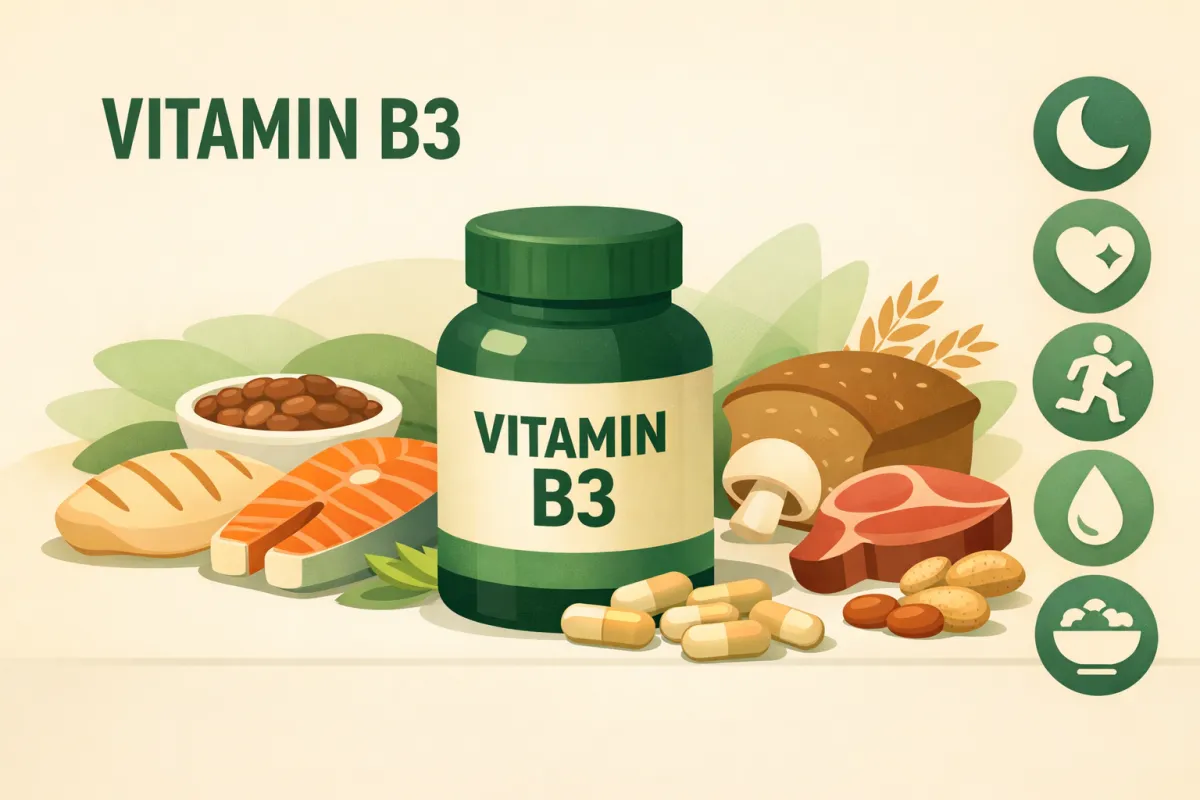
Niacin is common in protein-rich foods such as poultry, fish, and meat. It also shows up in peanuts, mushrooms, legumes, whole grains, and fortified grain products. Your body can also make some niacin from tryptophan, an amino acid in dietary protein.
What it is not:
Vitamin B3 is not an electrolyte, not a stimulant, and not a direct “fat burner”. It is also not the same as “niacin flush supplements” used in high-dose cholesterol therapy. Those protocols are pharmacologic doses and carry different risk profiles.
Who is Vitamin B3 for
Who’s most likely to benefit
People with low dietary intake (very restrictive diets, low protein intake, limited fortified foods) are most likely to benefit from ensuring adequate B3. Older adults may also benefit from higher-dose “NAD support” approaches, although evidence is still early and the most studied forms are NR and NMN.
People with significant sun damage history may benefit from nicotinamide for skin protection protocols that have supportive human data.
Who might not notice much
If you eat a reasonably varied diet with adequate protein and fortified grains, you are probably already meeting baseline requirements. In that scenario, adding a low-dose B3 supplement usually won’t feel dramatic because you are not fixing a bottleneck.
Athletes looking for an acute performance boost generally should not expect B3 to deliver that. In fact, taking nicotinic acid right before endurance exercise may impair fat use as fuel.
Who should be cautious
People with liver disease, active gout, uncontrolled diabetes, or a history of peptic ulcers should be cautious with higher doses. Anyone taking statins, blood thinners, or diabetes medications should treat high-dose niacin as a medical decision, not a casual supplement.
TLDR
• Vitamin B3 (niacin) is a water-soluble vitamin your body uses to make NAD+ and NADP+.
• NAD+ and NADP+ help your cells produce energy, handle oxidative stress, and support repair systems.
• Most people meet baseline needs through food, especially if they eat protein-rich foods and fortified grains.
• Nicotinamide (niacinamide) is usually the best default supplement form because it avoids flushing.
• Nicotinic acid often causes flushing. This is usually harmless but unpleasant.
• High-dose niacin can improve cholesterol numbers, but large trials did not show fewer heart attacks or strokes when added to statin therapy.
• Higher doses can stress the liver, raise blood sugar, and trigger gout in susceptible people.
• For sleep quality and aging related outcomes, the strongest early human research tends to use NR or NMN, but they are expensive and the evidence base is still developing.
• Do not take high-dose niacin without medical supervision, especially above typical daily value amounts.
What people take Vitamin B3 for
Correcting low intake and preventing deficiency (pellagra)
Cholesterol and triglyceride management (high-dose, medical use)
Energy, fatigue, and “low drive”
Sleep quality (mainly in older adults, early evidence)
Stress resilience and anxiety support (mixed, dose dependent)
Skin protection and sun damage support (nicotinamide)
Exercise performance (not a recommended use case)
1. Correcting low intake and preventing deficiency (pellagra)
Efficacy: Very positive
Who primarily benefit: People with severe dietary restriction, malnutrition, alcoholism, malabsorption, or other risk factors for deficiency.
What the evidence suggests: Vitamin B3 deficiency can cause pellagra, classically described as dermatitis, diarrhoea, and cognitive symptoms. Restoring niacin intake resolves deficiency symptoms because niacin is required for core cellular energy and repair pathways.
Typical protocol used: Dietary correction plus supplemental B3 under clinical guidance, often in the tens of milligrams per day range depending on severity.
Practical expectation: If deficiency is present, improvements are meaningful. If deficiency is not present, you won’t “feel” pellagra prevention.
2. Cholesterol and triglyceride management (high-dose, medical use)
Efficacy: Positive for lipid markers, neutral for cardiovascular outcomes
Who primarily benefit: People with dyslipidaemia who are managed by a clinician and have a specific reason to use niacin.
What the evidence suggests: High-dose niacin can raise HDL and lower triglycerides and LDL. However, large clinical trials found that improving cholesterol numbers with high-dose niacin did not translate into fewer heart attacks or strokes when added to statin therapy. This is a key reminder that lab markers and real-world outcomes do not always match.
Typical protocol used: Pharmacologic dosing (often in the 1,500 to 2,000 mg per day range of extended-release nicotinic acid) under medical supervision, with monitoring.
Practical expectation: You may see improved lipid panels, but you should not assume this reduces cardiovascular risk. Side effects are common at these doses.
3. Energy, fatigue, and “low drive”
Efficacy: Positive if intake is low, neutral if intake is already adequate
Who primarily benefit: People with low dietary intake, chronically poor nutrition, or older adults with low energy where overall micronutrient status is part of the problem.
What the evidence suggests: B3 is required to convert food into ATP, so deficiency or low intake can contribute to fatigue. Human evidence for B3 as a stand-alone anti-fatigue supplement is limited, but the mechanism is strong and B-complex studies suggest fatigue-related markers can improve when baseline intake is insufficient.
Typical protocol used: 10 to 30 mg per day for “gap filling” or broader B-complex support. In some protocols aimed at NAD+ support, 250 to 500 mg per day is used, mainly with NR or NMN forms.
Practical expectation: If you were low, you may feel steadier energy within a few weeks. If you were not low, you may feel nothing obvious.
4. Sleep quality (mainly in older adults, early evidence)
Efficacy: Positive (modest)
Who primarily benefit: Older adults with poor sleep quality, especially where sleep efficiency is low.
What the evidence suggests: Early human trials suggest certain B3 forms (notably NMN in some studies) may improve sleep quality and efficiency over 8 to 12 weeks in older adults. Animal data also suggests NAD+ related pathways interact with circadian biology, but human data is still limited.
Typical protocol used: 250 to 500 mg per day (often NR or NMN) for 8 to 12 weeks.
Practical expectation: Expect subtle improvements in sleep quality, not a sedative effect. If sleep is disrupted by sleep apnoea, pain, or stress overload, B3 is unlikely to be enough on its own.
5. Stress resilience and anxiety support (mixed, dose dependent)
Efficacy: Neutral to positive (individual response varies)
Who primarily benefit: People under chronic stress who have poor nutrition, and some anxiety-prone individuals who respond to nicotinamide.
What the evidence suggests: Mechanistically, B3 supports neurotransmitter pathways and nervous system function. Clinical evidence for anxiety is mostly case reports and small observational work, often using higher doses of nicotinamide. That means it may help some people, but it is not a reliable primary treatment.
Typical protocol used: 250 to 500 mg per day nicotinamide as a starting range for 6 to 12 weeks, sometimes titrated higher under supervision.
Practical expectation: If it helps, it usually feels like a small reduction in baseline tension and reactivity over weeks, not an immediate calming effect.
6. Skin protection and sun damage support (nicotinamide)
Efficacy: Positive
Who primarily benefit: People with a history of significant sun exposure, actinic keratoses, or a high burden of sun damage risk.
What the evidence suggests: Nicotinamide has supportive human trial evidence for reducing some markers of sun damage and actinic keratoses. It appears to support cellular repair capacity in skin exposed to UV stress.
Typical protocol used: Often 500 mg per day in divided doses in clinical protocols, commonly for 8 to 12 weeks or longer based on clinician guidance.
Practical expectation: This is not a cosmetic “glow” supplement. The goal is long-term skin protection and reduced lesion formation risk.
7. Exercise performance (not a recommended use case)
Efficacy: Negative for acute endurance performance in some settings
Who primarily benefit: Most people do not benefit. Older adults aiming for broader NAD+ support may see small improvements over time, but the evidence is early.
What the evidence suggests: Acute nicotinic acid can reduce fat mobilisation and fat oxidation, which can impair endurance performance. B3 is essential for energy metabolism, but more is not always better, especially right before training.
Typical protocol used: If used at all, avoid acute pre-workout dosing. Use consistent daily dosing instead, particularly in older adults where NAD+ support is the aim.
Practical expectation: Do not expect a performance boost. If anything, you may feel worse during endurance sessions if you take nicotinic acid close to training.
When it’s not worth taking Vitamin B3
If you already meet baseline intake through food and you have no specific goal (such as clinician-guided lipid therapy or skin protection), supplementing B3 is often low ROI.
If you have diabetes, gout, liver disease, or you are combining high-dose niacin with statins or blood thinners, the risk profile rises quickly and self-experimentation becomes a poor decision.
If your goal is hydration, electrolyte balance, or an immediate performance boost, B3 is not the tool. Focus on sleep, nutrition basics, hydration strategy, and training programming first.
Nuances and individual differences
Baseline status changes everything
Vitamin B3 is a perfect example of “baseline matters”. If you are low, correcting intake can meaningfully improve energy, skin, gut function, and cognition. If you are not low, adding more often produces little benefit and may only add side effects.
A practical way to think about it: B3 supports the engine, but it does not replace fuel, sleep, or training. If your fundamentals are weak, your results will be limited.
Special populations
Pregnancy and breastfeeding: Baseline intake targets are higher during pregnancy and breastfeeding, but high-dose supplementation is not a default. Stick to food-first and prenatal guidance unless a clinician advises otherwise.
Children and adolescents: Deficiency prevention is the focus. Avoid high-dose experiments.
Older adults: This is the group where NAD+ support strategies (often using NR or NMN) are most discussed. Evidence is still early, but older adults may see modest improvements in sleep quality, energy, and physical function over 8 to 12 weeks.
Liver or kidney disease: High-dose niacin can be risky, especially sustained-release forms. Avoid without clinician oversight.
Psychiatric medication use: If you take SSRIs, benzodiazepines, or other psychiatric medications, treat higher-dose nicotinamide as something to discuss with your prescriber.
Co-nutrients and stacking
B3 works as part of a broader micronutrient system. If you are using B3 for energy and fatigue support, it often makes sense to also ensure adequate intake of:
• Other B vitamins (especially B1, B2, B6, B12, and folate), because energy metabolism is a team sport.
• Magnesium, because many energy-related enzymes require it.
• Protein, because tryptophan and overall amino acid intake support the niacin pathway and recovery.
The goal is not to stack more supplements. The goal is to remove the few bottlenecks that keep your biology from running smoothly.
Testing and monitoring
Routine testing is not usually needed for low-dose supplementation. If you are using high-dose niacin (especially sustained-release forms), clinician-guided monitoring is appropriate, including liver enzymes and metabolic markers.
How to take Vitamin B3 (Niacin)
Simple starter approach
If you want a conservative, low-risk approach, start with nicotinamide (niacinamide) 10 to 30 mg per day with a meal for 4 weeks. This is a “gap-filling” dose that supports baseline needs without aiming for pharmacologic effects.
If you are specifically aiming for sleep quality or aging related NAD+ support and you are comfortable with higher cost, consider a time-limited trial of NR or NMN 250 mg per day for 8 to 12 weeks, then reassess.
Typical dose range
For baseline support, 10 to 30 mg per day is a common range.
For sleep quality or NAD+ support protocols in older adults, 250 to 500 mg per day is commonly used in research contexts, usually with NR or NMN. For stress and anxiety protocols reported in case literature, nicotinamide is sometimes used in the 250 to 1,000 mg per day range, with higher dosing requiring supervision due to safety considerations.
For cholesterol management, doses are far higher (often 1,500 to 2,000 mg per day of extended-release nicotinic acid) and this should be considered medical therapy, not routine supplementation.
Timing
Timing matters less than consistency for baseline support. Take B3 with food if you are prone to stomach upset.
If you are using a higher-dose nicotinamide protocol for relaxation or sleep support, evening dosing can be a sensible default. If you are using nicotinic acid and you experience flushing, taking it with food and avoiding alcohol can reduce intensity.
If you do endurance training, avoid nicotinic acid close to workouts because it may reduce fat availability as fuel.
Loading vs maintenance or cycling
B3 does not require loading. Your body recycles NAD+ continuously. Most people do best with a steady daily intake.
If you are trialling higher-dose NR or NMN, a practical cycle is 8 to 12 weeks on, followed by a reassessment period. The point is to evaluate whether you have a meaningful, real-world improvement, not to stay on an expensive protocol by default.
Duration to see effects
For baseline energy support, allow 2 to 4 weeks to notice steadier energy, if low intake was part of the problem.
For sleep quality, allow 4 to 8 weeks, with some protocols running 12 weeks.
For skin protection protocols, 8 to 12 weeks is a common minimum window.
For cholesterol and triglyceride changes in medical use, measurable changes can occur within 4 to 8 weeks, but risks and monitoring also matter.
Forms and whether form matters
For most people, nicotinamide (niacinamide) is the best default because it provides vitamin function with minimal flushing risk.
Nicotinic acid is the form most associated with flushing and is the classic form used in high-dose lipid therapy. Sustained-release forms may reduce flushing but can increase liver risk at higher doses.
NR and NMN are newer forms that are often marketed for NAD+ support. They are promising but not essential. Human data exists, but it is still early and not definitive across outcomes. They may be most reasonable for older adults trialling sleep quality and energy support, especially if fundamentals are already strong.
Food vs supplement
For many people, food can cover baseline needs. A diet with adequate protein plus some whole grains, legumes, or fortified foods typically provides sufficient niacin and tryptophan to prevent deficiency.
Supplements make the most sense when diet is limited, when a clinician recommends a specific therapeutic protocol, or when an older adult is trialling a targeted NAD+ strategy with realistic expectations.
Safety and side effects
Common side effects
Flushing (mostly with nicotinic acid): A warm, red, tingling sensation on the face, neck, or chest. It is usually harmless but uncomfortable. Taking it with food, starting with a low dose, and avoiding alcohol can reduce it.
Stomach upset: Nausea, heartburn, or cramping can occur, especially with higher doses. Taking with food often helps.
Headache or dizziness: Usually transient and more common at higher doses.
Serious risks (rare, but important)
Liver stress and liver injury: Risk rises with high doses, particularly sustained-release forms. Red flags include yellowing skin or eyes, dark urine, pale stools, upper right abdominal pain, or unusual fatigue.
Blood sugar disruption: High-dose nicotinic acid can worsen insulin resistance and raise blood glucose. People with diabetes or prediabetes should avoid high-dose protocols unless supervised.
Gout flare risk: High-dose niacin can raise uric acid, increasing gout risk in susceptible individuals.
Muscle injury risk when combined with statins: Rare but important. If you combine high-dose niacin with statins, the risk of muscle injury increases. This should only be done under medical supervision.
Contraindications and caution groups
Pregnancy and breastfeeding should stick to baseline intake unless a clinician advises otherwise.
Use caution or avoid higher-dose niacin if you have liver disease, active gout, uncontrolled diabetes, peptic ulcers, or significant bleeding risk.
Interactions
High-dose niacin can interact with:
• Statins (increased muscle injury risk)
• Blood thinners or antiplatelet agents (potential bleeding risk changes)
• Diabetes medications (blood sugar control can worsen)
• Blood pressure medications (blood pressure may drop further in some people)
• Alcohol (increases flushing and liver strain)
For athletes: anti-doping and contamination risk
Vitamin B3 itself is not prohibited in sport. The real risk is supplement contamination or adulteration. If you compete in drug-tested sport, choose products that are batch-tested under reputable programmes and treat any multi-ingredient pre-workout as higher risk.
Batch-tested means each production batch is tested. Company-tested often means the company self-reports quality checks, which is not the same as independent verification.
Quality checklist (buying guide)
What to look for on labels
Look for clear naming and dosing, such as “nicotinamide (niacinamide)” or “nicotinic acid (niacin)”, with the dose in milligrams per serving.
Prefer products that state the form clearly, list minimal fillers, and include a batch number and expiry date. If you are specifically avoiding flushing, choose nicotinamide or NR/NMN rather than nicotinic acid.
Third-party testing and certifications
Third-party testing means an independent organisation has tested the product and or audited manufacturing to verify label claims and screen for contaminants. No certification can guarantee a supplement is completely free of all risks, but reputable testing can meaningfully reduce common quality problems.
If you compete in drug-tested sport, supplement use always carries some risk because products can be contaminated or adulterated with prohibited substances. If you choose to use supplements anyway, prioritise products that are batch-tested under recognised anti-doping focused programmes such as NSF Certified for Sport, Informed Sport, Informed Choice, or BSCG Certified Drug Free.
For general quality assurance (identity, purity, potency, and contaminant screening), look for verification or certification programmes such as USP Verified, NSF/ANSI 173 certification, or a ConsumerLab quality seal. Some categories also have specialised quality programmes, for example IFOS for fish oil. If a company claims testing, ask for a recent Certificate of Analysis (COA) for the exact batch you are buying.
Red flags
• ❌ No batch number and no expiry.
• ❌ No COA available on request.
• ❌ “Proprietary blend” with no exact amounts.
• ❌ Unrealistic health claims.
• ❌ Very cheap pricing vs market norms.
Storage and stability
Store B3 supplements in a cool, dry place away from heat and direct sunlight. Water-soluble vitamins are generally stable, but heat and moisture can degrade potency over time. Use products before the expiry date, especially gummies and drink powders.
The Five Pillar impact analysis of Vitamin B3 (Niacin)
Five Pillar overview
Vitamin B3 supports the foundations that make healthy habits work. It is not a “fix” on its own, but it can remove bottlenecks when basic intake is low.
The strongest pillar link is Nutrition, because B3 is a core nutrient required for energy metabolism, antioxidant defence, and cellular repair. When intake is low, everything downstream suffers.
Sleep and stress may improve modestly in some groups, particularly older adults using NR or NMN for NAD+ support. Exercise performance is not enhanced acutely and may be impaired if nicotinic acid is taken close to endurance training. Hydration is neutral because B3 is not an electrolyte or hydration tool.
Five Pillar impact table

Five Pillar detailed review
Sleep
Pillar verdict (practical): Vitamin B3 is not a sleep supplement in the classic sense. In older adults, certain B3 forms may modestly improve sleep quality over weeks by supporting cellular energy and circadian biology.
What it may improve:
• Sleep efficiency (more time asleep while in bed)
• Subjective sleep quality in older adults
• Resilience to sleep loss in mechanistic models
Practical protocol:
• If trialling sleep support: NR or NMN 250 mg daily for 8 to 12 weeks
• Take in the evening as a default, especially if your goal is sleep quality
• Track a simple outcome: sleep quality rating and daytime energy
When it’s not worth it:
• You already sleep well
• Your main issue is sleep apnoea, pain, or uncontrolled stress
• Cost is a limiting factor and diet already covers baseline B3
Stress
Pillar verdict (practical): B3 may help stress tolerance indirectly by supporting nervous system function and energy metabolism. Evidence for anxiety support is mixed and individual response varies.
What it may improve:
• Baseline stress tolerance in people with poor nutrition
• “Battery level” stability across the day
• Subjective calmness in some nicotinamide responders
Practical protocol:
• Nicotinamide 250 mg daily for 2 weeks, then consider 250 mg twice daily
• Run a 6 to 12 week trial
• Pair with fundamentals: sleep consistency, light exposure, daily movement
When it’s not worth it:
• You need fast relief for severe anxiety
• You are already well nourished and stable
• You are on complex psychiatric medication without clinician support
Exercise
Pillar verdict (practical): Adequate B3 supports exercise capacity because it supports energy metabolism. Extra B3 is not an acute performance enhancer and nicotinic acid close to endurance training can backfire.
What it may improve:
• Long-term training tolerance if you were low in micronutrients
• Recovery markers indirectly when used as part of a broader B-complex approach
• Modest physical function outcomes in older adults in early trials
Practical protocol:
• Use food-first plus a low-dose B-complex if diet quality is inconsistent
• If trialling NAD+ support: NR or NMN 250 mg daily for 8 to 12 weeks
• Do not take nicotinic acid within several hours of endurance sessions
When it’s not worth it:
• You are using it for a pre-workout boost
• You are already meeting micronutrient needs consistently
• You have side effects that reduce training quality
Hydration
Pillar verdict (practical): Vitamin B3 is not a hydration supplement.
Nutrition
Pillar verdict (practical): This is where B3 matters most. Adequate intake supports energy production, antioxidant defence, and normal gut and brain function. If your nutrition is inconsistent, B3 can be a practical “minimum viable micronutrient” alongside the rest of the B family.
What it may improve:
• Energy metabolism and fatigue related symptoms when intake is low
• Skin and gut resilience in deficiency states
• Cellular repair capacity under oxidative stress
Practical protocol:
• Food-first: protein foods plus legumes, whole grains, and fortified foods
• If needed: nicotinamide 10 to 30 mg daily with food for 4 weeks
• Reassess diet quality before escalating supplement dose
When it’s not worth it:
• You already eat a varied diet with adequate protein
• You are chasing a pharmacologic effect without clinician oversight
• You have diabetes or gout and want high-dose niacin
FAQ
Does the niacin flush mean it is working?
Not necessarily. Flushing is mostly a property of nicotinic acid and how it affects blood vessels in the skin. It tells you about that side effect, not about NAD+ production or long-term benefits.
Is niacinamide the same as niacin?
They are both forms of vitamin B3. Niacinamide (nicotinamide) usually causes less flushing and is the better default for general supplementation.
Are NR and NMN worth it?
For most healthy adults, they are optional. For older adults trialling sleep quality or general NAD+ support, they may be worth a time-limited experiment, but the evidence base is still early and cost is high.
Can I use niacin to lower cholesterol?
High-dose niacin can improve cholesterol numbers, but it should be considered medical therapy because side effects and risks increase with dose. Also, improved lab markers have not consistently translated into fewer cardiovascular events when used alongside statins.
Can vitamin B3 raise blood sugar?
At high doses, yes, especially with nicotinic acid. If you have diabetes or prediabetes, avoid high-dose niacin unless supervised.
Can I take niacin with statins?
This combination increases the risk of muscle injury at higher niacin doses. Do not combine high-dose niacin with statins unless a clinician is guiding and monitoring the plan.
This article is for educational purposes only. It is not medical advice and it is not prescriptive.
Supplements can vary widely in quality and contamination risk, including products that are not tested for banned substances and products that contain concentrated plant, herb, or mushroom extracts.
If you are a competitive athlete, in a drug-tested sport, have a complex medical history, are pregnant or breastfeeding, take medications, or have a diagnosed health condition, prioritise direct guidance from a qualified professional who can advise you within the context of your specific needs.
Even if you are otherwise healthy, consult a qualified practitioner before making major health or lifestyle changes, including starting new supplements, changing dose significantly, or combining multiple supplements.
