
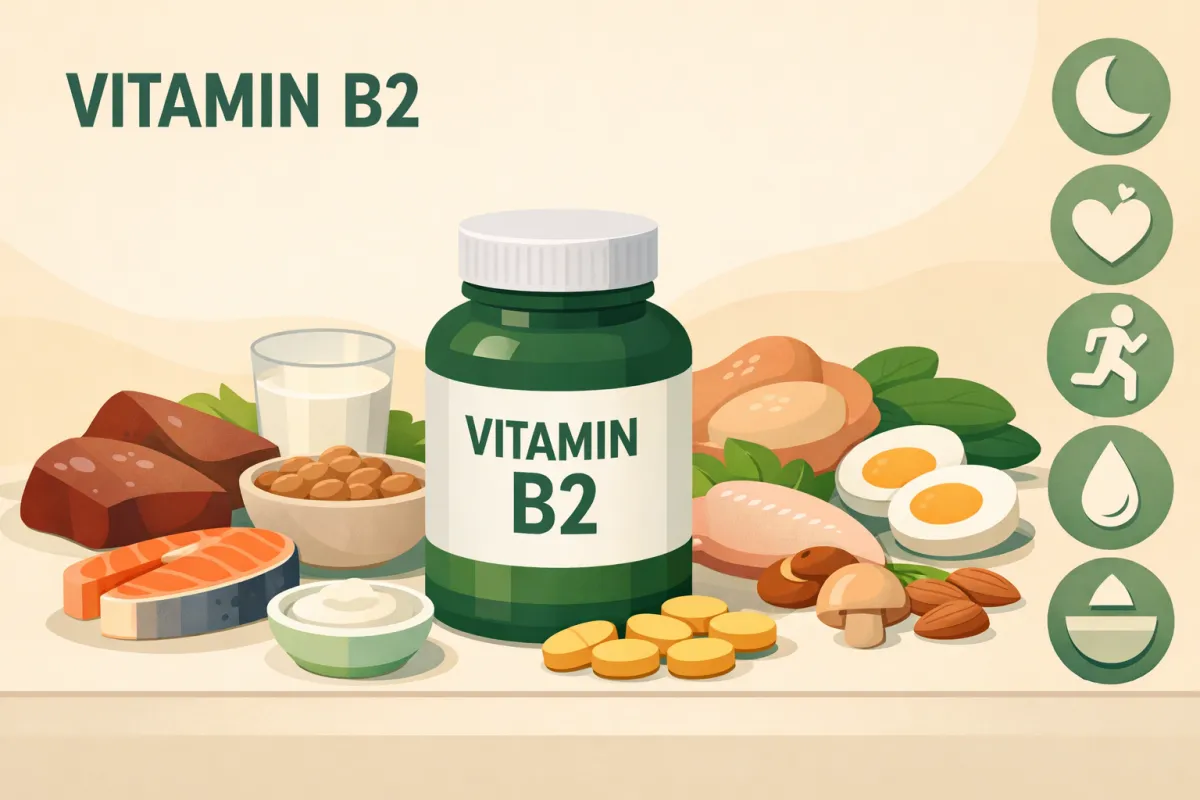
Vitamin B2 (Riboflavin)
What is Vitamin B2 (Riboflavin)
Vitamin B2, also called riboflavin, is a water-soluble vitamin your body uses to turn food into usable energy. It helps your cells run day to day, especially in your mitochondria (your cells’ energy factories).
Riboflavin is converted into two helper molecules called FMN and FAD. These act like “plug-in parts” for enzymes, allowing many biological reactions to work. Roughly 90 human proteins depend on these cofactors.
Because riboflavin is water-soluble, your body does not store much of it. Excess is excreted in urine, which is why supplements often cause bright yellow urine.
Natural food sources include:
Beef liver and organ meats
Fortified breakfast cereals and enriched grains
Milk, yogurt, and cheese
Eggs, chicken, lean beef, pork
Fish and shellfish (for example salmon, clams)
Mushrooms, spinach, almonds
Common supplement forms include:
Riboflavin (free riboflavin)
Riboflavin-5-phosphate (FMN)
FAD
In practice, these forms perform similarly because they are converted to free riboflavin before absorption.
What it is not
It is not a stimulant. If you feel more energetic, it is usually because you were low to begin with or because overall nutrition improved. It is not a fat burner or appetite suppressant. It is not a substitute for good sleep, adequate calories, or a balanced diet.
Who is Vitamin B2 for
Who is most likely to benefit
Migraine prevention: Adults with episodic migraines who can commit to a consistent daily protocol for at least 3 months.
Low or borderline intake: People with limited dairy/animal foods, low diet quality, restrictive eating patterns, or poor appetite.
Higher demand lifestyles: Endurance athletes or people under sustained metabolic load, where maintaining adequacy matters.
Malabsorption risk: People with conditions that may reduce absorption (for example celiac disease, Crohn’s disease), with clinician guidance.
Who might not notice much
People who already eat fortified grains and dairy (or a balanced diet) and have no specific reason to use a higher dose. People expecting an immediate “energy boost” without addressing sleep, calories, hydration, and training load.
Who should be cautious
Pregnancy and breastfeeding: Meeting the standard dietary requirement is appropriate, but high-dose protocols (for example 400 mg/day) have limited safety data in pregnancy. Use clinician guidance.
Significant malabsorption: You may need medical supervision for higher doses.
Medication considerations: If you take theophylline (asthma/COPD) or have chronic alcohol intake, riboflavin status can be affected. Discuss with a clinician.
TLDR
Vitamin B2 (riboflavin) helps your body convert food into energy and supports antioxidant defenses via glutathione recycling.
It is best known as a low-risk, evidence-supported option for migraine prevention in adults.
The standard migraine protocol is 400 mg daily for at least 3 months.
For stress and sleep, the best evidence is for riboflavin plus thiamine (B1) at 100 mg each daily for 4 weeks.
For exercise performance, benefits are modest and most relevant if intake is low or demand is high.
Bright yellow urine is expected and harmless at higher intakes.
Form usually does not matter (riboflavin vs FMN vs FAD) because absorption converts them to riboflavin anyway.
If your diet is already strong, the highest ROI use case is usually migraine prevention, not general “more energy.”
What people take Vitamin B2 for
1. Migraine prevention
2. Sleep quality and perceived stress (usually with B1)
3. Exercise performance and fatigue resistance (often as part of a B-complex)
4. General energy and fatigue (mainly when intake is low)
5. Bone health support (early evidence)
6. Blood sugar support (early evidence)
1. Migraine prevention
Efficacy: Positive
Who primarily benefit: Adults with episodic migraines who are willing to take it daily and track results over time.
What the evidence suggests: Consistent riboflavin supplementation can reduce migraine frequency and severity for many people. Effects tend to build gradually, often noticeable by about 1 month, with maximal benefit closer to 3 months. Response is not universal, but a meaningful proportion of users achieve a large reduction in headache days.
Typical protocol used: 400 mg daily for at least 3 months.
Practical expectation: Fewer migraine days, reduced intensity, and shorter attacks. If nothing changes by 12 weeks, it is less likely to be worth continuing as a stand-alone strategy.
2. Sleep quality and perceived stress (usually with B1)
Efficacy: Positive (when combined with vitamin B1); Neutral for B2 alone
Who primarily benefit: Adults with mild sleep disturbance and elevated perceived stress, especially during demanding life periods.
What the evidence suggests: A small controlled trial found that riboflavin paired with thiamine improved sleep quality scores and reduced perceived stress over 4 weeks. Anxiety scores did not meaningfully improve, so this should not be framed as an anxiety treatment. This is best thought of as “supporting the foundations” rather than a sedative effect.
Typical protocol used: Riboflavin 100 mg plus thiamine (B1) 100 mg daily for 4 weeks, then reassess.
Practical expectation: Slightly easier sleep onset, fewer restless nights, and a lower sense of being overwhelmed. If you are looking for rapid relief, this is usually too slow acting to be your only tool.
3. Exercise performance and fatigue resistance
Efficacy: Neutral to Positive (modest; context dependent)
Who primarily benefit: Endurance athletes, high-volume trainees, and people with marginal intake who want to support energy metabolism.
What the evidence suggests: Studies using B-complex formulas (that include riboflavin) suggest small improvements in endurance capacity and reduced build-up of fatigue-related markers after sustained exercise. Riboflavin deficiency clearly impairs aerobic performance, but supplementing above adequacy is not a guaranteed performance enhancer.
Typical protocol used: 25 to 100 mg daily as part of a B-complex for 28 days or longer.
Practical expectation: Subtle improvements in fatigue resistance, better ability to hold pace late in sessions, and possibly less post-session “crash.” If your diet is already sufficient, the effect may be hard to notice.
4. General energy and fatigue
Efficacy: Positive for deficiency; Neutral to slightly positive for most adequately nourished adults
Who primarily benefit: People with low intake, malabsorption risk, chronic alcohol use, or generally poor diet quality.
What the evidence suggests: Riboflavin is essential for ATP production, so inadequate intake can show up as low energy, reduced exercise tolerance, and slower recovery. In people who already meet needs, taking more is not consistently associated with large energy changes.
Typical protocol used: Meet dietary needs daily (roughly 1.0 to 1.3 mg/day for adults) through food, or use a low-dose supplement around the daily requirement.
Practical expectation: If you were low, energy and resilience can improve over 1 to 2 weeks. If you were already adequate, you may notice little.
5. Bone health support
Efficacy: Neutral to Positive (early evidence)
Who primarily benefit: Older adults and postmenopausal women focused on long-term bone resilience, especially if dietary intake is low.
What the evidence suggests: Observational data links higher dietary riboflavin intake with lower osteoporosis risk. This does not prove riboflavin supplements prevent bone loss, but it supports the idea that adequate riboflavin is part of a bone-supportive nutrition baseline.
Typical protocol used: Prioritize riboflavin-rich foods regularly; consider an RDA-level supplement if intake is consistently low.
Practical expectation: This is not something you “feel.” Think long-term baseline support, not an acute effect.
6. Blood sugar support
Efficacy: Neutral to Positive (early evidence; mostly dietary intake data)
Who primarily benefit: People at risk of type 2 diabetes who are improving overall diet quality and want to cover micronutrient basics.
What the evidence suggests: Higher dietary riboflavin intake is associated with lower diabetes risk in large population studies. Supplement trials are limited and mixed, so riboflavin should not be used as a primary blood sugar intervention.
Typical protocol used: Meet daily needs through diet; consider a low-dose supplement if dietary intake is low.
Practical expectation: Do not expect meaningful short-term blood sugar changes from riboflavin alone. Focus on fundamentals first (protein, fiber, sleep, activity).
When it’s not worth taking Vitamin B2
If your only goal is a fast, noticeable “energy boost.”
If you already meet daily needs through fortified foods and dairy/eggs, and you do not have migraines or another specific indication.
If you want it as a stand-alone anxiety treatment.
If you are pregnant and considering high-dose protocols without clinician oversight.
If you are avoiding foundational changes (sleep, nutrition quality, hydration, training load) and hoping riboflavin will compensate.
Nuances and individual differences
Genetics and responder differences
Rare genetic issues involving riboflavin transport can cause severe neurological symptoms and are treated with high-dose riboflavin under specialist care. This is not a self-diagnosis category. The practical takeaway is simple: if symptoms are serious, progressive, or unusual, this is a medical situation, not a supplement experiment.
Baseline status changes everything
Riboflavin is a “foundation nutrient.” If you are low, correcting intake can make a meaningful difference in energy, resilience, and exercise tolerance. If you are already adequate, going far above daily needs often produces little benefit unless you are targeting a specific outcome such as migraine prevention.
Special populations
Pregnancy and breastfeeding: Daily requirements increase, so meeting adequacy matters. High-dose protocols have limited safety data, so use clinician guidance.
Children and adolescents: Follow age-appropriate dietary targets. Pediatric migraine protocols exist in research, but dosing should be clinician-led.
Older adults: Riboflavin status can be lower due to diet quality or appetite changes. RDA-level supplementation can be reasonable if food intake is inconsistent.
Malabsorption conditions: Absorption occurs in the small intestine, so disorders affecting this area may reduce uptake. Clinician guidance is appropriate, especially for higher-dose protocols.
Co-nutrients and stacking
For stress and sleep outcomes, riboflavin appears to work best with thiamine (B1). For migraine prevention, some products combine riboflavin with magnesium and CoQ10. Combination formulas may be useful in practice, but it can be hard to know which ingredient drives the effect. If you want a clean trial, start with riboflavin alone.
How to take Vitamin B2
Simple starter approach
If you are a generally healthy adult and you are not using riboflavin for migraine prevention, start by ensuring you meet daily needs through food. If your diet is inconsistent or restrictive, consider a low-dose supplement close to the daily requirement. Run the trial for 2 to 4 weeks, then decide if it is doing anything meaningful.
If your goal is migraine prevention, treat it like a structured experiment: choose a consistent daily dose, track migraine days and severity, and commit to a full 12-week trial.
Typical dose range
For daily adequacy, most adults aim for roughly 1.0 to 1.3 mg per day (higher in pregnancy and breastfeeding).
For specific goals:
Migraine prevention: 400 mg daily for at least 3 months.
Stress and sleep (with B1): 100 mg riboflavin plus 100 mg thiamine daily for 4 weeks.
Exercise support (often in B-complex): 25 to 100 mg daily for 28 days or longer.
Higher doses are generally well tolerated, but higher dose does not automatically mean better results unless the outcome is dose-supported (for example migraines).
Timing
Timing is not highly sensitive for most outcomes. A practical default is to take riboflavin with breakfast or another meal for consistency and to reduce any chance of stomach upset. For migraine prevention, consistency matters far more than time of day.
Loading vs maintenance
Riboflavin does not require a loading phase. Daily consistency is the main driver. If you miss a day, resume the next day and continue tracking.
Duration to see effects
Migraine prevention: some change may appear around 4 weeks, with best assessment at 12 weeks.
Stress and sleep (with B1): assess at 4 weeks.
Exercise performance: assess after about 28 days.
Low intake correction: energy and general symptoms may improve in 1 to 2 weeks.
Forms and whether form matters
Most people can choose based on quality and cost because common forms appear to be used similarly:
Riboflavin (free riboflavin)
Riboflavin-5-phosphate (FMN)
FAD
Phosphorylated forms and FAD are broken down before absorption, so they are not automatically “more active” in the body. If you are taking 400 mg/day for migraines, prioritize a product with stable, consistent dosing and light-protective packaging rather than paying extra for a specialty form.
Food vs supplement
Many people can meet daily needs through food, especially with fortified grains plus dairy or eggs. Supplements become more relevant when:
You are on a restrictive diet with low riboflavin intake.
You have absorption concerns.
You are using the evidence-supported high-dose migraine protocol.
Safety and side effects
Common side effects
Bright yellow or orange urine is common and harmless. It is simply excess riboflavin being excreted.
Less common effects, typically at higher doses:
Mild nausea or stomach upset (taking with food often helps)
Increased urination
Diarrhea (rare; more likely at very high intakes)
Serious risks (rare, but important)
Riboflavin has an excellent safety profile and serious adverse effects are not well documented at typical supplement doses. If you experience unexpected symptoms that are severe, persistent, or concerning, stop the supplement and seek medical advice.
Contraindications and caution groups
Pregnancy and breastfeeding: Adequacy is appropriate. High-dose protocols have limited safety data, so use clinician guidance.
Significant malabsorption disorders: May require clinician oversight for dosing.
Genetic riboflavin transporter disorders: High-dose riboflavin can be therapeutic, but treatment must be specialist-supervised.
Interactions
Theophylline: May increase riboflavin loss in urine.
Chronic alcohol intake: Can reduce absorption and disrupt metabolism, increasing deficiency risk.
Other B vitamins: Generally compatible and often synergistic in practice.
Photosensitising medications: There is a theoretical concern at very high doses, but clinically meaningful issues are not well documented.
For athletes: anti-doping and contamination risk
Riboflavin itself is not a prohibited substance. The real risk is contamination or adulteration of supplements in general. If you compete in drug-tested sport, prioritize products that are batch-tested under recognised anti-doping programmes, and avoid products with proprietary blends or unclear sourcing.
Quality checklist (buying guide)
What to look for on labels
Look for:
“Riboflavin” or “Vitamin B2” clearly listed
A clear dose per serving (know if you are buying 1 to 2 mg vs 100 mg vs 400 mg)
A form listed (riboflavin, riboflavin-5-phosphate, or FAD), though form is usually not the deciding factor
An expiry date and batch number
Simple excipients and clear allergen information if relevant
Third-party testing and certifications
Third-party testing means an independent organisation has tested the product and or audited manufacturing to verify label claims and screen for contaminants. No certification can guarantee a supplement is completely free of all risks, but reputable testing can meaningfully reduce common quality problems.
If you compete in drug-tested sport, supplement use always carries some risk because products can be contaminated or adulterated with prohibited substances. If you choose to use supplements anyway, prioritise products that are batch-tested under recognised anti-doping focused programmes such as NSF Certified for Sport, Informed Sport, Informed Choice, or BSCG Certified Drug Free.
For general quality assurance (identity, purity, potency, and contaminant screening), look for verification or certification programmes such as USP Verified, NSF/ANSI 173 certification, or a ConsumerLab quality seal. Some categories also have specialised quality programmes, for example IFOS for fish oil. If a company claims testing, ask for a recent Certificate of Analysis (COA) for the exact batch you are buying.
Red flags
❌ No batch number and no expiry.
❌ No COA available on request.
❌ “Proprietary blend” with no exact amounts.
❌ Unrealistic health claims.
❌ Very cheap pricing vs market norms.
Storage and stability
Riboflavin is light-sensitive, especially in liquids. Prefer:
Opaque packaging (or dark glass) for liquids
Storage away from sunlight and heat
Clear labeling for storage conditions
If you use gummies or multi-ingredient powders, prioritize reputable brands with stability data and sensible packaging.
The Five Pillar impact analysis of Vitamin B2
Five Pillar overview
Vitamin B2 is mainly a Nutrition foundation supplement. It supports energy metabolism at the cellular level, which indirectly affects how you feel across all pillars. The strongest targeted use case is Migraine prevention, which can meaningfully improve sleep quality and stress resilience simply by reducing migraine burden.
For most people who already meet daily needs, riboflavin is not a dramatic lever. It is best used either to correct low intake or to run the evidence-based migraine protocol.
Five Pillar impact table

Five Pillar detailed review
Sleep
Pillar verdict (practical): Riboflavin can support sleep indirectly by improving migraine control and, when paired with B1, by improving perceived sleep quality in stressed individuals. It is not a sedative and it is not a direct sleep architecture enhancer.
What it may improve
Fewer migraine-driven sleep disruptions (when used for migraine prevention)
Slight improvements in sleep quality scores (when combined with B1)
Better daytime alertness in some stressed individuals (indirect effect)
Practical protocol
If migraines drive poor sleep: 400 mg daily for 12 weeks while tracking migraine days and sleep disruption.
If stress drives poor sleep: 100 mg B2 + 100 mg B1 daily for 4 weeks, then reassess.
Take with breakfast for consistency.
When it’s not worth it
Severe insomnia that needs medical evaluation or structured behavioral therapy.
Sleep apnea or restless legs syndrome (no direct evidence).
Expecting immediate sleep improvement in a few days.
Stress Management
Pillar verdict (practical): Riboflavin can help reduce perceived stress when combined with B1, but it does not reliably treat anxiety. Its role is best described as supporting the metabolic foundations that make stress feel more manageable.
What it may improve
Lower perceived stress scores (with B1)
A greater sense of coping capacity (indirect)
Stress resilience in people whose stress is driven by migraines
Practical protocol
100 mg B2 + 100 mg B1 daily for 4 weeks.
Pair with a simple stress system (daily walk, consistent sleep window, reduced late caffeine).
When it’s not worth it
Acute crisis or panic symptoms (you need faster, targeted support).
Treating diagnosed anxiety disorders as a stand-alone approach.
Exercise
Pillar verdict (practical): Riboflavin is essential for energy metabolism, so adequacy matters. Performance benefits above adequacy exist, but they are modest and most noticeable in endurance contexts or when diet is marginal.
What it may improve
Fatigue resistance during long sessions (small effect)
Post-exercise “crash” in some people (indirect)
Recovery resilience when combined with overall micronutrient adequacy
Practical protocol
First, meet daily intake through food (fortified grains, dairy, eggs, mushrooms).
If intake is inconsistent: use a low-dose supplement near daily needs.
For endurance blocks: consider 25 to 100 mg daily (often in B-complex) for 28 days, then reassess.
When it’s not worth it
Expecting strength or muscle gain improvements.
Using it as a shortcut instead of adequate calories, protein, and sleep.
Hydration
Pillar verdict (practical): Riboflavin is not a hydration supplement. Its contribution is indirect, supporting energy production that powers electrolyte handling. In most cases, sodium, potassium, magnesium, and fluid strategy matter more.
Nutrition
Pillar verdict (practical): This is where riboflavin is most important. It is a foundational nutrient that supports energy production, red blood cell function, antioxidant defenses, and overall metabolic reliability.
What it may improve
Baseline energy if intake was low
Resilience to training and life stress (indirect)
Nutritional completeness in restrictive diets
Practical protocol
Build riboflavin into your “default diet” using fortified grains plus dairy/eggs or riboflavin-rich plant foods.
If your diet makes this difficult, use an RDA-level supplement daily.
Reassess after 2 to 4 weeks.
When it’s not worth it
Using high doses for general wellness when you already meet needs.
Assuming more is always better.
FAQ
Why does Vitamin B2 turn urine bright yellow?
Riboflavin is water-soluble, so your body excretes extra amounts in urine. The color change is expected and harmless.
Is 400 mg/day safe?
For most healthy adults, riboflavin has an excellent safety profile and 400 mg/day is commonly used in migraine research. If you are pregnant, breastfeeding, or have complex medical issues, use clinician guidance.
Do I need to take it with food?
It is not strictly required, but taking it with a meal is a good default to reduce any chance of stomach upset and to build consistency.
Does the form matter (riboflavin vs riboflavin-5-phosphate vs FAD)?
For most people, not much. These forms are converted before absorption, so choose based on product quality and dosing accuracy.
Can I meet my needs from food alone?
Often, yes. Fortified grains plus dairy or eggs cover daily needs for many people. Supplements are most useful for restrictive diets, absorption concerns, or high-dose migraine protocols.
Is Vitamin B2 vegan?
Riboflavin itself can be produced by fermentation and may be suitable for vegans, but excipients and capsule materials vary. Check the label for a vegan statement if this matters to you.
How do I know if I’m low in riboflavin?
Low intake is more likely if your diet lacks fortified grains and dairy/eggs, or if you have absorption issues. If you suspect deficiency, discuss assessment with a clinician rather than guessing.
This article is for educational purposes only. It is not medical advice and it is not prescriptive.
Supplements can vary widely in quality and contamination risk, including products that are not tested for banned substances and products that contain concentrated plant, herb, or mushroom extracts.
If you are a competitive athlete, in a drug-tested sport, have a complex medical history, are pregnant or breastfeeding, take medications, or have a diagnosed health condition, prioritise direct guidance from a qualified professional who can advise you within the context of your specific needs.
Even if you are otherwise healthy, consult a qualified practitioner before making major health or lifestyle changes, including starting new supplements, changing dose significantly, or combining multiple supplements.
