
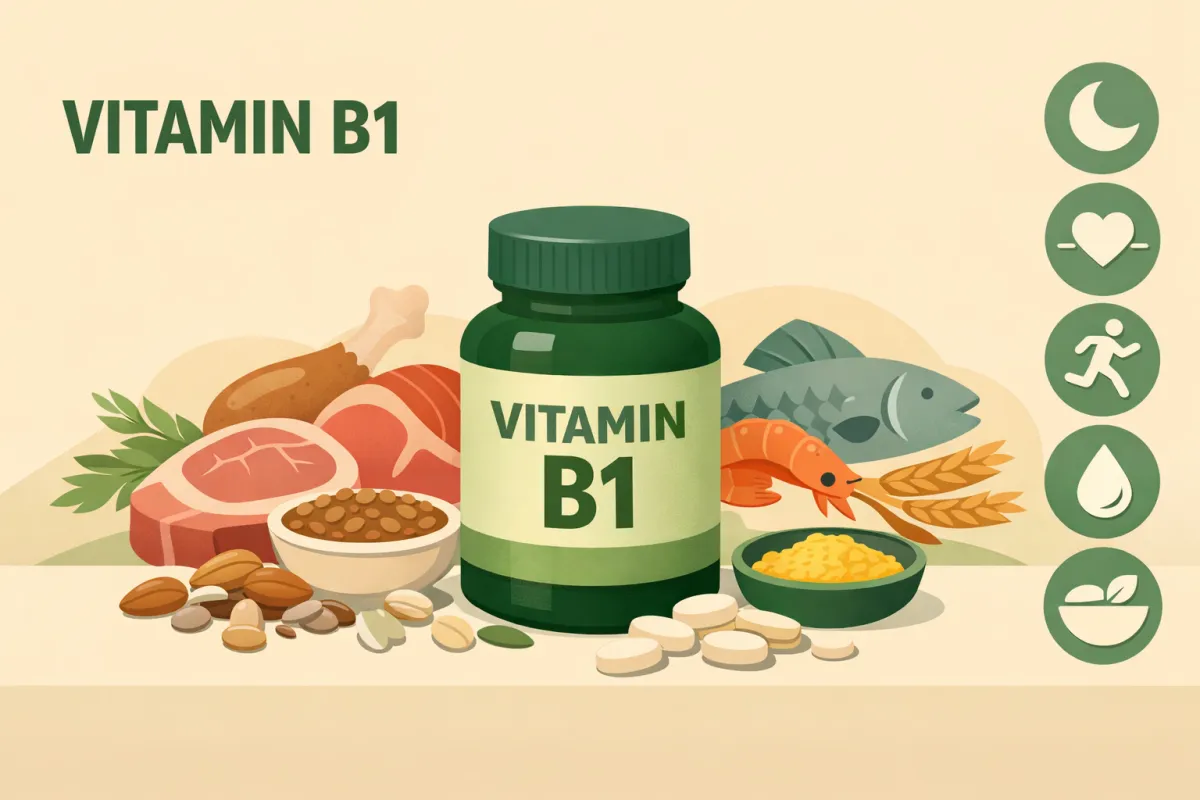
Vitamin B1 (Thiamine)
Vitamin B1 gets framed like an "energy vitamin". That is partly true, but the more useful frame is this: thiamine helps your cells turn food into usable power, and your nervous system depends on that steady power supply.
If you are already getting enough thiamine from food, you may not feel much from adding a supplement. If you are under high metabolic demand, under sustained stress, eating mostly refined carbs, or losing nutrients through alcohol use or certain medications, thiamine can matter a lot.
What is Vitamin B1 (Thiamine)
Vitamin B1, also called thiamine (or thiamin), is a water-soluble B vitamin. Water-soluble means your body does not store much of it for long, so you need regular intake.
Thiamine becomes active after your body converts it into thiamine pyrophosphate (TPP). TPP acts like a helper molecule that allows key enzymes to run energy production pathways.
Natural food sources include pork, fish and seafood, poultry, beef, whole grains, legumes, nuts and seeds, wheat germ, and nutritional yeast. Refined grains contain much less unless they are fortified.
Common supplement forms include thiamine hydrochloride, thiamine mononitrate, and benfotiamine (a fat-soluble derivative that can raise blood thiamine levels more than standard forms at the same labelled dose).
What it is not: thiamine is not a stimulant. It does not act like caffeine, and it does not "force" energy. It supports the machinery that creates energy when the rest of the system is in place.
Who is Vitamin B1 for
Who’s most likely to benefit
People with a higher risk of low thiamine status, higher metabolic demand, or higher losses. Common examples include heavy alcohol use, dialysis, malabsorption or chronic vomiting, very low intake, diets dominated by refined carbohydrates with low micronutrient density, endurance-focused training blocks, and sustained stress with sleep disruption (especially when thiamine is paired with riboflavin, vitamin B2).
Who might not notice much
If you eat a varied diet with regular whole grains or fortified grains plus animal proteins or legumes, you are likely meeting baseline needs. In that case, thiamine can still be a sensible "insurance" nutrient, but noticeable effects are less likely.
Who should be cautious
Thiamine is considered very safe for most people, but you should be thoughtful about supplementation if you have severe kidney disease or are on dialysis (dosing can differ and should be clinician guided), if you have a history of allergic reactions to supplements (rare, but possible), or if you are treating a known deficiency or Wernicke-Korsakoff syndrome (this is medical treatment, often requiring supervised high-dose or injectable thiamine).
TLDR
Vitamin B1 helps convert carbohydrates and certain amino acids into cellular energy.
Your body stores very little, so consistent intake matters more than occasional high doses.
Most people who eat a varied diet will not feel a dramatic effect.
Thiamine matters most when demand is high or intake is low: heavy training, high stress, high refined-carb intake, alcohol use, or absorption problems.
Human trials suggest thiamine combined with vitamin B2 can improve perceived stress and sleep quality over about 4 weeks in stressed people.
Athletic studies using B-complex formulas (including B1) show reduced fatigue markers and improved endurance over about 4 weeks, but B1’s isolated contribution is hard to separate.
Benfotiamine can raise blood thiamine levels more than standard thiamine forms and is often used in higher-dose protocols.
Oral thiamine has no established upper limit because toxicity is not documented at common supplemental doses.
What people take Vitamin B1 for
1. Energy and fatigue
2. Sleep quality in high stress periods
3. Stress management and resilience
4. Exercise endurance and recovery support
5. Premenstrual syndrome support
6. Cognitive support in older adults (early research, benfotiamine)
1. Energy and fatigue
Efficacy: Positive (mainly if intake is low or demand is high)
Who primarily benefit: People with low dietary intake, absorption issues, heavy alcohol use, or high carbohydrate turnover. Some people in high-demand seasons (busy work, hard training) may notice support.
What the evidence suggests: Thiamine is essential for energy metabolism. When thiamine is inadequate, your body struggles to process carbohydrates efficiently, and fatigue can increase. In people who are already adequate, supplementing may not produce a noticeable "energy boost".
Typical protocol used: For general wellness and coverage, 10 to 100 mg daily. If deficiency is suspected or confirmed, dosing is higher and should be clinician guided.
Practical expectation: If thiamine status is low, you may notice better baseline energy and less brain fog over days to weeks. If status is already adequate, you may notice nothing.
2. Sleep quality
Efficacy: Positive (best evidence when combined with vitamin B2)
Who primarily benefit: People whose sleep is fragmented by stress, overwork, or high cognitive load.
What the evidence suggests: Randomized trials in stressed populations show improved sleep quality scores after about 4 weeks of supplementation with vitamin B1 plus vitamin B2. The pattern looks more like improved sleep quality and consolidation rather than dramatically longer sleep duration.
Typical protocol used: 50 to 100 mg daily, typically alongside vitamin B2, for 4 to 8 weeks.
Practical expectation: You may not sleep longer, but the sleep you get can feel more restorative, with fewer middle-of-the-night awakenings.
3. Stress management
Efficacy: Positive (best evidence when combined with vitamin B2)
Who primarily benefit: People under sustained mental or physical stress, especially if diet quality is slipping or sleep is disrupted.
What the evidence suggests: Trials using vitamin B1 plus vitamin B2 show meaningful reductions in perceived stress scores over about 4 weeks. This does not prove thiamine is a "calming supplement" by itself. The more defensible interpretation is that supporting energy and nervous system function can improve stress tolerance when stress is already high.
Typical protocol used: 50 to 100 mg daily, typically with vitamin B2, for 4 to 8 weeks.
Practical expectation: Less feeling of being overwhelmed, smoother emotional regulation, and less irritability. Subtle changes are more common than dramatic changes.
4. Exercise endurance and recovery support
Efficacy: Positive (early to moderate evidence, usually in B-complex formulas)
Who primarily benefit: Endurance athletes and people doing frequent high-intensity training blocks where fatigue is a limiting factor.
What the evidence suggests: A 28-day trial using a B-complex supplement (including thiamine) showed improved time-to-exhaustion and reduced fatigue markers (ammonia and lactate) after exercise. Because the intervention included multiple nutrients, the effect cannot be attributed to thiamine alone, but the mechanism is consistent with thiamine’s role in carbohydrate metabolism.
Typical protocol used: 50 to 100 mg daily as part of a quality B-complex for 4 to 8 weeks.
Practical expectation: Better endurance "repeatability" and less post-workout fatigue, especially during heavy training. Do not expect an acute pre-workout effect.
5. Premenstrual syndrome support
Efficacy: Positive (moderate evidence)
Who primarily benefit: Women with PMS symptoms affecting mood, fatigue, and physical discomfort.
What the evidence suggests: Clinical trials show that 100 mg daily of thiamine can reduce both physical and mental PMS symptoms, with benefits often building across 2 to 3 menstrual cycles.
Typical protocol used: 100 mg daily either across the whole cycle or during the luteal phase (roughly the second half of the cycle), for 2 to 3 cycles.
Practical expectation: Reduced symptom intensity and improved coping, not total symptom elimination.
6. Cognitive support in older adults
Efficacy: Neutral to Positive (early evidence, benfotiamine)
Who primarily benefit: Older adults in clinical research settings, especially those with mild cognitive impairment or early Alzheimer’s type changes.
What the evidence suggests: Pilot research using high-dose benfotiamine is ongoing and suggests possible cognitive and metabolic benefits in some outcomes, but this is not yet established enough for confident general recommendations.
Typical protocol used: Benfotiamine 300 to 500 mg daily in clinical-style protocols, typically for months, with clinician oversight.
Practical expectation: This is not a shortcut for memory. If used, it should be framed as an adjunct to fundamentals like sleep, movement, and cardiometabolic health.
When it’s not worth taking Vitamin B1
If your diet is already thiamine dense (whole grains or fortified grains plus animal protein or legumes) and you feel well, standalone thiamine is often low return. A basic multivitamin or B-complex may be a better "coverage" strategy than high-dose B1 alone.
It is also not worth taking thiamine as a substitute for the fundamentals that actually drive energy and resilience: sufficient calories, protein, sleep consistency, and stress management. Thiamine supports the engine. It does not replace fuel, recovery, or training design.
Nuances and individual differences
Baseline status changes everything
Thiamine is a classic example of a nutrient where effects are baseline dependent. If you are deficient, supplementation can be lifesaving. If you are adequate, supplementation is more like insurance.
Two patterns raise the probability that thiamine is relevant: high carbohydrate intake with low overall nutrient density, and increased loss or impaired absorption (alcohol use, chronic gut issues, dialysis, chronic vomiting, some diuretics). If those patterns are present, thiamine moves up the priority list.
Special populations
Pregnancy and breastfeeding: thiamine is essential and generally considered safe. Needs increase slightly during pregnancy and lactation. A standard prenatal vitamin usually covers baseline needs.
Older adults: appetite changes, medication use, and lower diet variety can reduce B vitamin intake. A low to moderate supplemental dose can be reasonable, especially as part of a B-complex.
Kidney disease and dialysis: thiamine needs can be higher and losses can increase. Dosing should be guided by a clinician.
Alcohol use disorder: thiamine depletion is common, and high-dose thiamine is frequently part of medical management. This should not be self-treated if neurological symptoms are present.
Psychiatric medication use: thiamine has been studied as an adjunct in specific clinical contexts. It should not replace standard care.
Co-nutrients and stacking
Thiamine often performs best in context. In studies showing benefits for stress and sleep, thiamine was paired with riboflavin (vitamin B2). For training support, B-complex formulas are used more often than isolated B1.
A simple stacking logic is to match thiamine to the bottleneck. For stress and sleep quality, thiamine paired with riboflavin (vitamin B2) is the best supported combination, alongside behavioural sleep consistency. For training support, a complete B-complex is usually more appropriate than isolated B1. For general diet coverage, a balanced multivitamin can be more practical than chasing single nutrients.
Testing and monitoring
Routine thiamine testing is not common for healthy people. Testing becomes more relevant if there are signs of deficiency, malabsorption risk, dialysis, heavy alcohol use, or unexplained neurological symptoms. If deficiency is suspected, this is clinician territory.
How to take Vitamin B1
Simple starter approach
If you want a sensible default, start with 25 to 50 mg daily of thiamine (or a balanced B-complex that includes thiamine) taken with a meal for 4 weeks. Keep everything else stable so you can actually judge the effect.
If your main goal is stress and sleep quality, choose a B-complex or pairing that includes vitamin B2. If your goal is athletic support, use a complete B-complex rather than isolated B1.
Typical dose range
Baseline needs are small (around 1 to 1.5 mg daily for most adults), and many people can meet this from food. Supplemental doses are commonly higher because thiamine absorption becomes less efficient at higher intakes, and higher-dose supplements rely partly on passive diffusion.
A practical range looks like this. For diet coverage or low-risk support, 10 to 25 mg daily is usually enough. For stress, sleep, or high-demand seasons, 50 to 100 mg daily is commonly used, often paired with B2. For PMS protocols, 100 mg daily is typical. For benfotiamine protocols, 150 to 300 mg daily is common, with higher doses sometimes used in clinical settings under supervision.
Timing
Timing is not critical. Thiamine is water-soluble, and consistency matters more than clock time. A good default is taking it with breakfast or lunch to support tolerance.
Loading vs maintenance
There is no meaningful loading phase for oral thiamine in typical use. Take a consistent daily dose, then reassess.
Duration to see effects
For stress and sleep quality, 4 weeks is a reasonable trial window. For PMS support, plan for 2 to 3 cycles. For training support, allow at least 4 weeks, and often 8 to 12 weeks for full value. In deficiency states, improvements can begin in days to weeks, but dosing and route depend on severity and should be supervised.
Forms and whether form matters
Thiamine hydrochloride and thiamine mononitrate are the standard, affordable forms. They are appropriate for most goals and most people.
Benfotiamine is a fat-soluble derivative that can produce higher blood thiamine levels than standard thiamine at equivalent labelled doses. It is more expensive and is mainly relevant for higher-dose protocols or when absorption is a concern.
Food vs supplement
For many people, food can cover the need. A diet that regularly includes whole grains or fortified grains plus legumes or animal protein usually provides adequate thiamine.
Supplementation becomes more attractive when diet quality is inconsistent, when refined carbs dominate, or when losses or absorption issues are more likely.
Safety and side effects
Common side effects
Most people tolerate thiamine very well. Occasional reports include mild stomach upset or nausea, usually with higher doses taken on an empty stomach. Taking it with food usually resolves this.
Allergic reactions are very rare, but they can occur. If you have a history of supplement reactions, start with a low dose and monitor.
Serious risks (rare, but important)
No established toxicity has been documented for oral thiamine at common supplemental doses. Severe reactions are uncommon, but any signs of an allergic reaction (hives, swelling, trouble breathing) require immediate medical attention.
Neurological red flags like confusion, vision changes, severe unsteadiness, or memory problems are not a reason to self-experiment. Those symptoms require urgent medical evaluation.
Contraindications and caution groups
Pregnancy and breastfeeding: thiamine is generally considered safe and essential. Standard prenatal dosing is appropriate unless clinician guided otherwise.
Chronic disease: people with kidney disease (especially dialysis) and people with malabsorption conditions should discuss dosing with a clinician.
Interactions
Thiamine has minimal interactions. A few practical notes: loop diuretics (for example, furosemide) may increase thiamine loss over time; chronic heavy alcohol use reduces absorption and increases losses; and thiamine is commonly combined with other B vitamins, which is generally sensible because B vitamins support overlapping pathways.
For athletes: anti-doping and contamination risk:
Thiamine itself is not a prohibited substance. The main risk comes from supplement quality and contamination, not from thiamine.
If you compete in drug-tested sport, prioritise third-party certified products. "Batch tested" means the specific production batch was tested, while "company tested" often means internal testing that may not cover every batch.
Quality checklist (buying guide)
What to look for on labels
Look for a label that clearly states the form (thiamine hydrochloride, thiamine mononitrate, or benfotiamine), the dose per serving in milligrams, a complete ingredient list (especially if you avoid specific allergens), plus a clear expiry date and batch number.
If you are using thiamine as part of a broader strategy, a well-formulated B-complex that includes B1, B2, B3, B5, B6, B7, B9, and B12 is often more practical than isolated thiamine.
Third-party testing and certifications
Third-party testing means an independent organisation has tested the product and or audited manufacturing to verify label claims and screen for contaminants. No certification can guarantee a supplement is completely free of all risks, but reputable testing can meaningfully reduce common quality problems.
If you compete in drug-tested sport, supplement use always carries some risk because products can be contaminated or adulterated with prohibited substances. If you choose to use supplements anyway, prioritise products that are batch-tested under recognised anti-doping focused programmes such as NSF Certified for Sport, Informed Sport, Informed Choice, or BSCG Certified Drug Free.
For general quality assurance (identity, purity, potency, and contaminant screening), look for verification or certification programmes such as USP Verified, NSF/ANSI 173 certification, or a ConsumerLab quality seal. Some categories also have specialised quality programmes, for example IFOS for fish oil. If a company claims testing, ask for a recent Certificate of Analysis (COA) for the exact batch you are buying.
Red flags
❌ No batch number and no expiry.
❌ No COA available on request.
❌ “Proprietary blend” with no exact amounts.
❌ Unrealistic health claims.
❌ Very cheap pricing vs market norms.
Storage and stability
Store thiamine supplements in a cool, dry place away from direct sunlight. Keep lids tightly closed. Like most vitamins, potency can degrade with heat, humidity, and time.
The Five Pillar impact analysis of Vitamin B1
Five Pillar overview
Thiamine is primarily a "metabolic support" nutrient. That means its biggest value shows up when your body is trying to run a lot of output: high training volume, high cognitive load, or high stress.
In practice, thiamine most strongly supports the Nutrition pillar because it is foundational to carbohydrate and amino acid metabolism. From there, it can indirectly support Sleep and Stress when the root problem is low resilience due to high demand.
Hydration is not a primary thiamine domain. Movement support is plausible via reduced fatigue markers in B-complex studies, but the evidence is less direct for B1 alone.
Five Pillar impact table

Five Pillar detailed review
Sleep
Pillar verdict (practical): Thiamine may support sleep quality when stress is the main driver and when it is paired with vitamin B2. If you have sleep apnea, pain-driven insomnia, or irregular sleep timing, thiamine is unlikely to move the needle by itself.
What it may improve:
Sleep quality and perceived restfulness
Night-time awakenings linked to stress
Feeling more recovered on the same amount of sleep
Practical protocol:
50 mg daily with a meal for 4 weeks
Pair with vitamin B2 in a quality B-complex
Track a simple metric: sleep quality rating from 1 to 10 each morning
When it’s not worth it:
Your sleep issue is driven by a mechanical problem (sleep apnea) or chronic pain
You are already sleeping well and not under unusual stress
You expect an immediate first-night effect
Stress Management
Pillar verdict (practical): Thiamine can support stress tolerance in high-demand seasons, especially alongside B2. It is not a replacement for lifestyle stress management, but it can make the system more resilient when resources are low.
What it may improve:
Perceived stress and overwhelm
Irritability and stress sensitivity
Mental energy under load
Practical protocol:
50 to 100 mg daily with food for 4 to 8 weeks
Prefer a B-complex that includes B2
Combine with one behavioural anchor: a consistent wind-down routine or daily walk
When it’s not worth it:
Stress is primarily environmental and not being addressed at all
You have severe anxiety or depression and are avoiding professional care
You are already meeting B vitamin needs and feel stable
Movement
Pillar verdict (practical): The best evidence for performance support comes from B-complex interventions that include thiamine. If you are doing endurance work or high-volume training, ensuring thiamine adequacy can help reduce fatigue bottlenecks.
What it may improve:
Time-to-exhaustion in endurance contexts
Post-exercise fatigue markers (indirectly)
Day-to-day training consistency during heavy blocks
Practical protocol:
Use a B-complex daily for 4 weeks that includes 50 to 100 mg thiamine
Keep training stable and track one metric: perceived exertion or post-workout fatigue
Ensure basics are covered: adequate carbohydrates for training, adequate sleep, adequate protein
When it’s not worth it:
You train infrequently or at low intensity
Performance is limited by technique, programming, or recovery habits
You expect a stimulant-like pre-workout boost
Hydration
Pillar verdict (practical): Thiamine is not a hydration supplement. It does not replace fluids or electrolytes.
Nutrition
Pillar verdict (practical): Thiamine is a core nutrient for turning food into energy. If your diet is heavy in refined carbs or low in whole foods, thiamine becomes a high-leverage correction.
What it may improve:
Carbohydrate metabolism and energy production
Nervous system support via stable energy availability
Reduced risk of deficiency in higher-risk diets or lifestyles
Practical protocol:
For diet coverage: 10 to 25 mg daily with a meal
For high-demand seasons: 50 mg daily for 4 weeks, reassess
If deficiency is suspected: clinician evaluation and guided dosing
When it’s not worth it:
You already eat thiamine-rich foods consistently and feel well
You are using supplements to compensate for a chronically poor diet without any plan to improve it
FAQ
Do I need Vitamin B1 if I eat a lot of carbs?
Possibly. High carbohydrate intake increases thiamine demand, but the bigger issue is whether those carbs come with micronutrients. Whole grains and legumes contain thiamine. Refined carbs often do not unless fortified.
Can Vitamin B1 help with energy?
If your intake is low or your losses are high, yes. If you are already adequate, it is common to notice little or nothing.
Is benfotiamine better than regular thiamine?
Benfotiamine can raise blood thiamine levels more at similar labelled doses. It can be useful for higher-dose protocols or absorption concerns. Standard thiamine forms are usually fine for basic coverage.
Can I take Vitamin B1 at night?
Yes. Timing does not matter much. If you find it makes you feel more alert, take it earlier. Most people tolerate it any time.
Is Vitamin B1 safe during pregnancy?
Thiamine is an essential nutrient and is generally considered safe in pregnancy and breastfeeding at standard doses. Follow prenatal guidance unless your clinician recommends otherwise.
Do I need to cycle Vitamin B1?
For most people, no. Consistency matters more than cycling. Reassess after 4 to 8 weeks if you are using it for a specific goal.
This article is for educational purposes only. It is not medical advice and it is not prescriptive.
Supplements can vary widely in quality and contamination risk, including products that are not tested for banned substances and products that contain concentrated plant, herb, or mushroom extracts.
If you are a competitive athlete, in a drug-tested sport, have a complex medical history, are pregnant or breastfeeding, take medications, or have a diagnosed health condition, prioritise direct guidance from a qualified professional who can advise you within the context of your specific needs.
Even if you are otherwise healthy, consult a qualified practitioner before making major health or lifestyle changes, including starting new supplements, changing dose significantly, or combining multiple supplements.
