
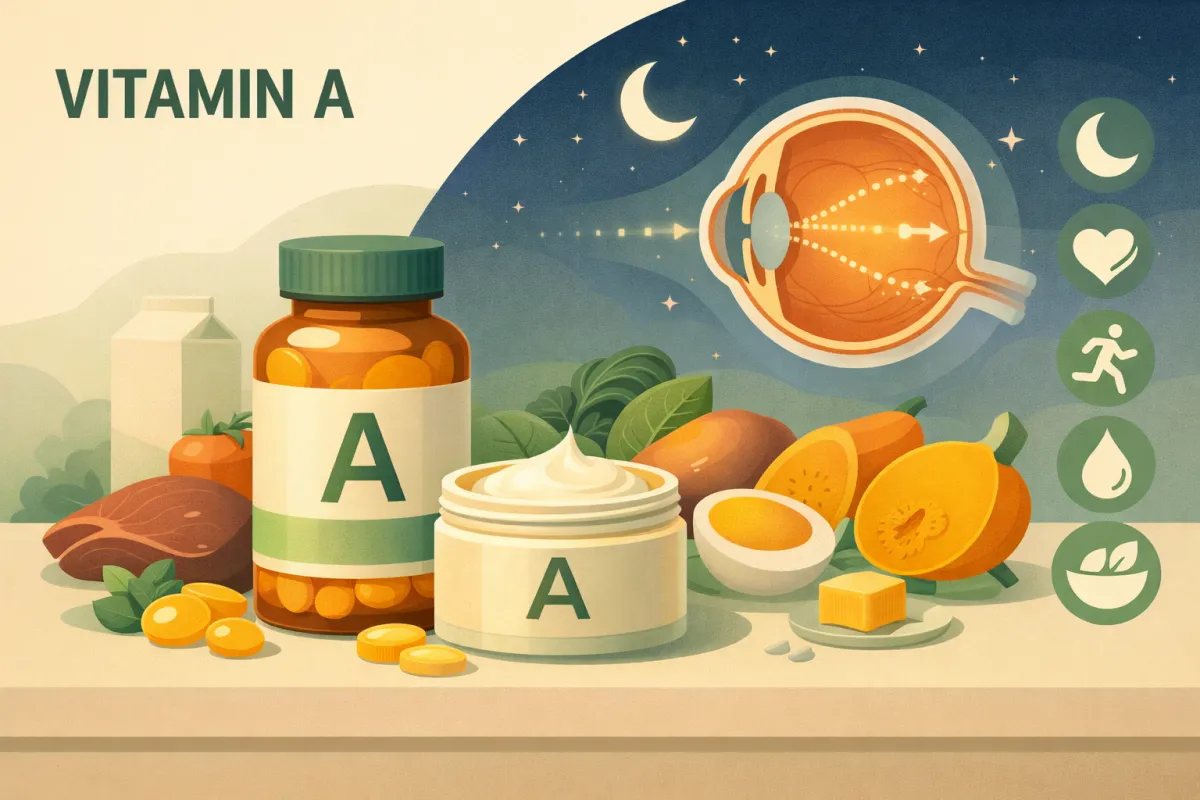
Vitamin A
Vitamin A gets talked about like it is a simple vitamin. It is not. It is a family of compounds your body uses to build vision molecules, maintain healthy barriers (skin, gut, airways), and regulate hundreds of genes involved in growth and immune function.
Here is the practical reality: vitamin A is essential, but more is not better. Because it is fat-soluble, your liver stores it. That is useful for resilience, but it also means chronic high dosing can cause toxicity.
If you are low in vitamin A, the earliest warning signs are often easy to miss. Common deficiency symptoms include trouble seeing in dim light (night blindness), persistently dry or gritty eyes, frequent infections, slow wound healing, and dry rough skin that can feel like small bumps on the backs of the arms or thighs.
What is Vitamin A
Vitamin A is a fat-soluble micronutrient your body needs for vision, immune defence, skin and tissue maintenance, and normal growth and development.
There are two main dietary sources:
Preformed vitamin A (retinoids) from animal foods. This is the ready-to-use form and includes retinol and retinyl esters (for example, retinyl palmitate). You find it in liver, fish oils, eggs, and full-fat dairy.
Provitamin A carotenoids from plants. These are pigments your body can convert into vitamin A. The main one is beta-carotene, plus alpha-carotene and beta-cryptoxanthin (from carrots, sweet potato, squash, leafy greens, and some fruits).
Inside the body, vitamin A shows up in active forms that do the work:
Retinal supports vision (especially low-light vision).
Retinoic acid acts like a gene “switchboard”, turning on and off many genes across immune cells, skin cells, and the gut lining.
Common supplement forms include retinyl palmitate, retinyl acetate, beta-carotene, and mixed carotenoids. Vitamin A is often also present in fish liver oils.
Vitamin A is not the same thing as topical “retinoids” (retinol, retinoic acid, tretinoin) used in skincare. Those products act locally in skin and are dosed very differently than oral supplements.
Food sources and what RAE means
Vitamin A content is typically reported as mcg RAE. RAE stands for retinol activity equivalents. It is a standard unit that helps you compare different forms of vitamin A because retinol and beta-carotene do not have the same biological potency.
For beta-carotene, the body has to convert it, so you need more to get the same activity. A common rule of thumb is that 12 mcg of beta-carotene from food provides about 1 mcg RAE, while supplemental beta-carotene is typically treated as 2 mcg beta-carotene per 1 mcg RAE. Other provitamin A carotenoids like alpha-carotene and beta-cryptoxanthin are less potent and are commonly treated as about 24 mcg from food per 1 mcg RAE.
The table below shows practical food sources. For plant foods, values are approximate because conversion depends on cooking, dietary fat, and individual genetics.

Who is Vitamin A for
Who’s most likely to benefit
People with low dietary intake, low-fat diets, fat malabsorption issues, restrictive diets, or a clinically confirmed deficiency. If deficiency is the issue, replenishing vitamin A can rapidly improve night vision and help immune barriers work more effectively.
Who might not notice much
Well-nourished adults who already meet needs through food. In this group, supplementing often produces little you can feel day to day, and higher doses do not reliably create extra benefit.
Who should be cautious
Pregnant or trying-to-conceive individuals (preformed retinol can be teratogenic at higher intakes), people with liver disease, heavy alcohol intake, osteoporosis risk, those using prescription retinoids (for example isotretinoin), and smokers considering high-dose beta-carotene supplements.
TLDR
Vitamin A is essential for vision, immune barriers, and skin and tissue maintenance.
Deficiency symptoms often include night blindness, dry gritty eyes, frequent infections, slow wound healing, and rough dry skin.
Vitamin A comes as preformed retinol (animal foods, many supplements) or carotenoids like beta-carotene (plants) that your body converts.
Vitamin A is measured in mcg RAE (retinol activity equivalents), which standardises activity across forms.
Supplementation is most clearly helpful when deficiency is present.
For most well-nourished adults, routine high-dose supplementation is low return on investment.
Vitamin A is fat-soluble and accumulates, so chronic high dosing can cause liver and bone issues.
Pregnancy is the biggest safety line: avoid high-dose preformed vitamin A unless medically supervised.
If you supplement, a conservative maintenance range is often 500 to 1,000 mcg RAE daily with food.
Take vitamin A with a meal that contains fat to improve absorption.
What people take Vitamin A for
Night vision and deficiency-related eye problems
Age-related macular degeneration (AMD) and other degenerative eye diseases
General eye health, including screen-heavy lifestyles
General immune support
Measles (clinical use)
Skin health and anti-ageing
Mood and stress resilience
Sleep and circadian rhythm support
Athletic performance and recovery
1. Night vision and deficiency-related eye problems
Efficacy: Very positive (when deficiency is present)
Who primarily benefit: People with vitamin A deficiency, often due to low intake or absorption problems.
What the evidence suggests: Vitamin A is required to form rhodopsin, the light-sensing molecule in your retina. In deficiency, night blindness is often the earliest symptom and can improve within days to weeks after repletion. If deficiency is the cause, supplementation can be genuinely life-changing.
Typical protocol used: In clinical deficiency, high-dose protocols exist (often tens to hundreds of thousands of IU given on a schedule), but these should be prescribed and monitored. For non-clinical use, food-first or conservative doses are preferred.
Practical expectation: If you are deficient, you may notice clearer night vision and less eye dryness over 1 to 4 weeks. If you are not deficient, you should not expect noticeable visual changes.
2. Age-related macular degeneration (AMD) and other degenerative eye diseases
Efficacy: Neutral to slightly positive (context-dependent)
Who primarily benefit: Some people with specific eye conditions using multi-nutrient protocols under clinical guidance.
What the evidence suggests: For AMD, vitamin A is not a stand-alone solution. Some antioxidant combinations that include carotenoids may slow progression in some contexts, but reversal is not expected. For retinitis pigmentosa, updated analyses suggest vitamin A is not recommended as a meaningful therapy.
Typical protocol used: Typically used as part of combined antioxidant formulas, not as high-dose vitamin A alone.
Practical expectation: Do not expect symptom reversal. If used, it is usually a long-term, clinician-guided risk-management strategy rather than a “feel it” supplement.
3. General eye health, including screen-heavy lifestyles
Efficacy: Neutral to slightly positive (mainly through adequacy)
Who primarily benefit: People whose diet is low in vitamin A and who have dry-eye or eye strain symptoms, especially if overall diet quality is poor.
What the evidence suggests: There is no strong evidence that screens specifically deplete vitamin A. However, adequate intake supports the normal visual cycle and the surface tissues of the eye. For screen-related eye strain, the stronger human evidence is for macular carotenoids (lutein and zeaxanthin) rather than vitamin A itself, but vitamin A adequacy still matters as a foundation.
Typical protocol used: Meet the RDA daily through food. If intake is inconsistent, consider a conservative supplement dose with meals for 8 to 12 weeks while improving food intake.
Practical expectation: Expect small, baseline-level improvements (less dryness, less irritation) if low intake was part of the problem. Do not expect dramatic changes in eye strain if the main drivers are screen habits, poor blinking, and sleep disruption.
4. General immune support
Efficacy: Positive (in deficiency), neutral (when adequate)
Who primarily benefit: Children and adults with deficiency, or people with diets that chronically undersupply vitamin A.
What the evidence suggests: Vitamin A supports mucosal IgA production, helping protect the nose, throat, gut, and airways. In vitamin A-deficient regions, supplementation reduces illness and mortality in children. In well-nourished adults, trials generally do not support routine supplementation for fewer colds, and excessive dosing may be counterproductive in some studies.
Typical protocol used: Food-first adequacy daily, or conservative supplementation (for example 500 to 1,000 mcg RAE daily) when intake is low.
Practical expectation: If you were low or deficient, you may notice fewer infections over months. If you were already adequate, you will likely notice nothing.
5. Measles (clinical use)
Efficacy: Very positive (in the right context)
Who primarily benefit: Children with measles, especially in settings where deficiency is common.
What the evidence suggests: Vitamin A is used therapeutically in measles to reduce complications and mortality, particularly where deficiency is prevalent.
Typical protocol used: High-dose medical protocols are used (for example 200,000 IU dosing schedules in children), and this is not a DIY protocol.
Practical expectation: This is a clinician-guided intervention, not a general wellness supplement strategy.
6. Skin health and anti-ageing
Efficacy: Positive (topical), neutral to slightly positive (oral, limited evidence)
Who primarily benefit: People using topical retinoids for fine lines, sun damage, and texture changes.
What the evidence suggests: Topical retinol and retinoic acid have strong evidence for improving fine wrinkles and skin texture over 8 to 24 weeks by increasing collagen and glycosaminoglycans in skin. Oral vitamin A is not the primary tool here and carries more risk. A small body of evidence suggests oral plus topical may outperform topical alone, but dosing details and long-term safety matter.
Typical protocol used: Topical retinol 0.3 to 0.5% applied 2 to 3 nights per week initially, then increase as tolerated. If using oral vitamin A alongside topical retinoids, keep total intake well below the upper limit and consider professional guidance.
Practical expectation: With topical use, mild dryness or irritation is common in the first month. Visible improvements in fine lines often appear by 4 to 12 weeks, continuing up to 6 months.
7. Mood and stress resilience
Efficacy: Neutral to slightly positive (early evidence)
Who primarily benefit: People with low dietary intake and overall low diet quality.
What the evidence suggests: Observational studies link higher vitamin A and beta-carotene intake with lower depression risk, but this does not prove cause and effect. Mechanistically, vitamin A influences inflammation and stress-response pathways, but high-quality supplementation trials for mood are lacking.
Typical protocol used: Focus on dietary adequacy. If supplementing due to low intake, use conservative doses and avoid megadosing.
Practical expectation: Do not expect a strong, immediate mood shift. Think of vitamin A as “supporting the baseline”, not as a primary mental health intervention.
8. Sleep and circadian rhythm support
Efficacy: Neutral to slightly positive (mainly if deficient)
Who primarily benefit: People with low intake or deficiency, and possibly shift workers who struggle with circadian stability.
What the evidence suggests: Vitamin A is concentrated in the pineal gland and is required for normal melatonin synthesis. Animal and mechanistic evidence is strong, but direct human supplementation trials are limited.
Typical protocol used: Food-first adequacy (700 to 900 mcg RAE daily) and consistent meal timing.
Practical expectation: If you were low, correcting intake may make sleep timing feel more stable over weeks. If you are adequate, supplementing above needs is unlikely to help.
9. Athletic performance and recovery
Efficacy: Neutral (no good human evidence)
Who primarily benefit: People with deficiency, or athletes with inadequate diets who need to meet basic micronutrient needs.
What the evidence suggests: Vitamin A is required for normal protein synthesis and tissue maintenance, and turnover may increase with intense training. However, there are no good trials showing supplementation improves strength, endurance, or recovery in already-adequate athletes.
Typical protocol used: Meet the RDA through food. Avoid chronic high-dose vitamin A, especially if bone health is a priority.
Practical expectation: If you are already eating well, you should not expect performance changes.
When it’s not worth taking Vitamin A
If you are a well-nourished adult meeting needs through food, adding preformed vitamin A just in case is usually low return on investment.
It is also not worth it if your plan relies on megadoses for immunity, mood, sleep, or performance. The evidence does not support that approach, and the risk rises with chronic high dosing.
If you are pregnant, trying to conceive, have liver disease, or take prescription retinoids, the risk-to-benefit ratio often favours food sources and careful medical oversight rather than supplementation.
Nuances and individual differences
Genetics and responder differences
Carotenoid conversion varies. Beta-carotene must be converted to retinol, and this depends partly on BCMO1 enzyme activity, which can be influenced by genetics. Practically, some people do great with carotenoid-rich diets, while others may need more preformed retinol from food.
If you eat plenty of colourful plants but still struggle with signs of low vitamin A status, consider discussing testing and diet strategy with a qualified practitioner instead of simply increasing dose.
Baseline status changes everything
Vitamin A benefits are strongest when deficiency is present. In that scenario, correcting intake can rapidly improve night vision and immune resilience. If you are already adequate, the body largely stores and regulates vitamin A, so you often do not feel extra intake.
This is why vitamin A is a great nutrient to get right, but a poor nutrient to megadose.
Special populations
Pregnancy and breastfeeding: This is the most important caution group. High intakes of preformed vitamin A (retinol and retinyl esters) during pregnancy can increase birth defect risk. Food sources are usually safest. If supplementation is needed, beta-carotene is generally preferred. Involve your maternity care team in any plan that goes beyond a standard prenatal.
Children and adolescents: Dosing must be age-specific because toxicity risk rises at lower body weights. Keep supplements out of reach and avoid high-dose gummies.
Older adults and bone health: Chronic high intakes of preformed vitamin A have been associated with increased fracture risk in some studies. If bone health is a priority, avoid high-dose retinol and focus on meeting, not exceeding, needs.
Liver or kidney disease: Vitamin A is stored in the liver and its metabolism is affected by organ function. Supplementation should be clinician-guided.
Smokers: High-dose beta-carotene supplements have been linked to increased lung cancer risk in smokers in large trials. This does not apply to food sources, but it is a strong reason to avoid high-dose beta-carotene pills if you smoke.
Co-nutrients and stacking
Vitamin A works as part of a system. Dietary fat improves absorption, so taking vitamin A with a very low-fat meal reduces uptake. Zinc supports conversion and metabolism, so low zinc status can reduce how well plant carotenoids convert. Other fat-soluble vitamins (D, E, K) share absorption pathways, so chronic high-dose vitamin A can distort balance.
A simple, high-return approach is to build meals that combine vitamin A-rich foods with healthy fats and a diet pattern that covers zinc.
Testing and monitoring
Serum retinol testing exists but is not routinely done for healthy adults. Testing becomes more useful if you have symptoms consistent with deficiency, malabsorption risk, a restrictive diet pattern, or if you are considering longer-term supplementation above conservative doses.
If supplementation is used to correct low status, a clinician may retest after a few months to confirm you have reached adequacy without overshooting.
How to take Vitamin A
Simple starter approach
For most people, vitamin A is best approached as a food-first nutrient. Aim for one to two servings of vitamin A-rich foods daily, paired with dietary fat. If your diet is inconsistent or restricted, a conservative supplement can be used as a temporary bridge.
A practical trial is 8 to 12 weeks at a conservative dose while you improve food intake, then reassess whether you still need the supplement.
Typical dose range
Vitamin A intake targets are measured in mcg RAE. Typical RDAs are about 900 mcg RAE for adult men and 700 mcg RAE for adult women. If you supplement for general coverage, 500 to 1,000 mcg RAE daily is a conservative range for many adults.
The tolerable upper limit for adults is 3,000 mcg RAE daily, which is approximately 10,000 IU of preformed vitamin A. If you use multiple products (multivitamin plus fish liver oil plus a separate vitamin A), it is easy to accidentally exceed this.
Timing
Take vitamin A with a meal that contains fat (for example olive oil, nuts, avocado, eggs, or fatty fish). Time of day is less important than taking it with food and being consistent.
Loading vs maintenance
Vitamin A does not need a loading phase for general use. Because it is stored, steady daily intake is safer and more predictable than occasional high-dose pulses.
Duration to see effects
If deficiency is present, night vision can improve within 1 to 4 weeks. For immune resilience, think in months rather than days. For skin outcomes, topical retinoids can show early changes in 4 to 6 weeks, with clearer improvements by 12 to 24 weeks.
Forms and whether form matters
For most people, the form mainly affects safety and conversion. Retinyl palmitate and retinyl acetate are common preformed forms and tend to be well absorbed. Beta-carotene is generally the safer supplemental option because conversion is regulated by need, but conversion varies between individuals. Mixed carotenoids can be useful for a whole-food style approach. Fish liver oils provide vitamin A plus omega-3s, but dosing can be variable and product quality matters.
If you are pregnant or trying to conceive, favour food sources and avoid high-dose preformed retinol supplements. If a supplement is needed, beta-carotene is typically preferred under professional guidance.
Food vs supplement
Most people can meet vitamin A needs through food. One medium sweet potato or a cup of cooked leafy greens can cover daily needs for many adults. Supplementation makes the most sense when diet is restrictive, absorption is impaired, or deficiency is confirmed.
Safety and side effects
Vitamin A is generally well tolerated at normal intakes, but it has a narrower safety margin at higher chronic doses because it accumulates.
Common side effects
At typical doses below the upper limit, most people notice nothing. If dose creeps higher, some people report headache, nausea, dizziness, or skin dryness. With topical retinoids, dryness, redness, and peeling are common early on.
To reduce side effects, keep oral intake conservative, take with food, and if using topical retinoids, start with fewer nights per week and moisturise.
Serious risks (rare, but important)
Chronic vitamin A toxicity (hypervitaminosis A) can occur with high intakes of preformed retinol over weeks to months. Risks include liver injury, bone loss and fracture risk, hair loss, severe skin dryness, and increased intracranial pressure (severe headaches and vision changes).
Acute toxicity is uncommon but can occur with very large single doses. Symptoms include severe nausea, vomiting, headache, and blurred vision.
Contraindications and caution groups
Pregnancy and breastfeeding: Avoid high-dose preformed vitamin A unless medically supervised. If supplementation is needed, discuss dose and form with your care team.
Liver disease or heavy alcohol intake: Avoid routine supplementation unless clinically indicated and monitored.
Osteoporosis risk: Avoid chronic high-dose retinol. Aim to meet needs without exceeding them.
Interactions
Prescription retinoids (isotretinoin, tretinoin, alitretinoin): Do not combine with high-dose vitamin A supplements. This increases toxicity risk.
Anticonvulsants (for example phenytoin, phenobarbital): May alter vitamin A metabolism. Monitoring may be appropriate.
Warfarin: Very high vitamin A intakes may affect anticoagulant response. Avoid sudden dose changes and discuss with a clinician.
Other fat-soluble vitamins: High-dose vitamin A can interfere with balance of vitamins D, E, and K. Avoid the one vitamin at megadose pattern.
Food: Dietary fat improves absorption, while extremely high fibre intake may modestly reduce absorption.
For athletes: anti-doping and contamination risk
Vitamin A is not a banned substance. The main risk is product contamination or mislabelling. If you are drug-tested, prioritise third-party batch-tested products. Batch-tested means the exact production batch is screened, which is more protective than a company claiming internal testing without independent verification.
Quality checklist (buying guide)
What to look for on labels
Look for a clear form and clear dose expressed in mcg RAE (or IU with a clear statement of whether it is retinol or beta-carotene). Retinyl palmitate and retinyl acetate are common preformed forms, while beta-carotene and mixed carotenoids are provitamin forms.
Check whether your product is a single nutrient or part of a multi. Many multivitamins already contain vitamin A, and fortified foods can add more. Your goal is to stay under the adult upper limit unless medically supervised.
If you have pregnancy concerns, choose products that specify beta-carotene rather than preformed retinol, and confirm the amount per serving.
Third-party testing and certifications
Third-party testing means an independent organisation has tested the product and or audited manufacturing to verify label claims and screen for contaminants. No certification can guarantee a supplement is completely free of all risks, but reputable testing can meaningfully reduce common quality problems.
If you compete in drug-tested sport, supplement use always carries some risk because products can be contaminated or adulterated with prohibited substances. If you choose to use supplements anyway, prioritise products that are batch-tested under recognised anti-doping focused programmes such as NSF Certified for Sport, Informed Sport, Informed Choice, or BSCG Certified Drug Free.
For general quality assurance (identity, purity, potency, and contaminant screening), look for verification or certification programmes such as USP Verified, NSF or NSF/ANSI 173 certification, or a ConsumerLab quality seal. Some categories also have specialised quality programmes, for example IFOS for fish oil. If a company claims testing, ask for a recent Certificate of Analysis (COA) for the exact batch you are buying.
Red flags
❌ No batch number and no expiry.
❌ No COA available on request.
❌ Proprietary blend with no exact amounts.
❌ Unrealistic health claims.
❌ Very cheap pricing vs market norms.
Storage and stability
Vitamin A degrades with heat, light, and oxygen. Store supplements in a cool, dark place and pay attention to expiry dates. Gummies and liquids tend to be less stable than capsules, so quality and storage matter more.
The Five Pillar impact analysis of Vitamin A
Five Pillar overview
Vitamin A most strongly supports the Nutrition pillar because it is a foundational micronutrient that influences tissue maintenance, immune barriers, and gene regulation. In a practical sense, it helps you maintain normal function rather than giving a stimulant-like boost.
Sleep and stress effects are mostly baseline-dependent. If someone is low or deficient, restoring vitamin A can support melatonin-related pathways and immune stability, which indirectly supports sleep quality and resilience. If someone is already adequate, the impact is usually small.
Hydration is essentially neutral. Exercise performance benefits are unproven beyond preventing deficiency-related problems.
Five Pillar impact table

Five Pillar detailed review
Sleep
Pillar verdict (practical): Vitamin A can support sleep timing and initiation if deficiency is part of the problem. If intake is already adequate, it is unlikely to be a meaningful sleep lever on its own.
What it may improve:
Support melatonin-related pathways (baseline-dependent)
Support mucosal immunity, which can reduce fatigue from frequent minor infections
Support circadian stability indirectly through consistent nutrition
Practical protocol:
Aim for food-first intake daily (sweet potato, leafy greens, eggs, fish)
If supplementing, use 500 to 1,000 mcg RAE daily with dinner
Run a conservative 8 to 12 week trial, then reassess
When it’s not worth it:
You already meet vitamin A needs through diet and your sleep issues are stress or schedule driven
You are using high-dose vitamin A as a substitute for sleep fundamentals (light, timing, routine)
Stress Management
Pillar verdict (practical): Vitamin A is not a primary stress supplement. It is a baseline nutrient that helps maintain normal immune and tissue function, which can make stress feel more manageable when deficiency is corrected.
What it may improve:
Support immune barrier function (lower inflammation burden)
Support normal stress-response signalling (mechanistic evidence, limited supplement trial evidence)
Support overall nutritional adequacy which lowers physiological noise
Practical protocol:
Focus on a diet pattern that reliably hits 700 to 900 mcg RAE daily
If supplementing, stay conservative and avoid stacking multiple products that contain retinol
Pair with higher return stress levers (sleep timing, movement, breath work)
When it’s not worth it:
Using it as a treatment for anxiety or depression
Using megadoses to chase a stronger effect
Exercise
Pillar verdict (practical): Vitamin A matters for preventing deficiency-related problems, but there is no good evidence it improves performance in already-adequate athletes.
What it may improve:
Support normal tissue maintenance and epithelial integrity
Support recovery indirectly through immune function and barrier health
Support adequacy during high training loads
Practical protocol:
Meet needs through food consistently
If diet is limited, use a low-dose multi or 500 mcg RAE daily with food
When it’s not worth it:
Taking extra vitamin A hoping for strength, endurance, or muscle gains
Chronic high-dose use that increases bone and liver risk
Hydration
Pillar verdict (practical): Vitamin A does not meaningfully influence hydration status.
Nutrition
Pillar verdict (practical): This is where vitamin A has the most relevance. It is a foundational micronutrient that supports normal vision, immune barriers, and tissue maintenance. Getting to adequacy is the win.
What it may improve:
Normal low-light vision and eye surface health
Barrier integrity in skin, gut, and airways
Immune resilience (especially in deficiency)
Healthy cell differentiation and repair processes
Practical protocol:
Food-first: one to two vitamin A-rich servings per day, paired with dietary fat
If supplementing: 500 to 1,000 mcg RAE daily with a fat-containing meal
Pay attention to total intake from multis and fortified foods
When it’s not worth it:
You already eat vitamin A-rich foods consistently and have no deficiency risk
You are tempted to exceed the upper limit chronically for extra benefit
FAQ
What is the difference between retinol and beta-carotene
Retinol is the ready-to-use form found in animal foods and many supplements. Beta-carotene is a plant pigment your body can convert into vitamin A. Beta-carotene is generally safer because conversion is regulated by need.
What does mcg RAE mean
It stands for retinol activity equivalents. It standardises vitamin A activity across different forms because beta-carotene and retinol do not have the same potency.
Is vitamin A toxicity real
Yes. Chronic high intakes of preformed vitamin A can accumulate and cause liver injury, bone loss, hair loss, and severe headaches. This is why staying below the upper limit matters.
Can I get enough vitamin A from food alone
Most people can. Sweet potato, leafy greens, eggs, dairy, and fatty fish make it realistic to hit daily needs without supplements.
Is vitamin A helpful for acne
The strongest evidence is for prescription and topical retinoids, not for oral vitamin A supplements. Oral megadosing carries more risk than reward.
Can I use topical retinol and take an oral vitamin A supplement
Often yes at conservative doses, but you should avoid stacking high-dose oral retinol with strong topical or prescription retinoids. If you are already using prescription retinoids, get professional guidance.
What if I am pregnant or trying to conceive
Avoid high-dose preformed vitamin A. Focus on food sources and discuss any supplementation with your maternity care team. Beta-carotene is usually the safer supplemental form if needed.
Should I get tested
Testing is most useful if you have symptoms of deficiency, malabsorption risk, or a restrictive diet pattern, or if you are considering long-term supplementation above conservative doses.
This article is for educational purposes only. It is not medical advice and it is not prescriptive.
Supplements can vary widely in quality and contamination risk, including products that are not tested for banned substances and products that contain concentrated plant, herb, or mushroom extracts.
If you are a competitive athlete, in a drug-tested sport, have a complex medical history, are pregnant or breastfeeding, take medications, or have a diagnosed health condition, prioritise direct guidance from a qualified professional who can advise you within the context of your specific needs.
Even if you are otherwise healthy, consult a qualified practitioner before making major health or lifestyle changes, including starting new supplements, changing dose significantly, or combining multiple supplements.
